
Global high-mix volume high-speed PCBA manufacturer
9:00 -18:00, Mon. - Fri. (GMT+8)
9:00 -12:00, Sat. (GMT+8)
(Except Chinese public holidays)





HomePage > Blog > Knowledge Base > PCBA Testing: A Complete Guide to PCB Assembly Testing
In modern electronic manufacturing, whether a product can work stably and whether its performance is reliable largely depends on PCBA testing. With the continuous development of printed circuit boards towards miniaturization, high density and complex structures, it has become difficult to detect potential problems merely by manual visual inspection. To ensure product quality, manufacturers must conduct systematic PCBA testing and inspection to promptly identify defects that may affect electrical performance, functional operation, and long-term reliability.
Whether it is consumer electronics, industrial control equipment, automotive electronics, or Internet of Things (IoT) products, standard testing in PCBA is a key step to avoid field failures, reducing rework costs, and meeting industry compliance requirements.
This article will provide a comprehensive introduction to PCBA testing, including common inspection stages, testing methods, strategies for selecting the right test approach, and how PCBasic ensures product quality through a complete PCBA system testing system.
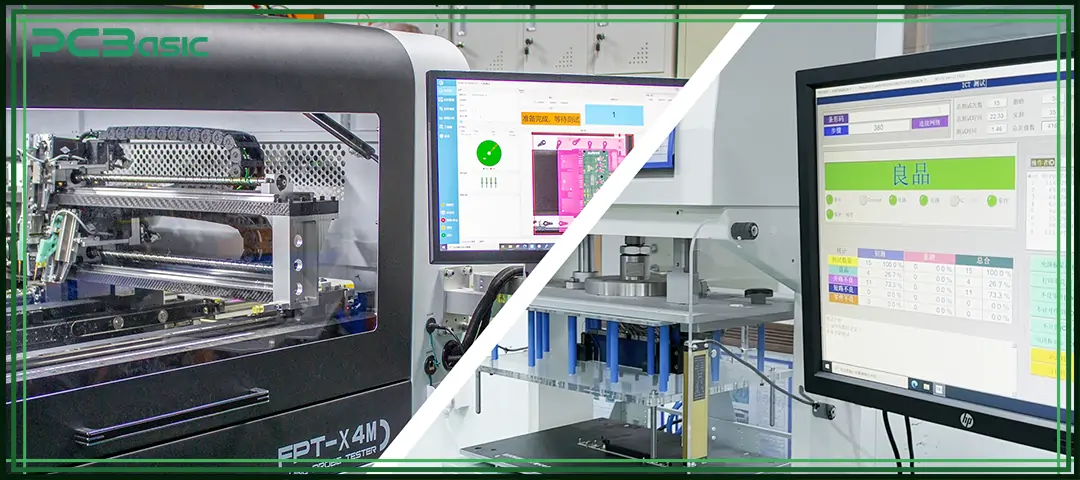
PCBA testing refers to a complete set of inspections and testing processes carried out on the circuit board after the components have been mounted and soldered. It is used to confirm whether the electrical connections are correct, whether the functions are normal, and whether the product has reliable long-term performance.
In simple terms, PCBA testing mainly involves checking whether components are installed incorrectly, missing or in reverse, whether circuit connections meet design requirements, whether there are open circuits or short circuits, and whether the circuit board can operate normally as expected after being powered on.
Compared with simple manual visual inspection, PCBA testing and inspection not only look at the appearance but also conduct electrical and functional verifications. Additionally, combined with reliability testing, it can detect the following common problems earlier:
• Electrical faults such as open circuits and short circuits
• Incorrect component values or wrong component types
• Poor solder joints, cold soldering, or other soldering defects
• Firmware programming issues or functional abnormalities
• Potential reliability risks that may occur during actual use

PCBA testing is not a single step but a quality control process that runs throughout the entire PCBA assembly flow. It is used to identify problems as early as possible at different stages and prevent defects from being carried over to the next process.
Solder paste inspection (SPI) is the first step in standard testing in PCBA and is carried out before mounting components.
After reflow soldering is completed, inspection focuses on the assembly and soldering quality of components. AOI (Automated Optical Inspection) and AXI (X-ray Inspection) are commonly used.
Electrical testing is the core part of PCBA testing, mainly including ICT testing, flying probe testing and manufacturing defect analysis (MDA).
PCBA functional testing is conducted after the circuit board is powered on to confirm whether the entire board can work normally as per the design requirements.
To ensure the stability of the product during long-term use, PCBA system testing will also incorporate tests such as aging, burn-in, thermal cycling, vibration, and environmental stress tests.
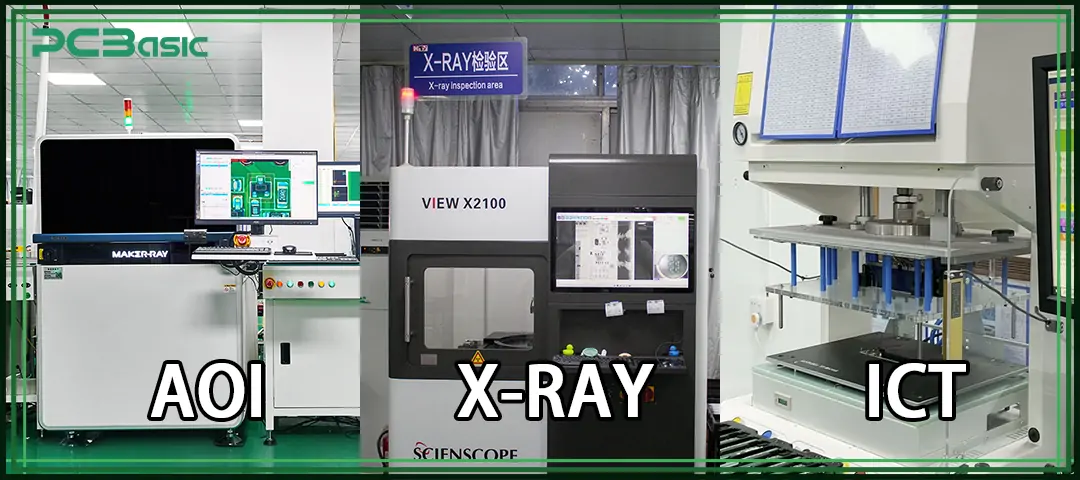
Automatic optical inspection (AOI) is one of the most widely used methods in PCBA testing and inspection. It scans the circuit board through high-resolution cameras and a vision algorithm, compares it with standard images, and thereby determines whether the components are correctly placed, properly aligned, and whether the appearance of the solder joints is acceptable.
AOI can effectively detect problems such as missing components, incorrect parts, reverse polarity, excessive or insufficient solder, and solder bridging, while providing timely feedback for process improvement.
X-ray inspection is mainly used to detect internal soldering problems that AOI cannot cover, making it a very important method in modern PCBA testing. Through X-ray imaging, the distribution of solder can be clearly observed, thereby determining whether there are defects such as cold solder joints, voids, and insufficient solder.
This inspection method is particularly crucial in fine-pitch or bottom-terminated packages such as BGA and QFN, as it can significantly enhance the coverage of hidden solder joints in PCBA testing and detection, and reduce the risk of failure caused by soldering issues in the later stage.
ICT testing, also known as in-circuit testing, is one of the most common electrical testing methods used in the mass production stage.
ICT testing measures resistance, capacitance, inductance, continuity and component values by using a bed-of-nails fixture to contact predefined test points on the PCB. This kind of circuit testing can quickly detect problems such as open circuits, short circuits, incorrect components, missing or wrong components, and component orientation errors.
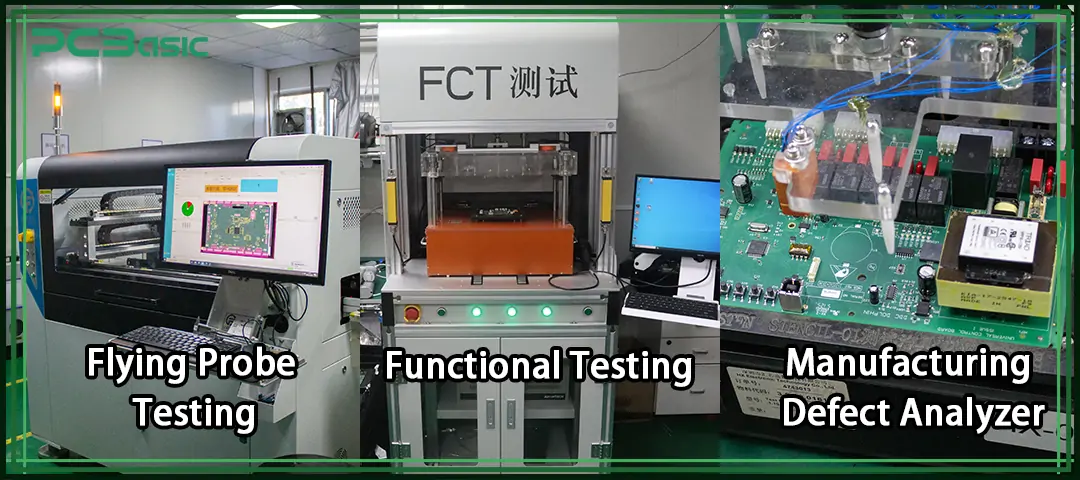
Flying probe testing is a circuit testing method that does not require custom fixtures. During the testing process, the probe automatically moves according to the CAD data of the PCB, contacting each test point one by one to complete the measurement.
This approach is highly suitable for prototyping and small-batch PCBA testing, and it can also quickly adjust the test programs when there are frequent design changes.
PCBA functional testing is a test conducted after the circuit board is powered on, with the aim of confirming whether the entire board can operate normally as per the design requirements. Test items usually include whether the power supply voltage is stable, whether the communication interface is normal, whether the firmware is operating correctly, and whether all functions meet expectations.
Manufacturing Defect Analysis (MDA) is a circuit testing method that does not power on the circuit board, mainly used for the rapid detection of basic electrical problems such as open circuits and short circuits.
MDA equipment has a low cost and fast testing speed, and is often used in the early stage of production or as an auxiliary detection method.
Reliability testing is a further extension of PCBA testing beyond basic functional verification. Common testing methods include:
• Burn-in testing
• Aging tests
• Thermal cycling
• Vibration and mechanical stress testing
• Environmental exposure tests
These tests are mainly used to evaluate the durability of products during long-term use. For industrial equipment, automotive electronics, and critical application scenarios with extremely high reliability requirements, they are an important part of achieving highly reliable PCBA system testing.
Time is money in your projects – and PCBasic gets it. PCBasic is a PCB assembly company that delivers fast, flawless results every time. Our comprehensive PCB assembly services include expert engineering support at every step, ensuring top quality in every board. As a leading PCB assembly manufacturer, we provide a one-stop solution that streamlines your supply chain. Partner with our advanced PCB prototype factory for quick turnarounds and superior results you can trust.
To select an appropriate PCBA testing solution, the following factors need to be comprehensively considered:
• Product application and reliability requirements
• Production volume
• PCB complexity and density
• Required test coverage
• Cost and time constraints
• Compliance with standard testing in PCBA regulations
In actual production, the most effective testing strategies are usually the combined use of multiple methods, including:
• AOI / AXI for assembly inspection
• ICT testing or Flying Probe for circuit testing
• PCBA functional testing for system validation
• Reliability testing for long-term assurance
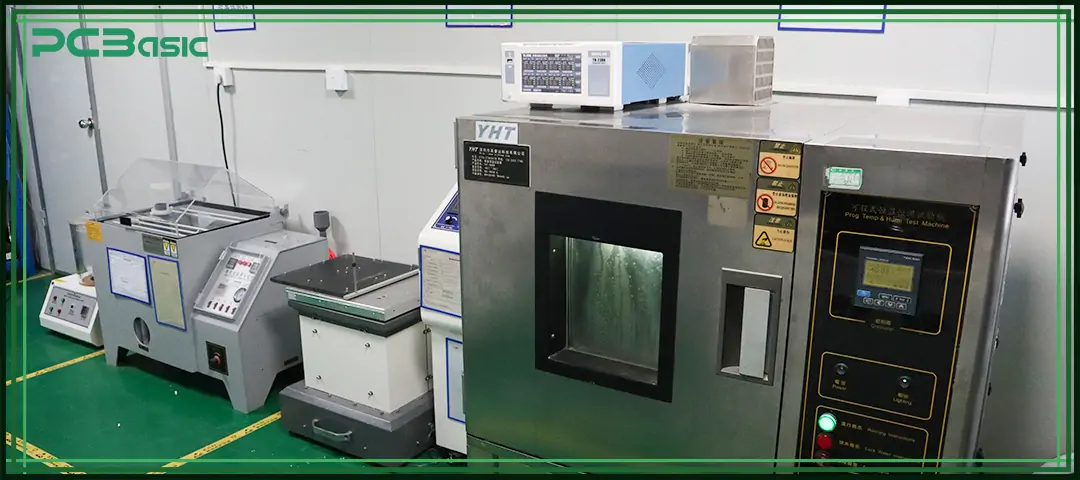
In PCBasic, PCBA testing is systematically integrated into the entire manufacturing process as an important component of the structured quality control system.
PCBasic adopts multi-level PCBA testing and inspection, specifically including:
• SPI, AOI, and X-Ray inspection for process control
• ICT testing, in circuit test, and Flying Probe testing for electrical verification
• PCBA functional testing and PCBA system testing with customized fixtures
• Aging and reliability tests to ensure long-term stability
By integrating standard testing in PCBA from the prototyping stage to the mass production stage, PCBasic can effectively reduce the outflow of defects, shorten the troubleshooting cycle, and continuously deliver stable and reliable PCB assembly products.

With the continuous upgrading of PCB design, PCBA testing has gradually become a key factor influencing product quality and market competitiveness. Relying solely on a single testing method is no longer sufficient to comprehensively cover potential risks. By implementing PCBA testing and inspection in layers, only by integrating ICT testing, circuit testing, PCBA functional testing and reliability verification can the stable performance of products in terms of performance and durability be more effectively guaranteed.
Therefore, choosing a manufacturing partner like PCBasic that has a mature PCBA testing system is significant to ensure the reliability and overall quality of electronic products.
What is ICT testing?
ICT testing is an in-circuit test method that measures electrical parameters and connectivity on a PCB without powering it.
Why is PCBA functional testing necessary?
PCBA functional testing ensures the assembled board operates correctly under real working conditions, validating system-level performance.
Is AOI enough for PCBA testing?
No. AOI is part of PCBA testing and inspection, but electrical and functional tests are required for complete coverage.
When should PCBA testing be performed?
PCBA testing should be applied at multiple stages, from solder paste inspection to final system validation, to ensure optimal quality control.

Assembly Enquiry
Instant Quote
Phone contact

+86-755-27218592
In addition, we've prepared a Help Center. We recommend checking it before reaching out, as your question and its answer may already be clearly explained there.
Wechat Support

In addition, we've prepared a Help Center. We recommend checking it before reaching out, as your question and its answer may already be clearly explained there.
WhatsApp Support

In addition, we've prepared a Help Center. We recommend checking it before reaching out, as your question and its answer may already be clearly explained there.
