
Global high-mix volume high-speed PCBA manufacturer
9:00 -18:00, Mon. - Fri. (GMT+8)
9:00 -12:00, Sat. (GMT+8)
(Except Chinese public holidays)





HomePage > Blog > Knowledge Base > PCB Rack and PCB Holder: A Complete Guide
PCB is a high-value electronic assembly carrier. During its manufacturing, assembly, testing and transportation, it requires standardized handling and storage management. In the industry, PCB racks and PCB holders are widely used specialized tools. They are utilized to support, fix and protect circuit boards in various production stages. Coupled with anti-static racks or structures with ESD PCB assembly rack slots, the risk of failure caused by improper operation can be effectively reduced. Next, this article will provide a systematic introduction to the PCB racks and the PCB holders. First, we will introduce the definitions.

A PCB rack is a structured bracket system used for storing or transferring multiple printed circuit boards. We can insert the circuit boards into their fixed slots either vertically or horizontally. It is mainly used for orderly storage and safe transfer of PCBs between different production stages such as assembly, testing, and packaging. The PCB rack mainly focuses on capacity and turnover functions.
A PCB holder, also known as a board holder or a circuit board holder, is a small-sized support fixture used to stably fix one or more PCBs in a designated position during manual assembly, inspection, and rework. The PCB holder emphasizes precise positioning of the circuit board and ease of operation.
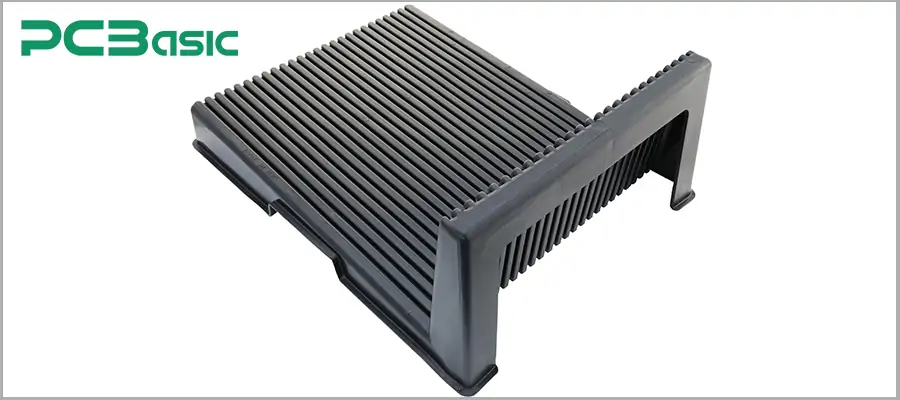
To meet the requirements of different production stages for the storage and handling of PCBs, various types of PCB racks and PCB holders have emerged in the industry. The following table lists some common types:
|
Type |
Description |
Key Features |
Typical Applications |
|
PCB Magazine Rack |
A specialized PCB rack used in automated SMT production lines for loading and unloading circuit boards. |
Adjustable slot width, high-temperature resistance, compatible with conveyors and loaders. |
SMT lines, reflow soldering processes, mass production environments. |
|
PCB Storage Rack |
A PCB storage rack designed for organized warehousing and temporary storage of multiple PCBs. |
High board capacity, stable frame structure, often combined with ESD protection. |
Buffer storage between fabrication, assembly, and testing stages. |
|
PCB Assembly Rack |
A PCB assembly rack used during manual or semi-automated assembly to hold boards in a fixed position. |
Stable support, easy board access, suitable for inspection and testing tasks. |
Soldering stations, functional testing, quality inspection areas. |
|
ESD Racks |
ESD racks manufactured from conductive or dissipative materials to prevent electrostatic discharge. |
ESD-safe materials, controlled surface resistivity, secure slot design such as ESD PCB assembly rack slots. |
Handling sensitive ICs and fine-pitch components in ESD-controlled zones. |
|
PCB Holder / Board Holder |
A PCB holder, also called a board holder or circuit board holder, used to fix a PCB in place for manual assembly, inspection, or rework. |
Precise positioning, easy access to both sides of the board, compact structure. |
Repair and rework stations, AOI or visual inspection, laboratory testing environments. |
When choosing a PCB rack or holder, it is necessary to consider multiple factors comprehensively. Common influencing factors include materials, slot structure, carrying capacity, temperature resistance performance, and ESD grade, etc. These factors will directly affect the safety and applicability of the PCB rack/holder.
The material of the PCB rack or circuit board holder determines its mechanical strength, service life and anti-static performance. Common materials include:
Stainless steel: High mechanical strength, long service life
Aluminum alloy: Light weight, good overall stability
ESD plastic: Suitable for environments with static protection
Composite conductive material: Combines structural strength with anti-static properties
If sensitive electronic components are present on the PCB, then materials with conductive or electrostatic dissipation properties should be given priority.
When choosing a PCB rack, the width and spacing of the slots must be matched with the thickness and size of the PCB. This ensures that the circuit boards remain stable during storage or transportation and do not come into contact with each other. (There are adjustable-spacing ESD PCB assembly rack slots available on the market, which can accommodate circuit boards of different specifications without affecting the stability of the support.)
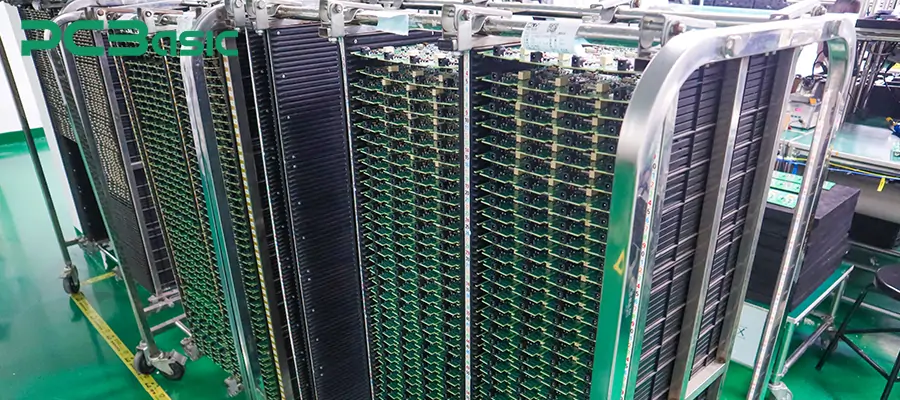
The carrying capacity is usually measured from two aspects:
The number of circuit boards that each PCB rack can accommodate
The maximum load-bearing capacity
The PCB rack used for storage places more emphasis on the quantity of storage. In contrast, the board holder used at the workstations focuses more on the stable support and operational convenience of individual or small quantities of circuit boards.
The temperature resistance performance is particularly important for PCB racks located near heat treatment equipment. If you are going to use the PCB rack near the reflow soldering or drying process, you should choose one whose structure will not deform at higher temperatures.
In the anti-static control area, the surface resistance value of the PCB rack or PCB holder is an important indicator. The surface resistivity of common ESD racks and PCB assembly racks is usually controlled within the range of 10⁴ to 10⁹ ohms. Within this range, the static charges can be safely released without causing damage to integrated circuits and precision components.

In practical usage, PCB racks and PCB holders are often used interchangeably, but in fact, the functions they perform are not the same. The following table shows some of the differences between the two:
|
Feature |
PCB Rack |
PCB Holder |
|
Capacity |
Holds multiple PCBs at the same time |
Supports one or a few PCBs |
|
Primary Usage |
Storage and transport between processes |
Assembly, inspection, and rework |
|
Structure |
Slot-based rack system with fixed or adjustable spacing |
Clamp or frame-style support |
|
Common Types |
PCB storage rack, PCB magazine rack, PCB assembly rack |
board holder |
PCB racks are typically used in production lines or storage areas for centralized management of batches of circuit boards. PCB holders are more commonly used at workstations to facilitate precise operations by personnel.
When choosing a PCB rack or a PCB holder, it should be matched according to the characteristics of the circuit board and the usage environment. Here are several tips that can be referred to when making the selection.
1. PCB Size and Quantity
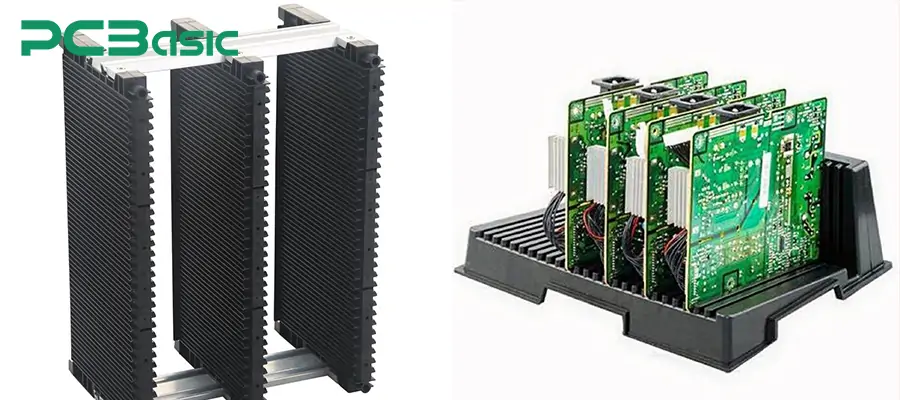
The size and quantity of the circuit board determine the type of equipment required. For large-sized PCB boards or in batch production scenarios, a structurally stable and highly load-bearing PCB storage rack is usually needed. For smaller-sized or single-piece operation circuit boards, a compact PCB holder is more suitable, as it is more convenient for manual operation and inspection.
2. ESD Requirements
For PCBs containing sensitive electronic components, the anti-static performance of the racks is a key factor that must be taken into consideration. In such cases, anti-static racks (ESD racks) or PCB rack holders certified for ESD should be selected. These tools are made of conductive or electrostatic dissipation materials and can safely discharge static charges, reducing the risk of damage to the components.
3. Production Stage
The types of equipment applicable in different production stages are different:
SMT production line → PCB magazine rack (for automatic board lifting and lowering)
Storage area → PCB storage rack (for orderly storage and turnover)
Maintenance workstation → PCB holder (for repair and inspection)
Assembly line → PCB assembly rack (for manual or semi-automatic operations)
4. Environmental Conditions
The usage environment (such as humidity, temperature and cleanliness requirements) is also an important consideration factor. For instance, the PCB magazine rack located near the reflow soldering equipment should have excellent high-temperature resistance. In areas that are clean or under controlled conditions, the PCB rack used should minimize dust generation and pollution risks.

Using the appropriate PCB racks and PCB holders can bring multiple practical benefits in electronic manufacturing.
1. Improving the Protection Level of Products
A well-structured PCB rack or PCB storage rack can keep each circuit board in an independent and stable position, reducing the problems of bending, surface scratches and contamination caused by improper stacking or manual operation.
2. ESD Safety
The use of ESD racks or fixed racks made of conductive or electrostatic dissipative materials can safely discharge static electricity. When used in conjunction with ESD PCB assembly rack slots, it can effectively prevent static electricity from damaging integrated circuits and precision components.
3. Enhance Work Efficiency
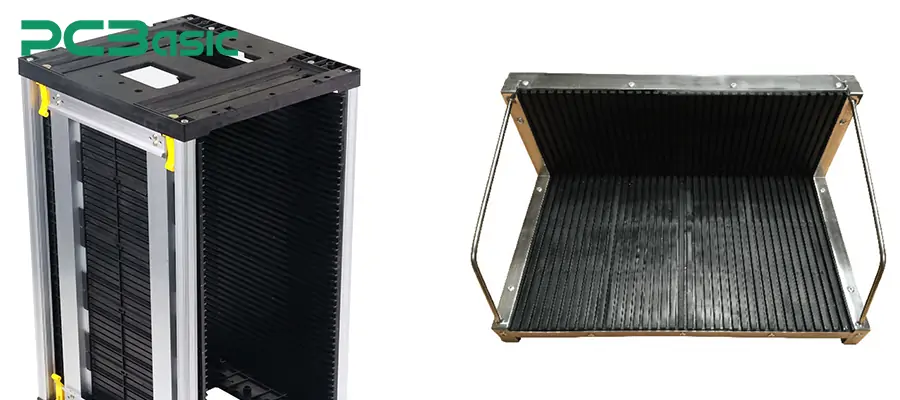
By organizing circuit boards in an orderly manner in the PCB magazine rack and PCB assembly rack, the process of loading and unloading boards and inspection can be simplified, reducing operation time.
4. Achieve Process Standardization
Standardized PCB racks and trays can be used in conjunction with automated equipment and conveyor systems. This way, SMT production lines, assembly workstations, and storage areas maintain a consistent approach to PCB handling, thereby reducing the unstable factors caused by operational differences.
5. Reduce Defect Rate
Stable PCB racks and board holders can minimize the shaking and uneven force on circuit boards during handling and operation, thereby reducing the probability of human errors and rework.
PCB racks and PCB holders are crucial tools for achieving safe and efficient PCB management in the electronic manufacturing process. By selecting the appropriate solution based on the size, quantity, production stage, and anti-static requirements of the PCBs, it is possible to effectively prevent damage, reduce defect rates, and enhance overall production efficiency.
Time is money in your projects – and PCBasic gets it. PCBasic is a PCB assembly company that delivers fast, flawless results every time. Our comprehensive PCB assembly services include expert engineering support at every step, ensuring top quality in every board. As a leading PCB assembly manufacturer, we provide a one-stop solution that streamlines your supply chain. Partner with our advanced PCB prototype factory for quick turnarounds and superior results you can trust.
1. Do all the PCB racks to be used need to have ESD properties?
Not necessarily. However, when dealing with ICs, BGA components or high-density components, it is essential to choose an ESD PCB rack or holder.
2. If the PCB is not stored in a dedicated rack or holder, what risks will it bring?
It is prone to problems such as board bending, surface scratches, contamination, and electrostatic damage.
3. How often should the PCB rack and PCB holder be inspected or replaced?
Regular checks should be conducted to ensure the stability, cleanliness and anti-static properties of the slots. If any signs of aging or deformation are noticed, they should be replaced immediately.
4. Is the PCB rack suitable for both bare boards and assembled PCBA?
Not necessarily. The requirements for support methods for bare boards and PCBA are different. The choice should be based on the actual board type and weight.
Assembly Enquiry
Instant Quote



Phone contact

+86-755-27218592
In addition, we've prepared a Help Center. We recommend checking it before reaching out, as your question and its answer may already be clearly explained there.
Wechat Support

In addition, we've prepared a Help Center. We recommend checking it before reaching out, as your question and its answer may already be clearly explained there.
WhatsApp Support

In addition, we've prepared a Help Center. We recommend checking it before reaching out, as your question and its answer may already be clearly explained there.
