In the field of electronics, everything we design, perceive, and process can basically be divided into two categories: analog and digital. Understanding the difference between analog and digital circuits is the fundamental introductory knowledge for every electronic engineer or learner.
The real world we are in is analog, with physical quantities such as temperature, sound, light, and pressure constantly changing. Modern electronic devices - whether they are smartphones, computers or satellite systems - mostly rely on digital electronics. The core difference between these two technologies lies in how we acquire, process and transmit signals.
This article will systematically explain the main differences between analog and digital, illustrate their working methods, design features, and how they work together in integrated circuits (ICs) and printed circuit boards (PCBs). Whether it is learning the basic concepts of analog signals vs. digital signals, researching analog and digital design methods, or optimizing PCB layout, this article will help you fully understand the core principles and application scenarios of these two types of circuits。
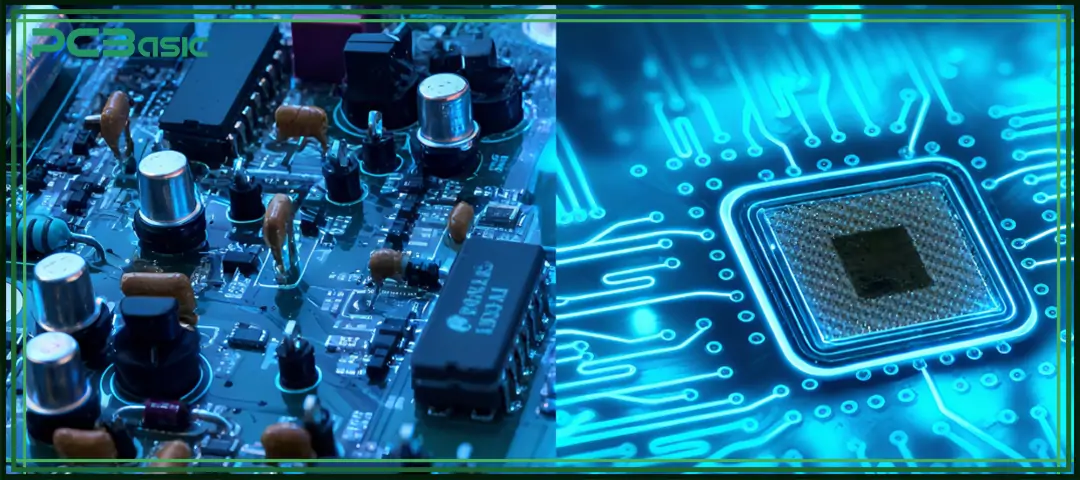
The Analog World and the Digital Revolution
The Analog Reality
All changes in the real world are continuous. When we measure temperature, record sound, or capture the intensity of light, the signal we obtain is not jumping abruptly but a continuously changing waveform - a smooth curve with infinite possible values. This type of continuous waveform is called an analog signal.
In electronic systems, analog circuits operate at such continuous voltage or current values to amplify, filter or regulate signals. Common analog circuits include amplifiers, filters, oscillators and voltage regulators. They use a variety of passive and active components to process, control or amplify signals.
The Digital Transformation
Although the natural world is analog, the development of modern technology has made digital signals the core of computing, communication and control systems. In a digital circuit, voltage no longer varies continuously but switches between two fixed levels: logic "1" represents a high level, and logic "0" represents a low level.
The digital signal is discrete. It represents information in binary form (0 and 1) rather than continuous voltage values. Since each signal has only two states, digital systems are less sensitive to noise and the signals are easier to replicate, transmit and store. Therefore, they are highly suitable for long-distance digital transmission.
In digital electronics, logic gates are the fundamental building blocks of circuit design. By combining logical structures such as AND, OR, and NOT gates, engineers can build various functional modules, such as memory, microcontrollers, and microprocessors. These are all at the core of modern computing and automation systems.
When we plot analog signals and digital signals on an oscilloscope, the differences are very obvious: an analog waveform is a continuous and smooth curve, such as a sine wave. A digital waveform is composed of a series of steep rectangular pulses that switch back and forth between logical high and low levels.
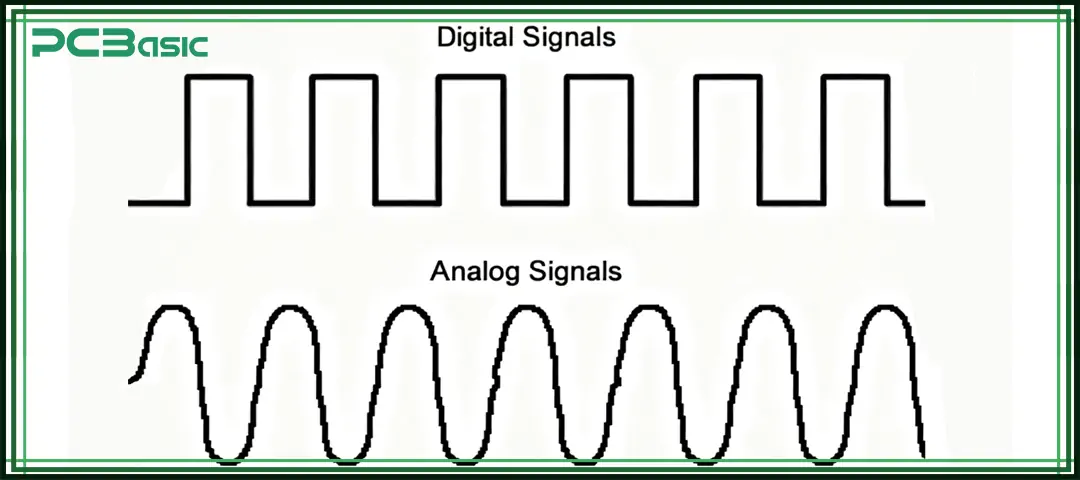
Understanding the difference between analog and digital circuits is not only about differentiating the forms of signals, but also the key to grasping the two distinct electronic design concepts:
• Analog circuits are used to capture, amplify and reproduce continuous signals from the real world.
• Digital circuits are responsible for precisely analyzing, calculating and controlling these signals.
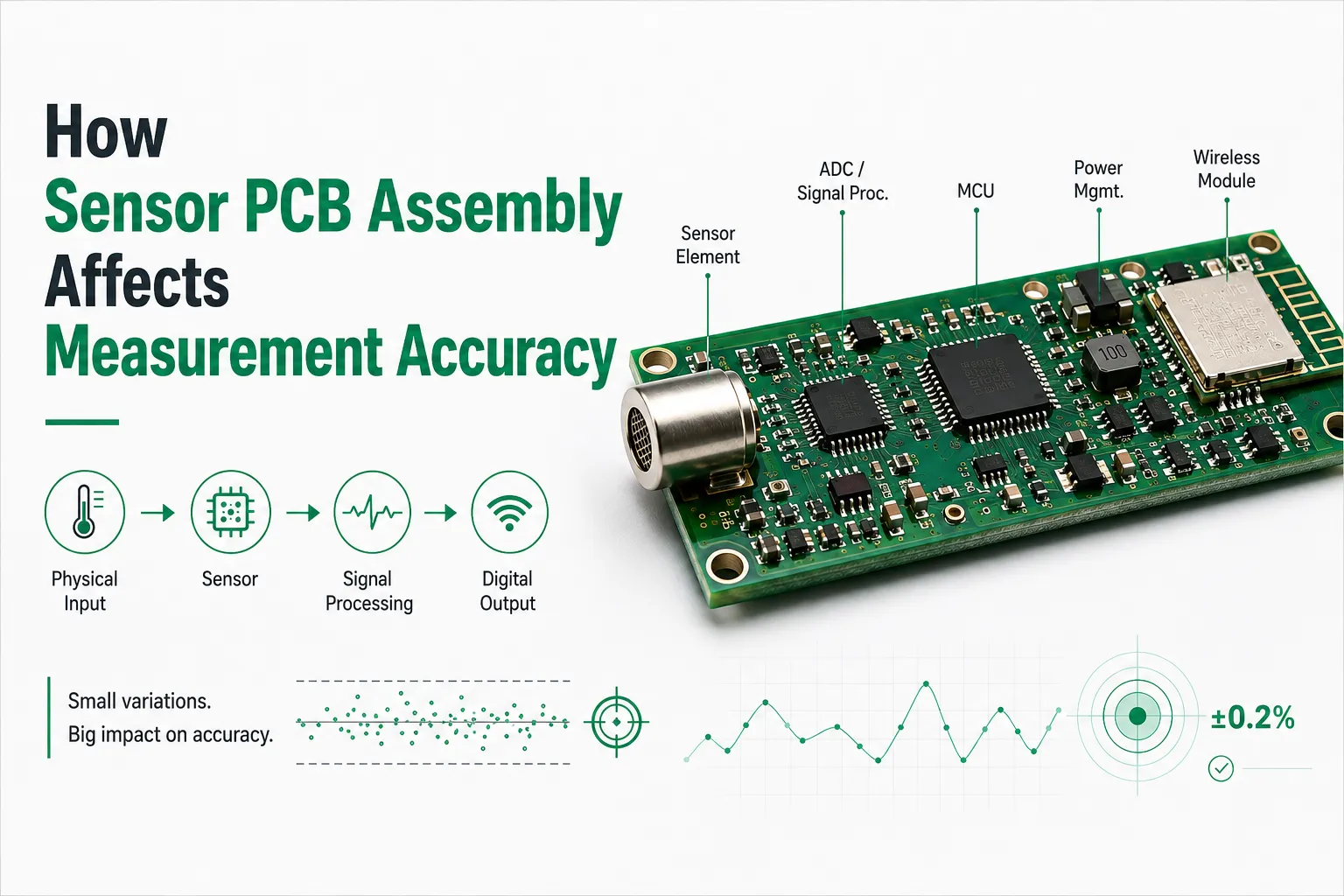
These two circuits are interdependent and complementary to each other. Almost all modern electronic devices integrate both analog and digital systems: the sensor side collects analog signals, while the processing and control sections handle digital signals. This collaborative design enables electronic devices to not only perceive the real world but also perform logical computing and communication efficiently.

Inside the Circuits: Analog vs. Digital Electronics
Analog Circuits
An analog circuit deals with continuously varying signals and forms the basis of analog electronics. It is mainly used to process electrical signals that are proportional to physical quantities such as sound, temperature, pressure or light intensity. Common analog circuits include amplifiers, filters, oscillators, sensors and transducers.
Digital Circuits
Digital circuits operate based on binary logic. A transistor in a circuit has only two states: ON or OFF. Digital signals switch between fixed voltages, typically between 0V and 3.3V or 5V.
The basic logic gates can be combined into more complex systems, such as flip-flops, counters, memory units and central processing units (CPUs). Unlike analog systems, digital electronics have strong noise resistance and are easy to simulate, convenient to replicate, and can perform the same logical functions with high precision.
Nevertheless, every digital signal comes from or eventually returns to the analog world. For instance, the sound output by a microphone is an analog signal, which needs to be converted into digital form through an analog-to-digital converter (ADC) before it can be processed. Then, it is reconverted to an analog signal through a digital-to-analog converter (DAC) to drive the speaker for playback.
This indicates that whether it is analog vs digital circuits or digital and analog signals, the two are closely related and interdependent. Modern electronic systems often combine the two: the analog part is responsible for collecting and outputting real signals, while the digital part is responsible for processing, storing and controlling.
About PCBasic
Time is money in your projects – and PCBasic gets it. PCBasic is a PCB assembly company that delivers fast, flawless results every time. Our comprehensive PCB assembly services include expert engineering support at every step, ensuring top quality in every board. As a leading PCB assembly manufacturer, we provide a one-stop solution that streamlines your supply chain. Partner with our advanced PCB prototype factory for quick turnarounds and superior results you can trust.
Key Differences Between Analog and Digital Circuits
|
Parameter
|
Analog Circuits
|
Digital Circuits
|
|
Signal Type
|
Continuous
|
Discrete (binary)
|
|
Example Signal
|
An analog signal, such as a sine wave
|
Digital signals represented by 0 and 1
|
|
Noise Susceptibility
|
Sensitive to interference
|
Highly immune to noise
|
|
Power Consumption
|
Typically higher
|
Generally lower
|
|
Accuracy & Fidelity
|
High fidelity, precision required
|
Quantized, but repeatable
|
|
Design Flexibility
|
Limited; manual tuning
|
High; programmable and tool-assisted
|
|
Speed
|
Limited by frequency response
|
High-speed clocked operation
|
|
Main Components
|
R, L, C, transistor, op-amp
|
Logic gates, flip-flops, ICs
|
|
Processing Type
|
Continuous-time processing
|
Discrete-time computation
|
|
Common Domains
|
Sensors, audio, RF, instrumentation
|
Microcontrollers, CPUs, memory
|
|
Error Type
|
Drift and distortion
|
Quantization and rounding errors
|
|
Data Storage
|
Continuous waveforms
|
Binary bits
|
As can be seen from the above table, analog signals and digital signals each have their own advantages and disadvantages. The analog world offers greater realism and detailed representation, while the digital domain features faster speed, higher precision and stronger scalability.
PCB Design Guidelines for Analog and Digital Circuits
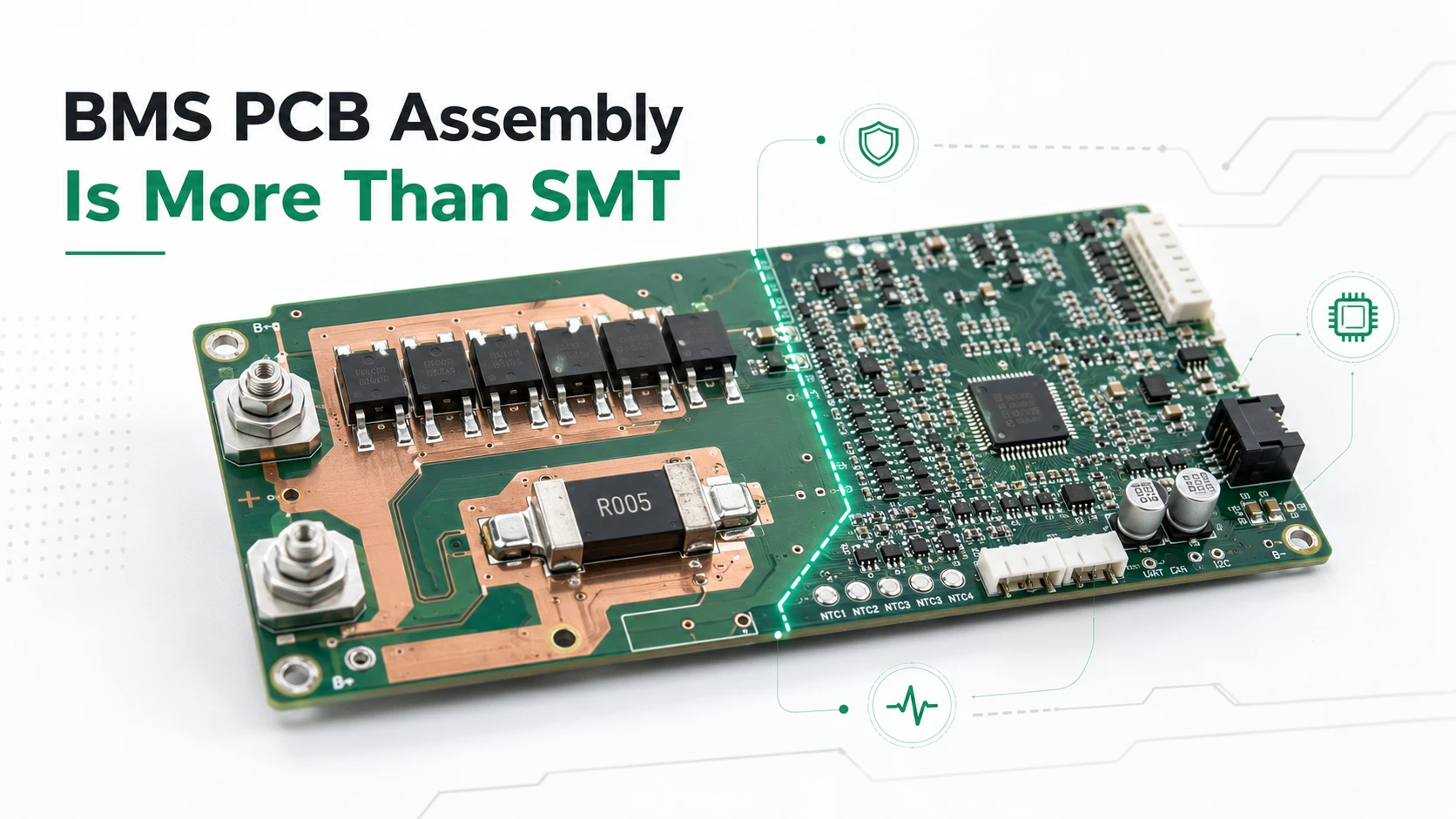
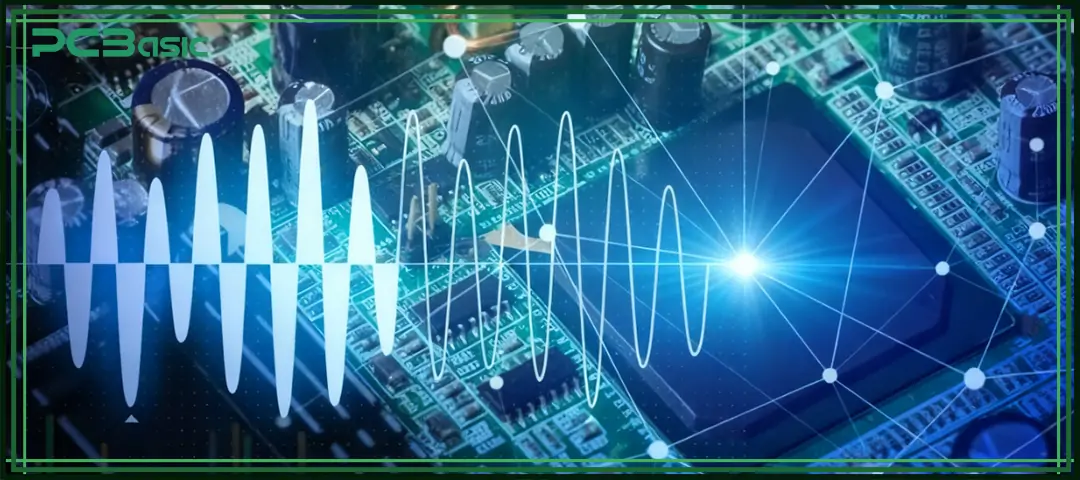
In modern electronic products, analog circuits and digital circuits are often integrated on the same PCB. For instance, in industrial controllers, communication modules, audio systems, and consumer electronic devices, both analog and digital signals need to be processed simultaneously.
This design is called a mixed-signal board. Due to the different characteristics of the two signals, meticulous planning and layout must be carried out during the design to ensure the integrity of the signals and the stability of the system.
Analog PCB Design Rules
1. Compact Layout and Short Traces
Analog circuits should be arranged as compactly as possible, and all signal traces should be kept as short as possible to reduce parasitic capacitance, inductance and noise coupling. The shorter the signal path, the lower the probability of interference, which is particularly important in audio amplification or sensor signal processing.
2. Noise Source Isolation
Keep devices with high-frequency switching noise (such as power converters, PWM controllers, and DC-DC regulators) away from sensitive analog areas. If complete isolation is not possible, grounding shielding or metal barrier belts should be added between the noise source and the analog area.
3. Dedicated Analog Ground Plane
The analog circuit should adopt an independent Analog Ground Plane (AGND) to ensure that the return path of the current is continuous, with no splits or excessive vias, to avoid interference from the ground loop. For high-precision amplifiers or sensor circuits, the integrity of the ground layer directly affects the accuracy of the signal.
4. Shielding and Guard Rings
Shield the important signal traces (such as sensor input, amplifier output), and add a guard ring around the analog area. This layout can effectively reduce the electromagnetic interference (EMI) from the digital area from entering the analog circuit area.
Digital PCB Design Rules
1. High-Speed Signal Planning and Controlled Impedance
Make a reasonable layout for high-speed digital signals (such as clocks or data buses) to ensure that the impedance of the traces is controlled and that reflection and signal distortion are prevented. Meanwhile, power and ground planes should be balanced and continuous to ensure the integrity of the signal return path.
2. Differential Pair Matching
Maintain equal-length and equal-spacing routing for differential signal pairs (such as USB, Ethernet, LVDS) to maintain the phase consistency of balanced signals. Unmatched may cause differential signal distortion and affect the quality of high-speed communication.
3. Clock and Data Separation
The clock line should be kept away from analog traces. High-speed switching of digital signals can generate strong electromagnetic fields. If they are close to analog channels, it is easy to cause crosstalk and noise interference.
4. Via and Stack-Up Control
Select the appropriate via size and PCB stack-up thickness based on the signal frequency. The high-frequency signal layer should be close to the ground to reduce the loop area and lower the radiation interference.
Mixed-Signal PCB Strategy
When analog and digital circuits coexist on the same PCB, we can adopt the following strategies to achieve effective isolation and interference control:
1. Physical Separation
In PCB layout, analog circuits and digital sections should be physically separated to form distinct analog and digital areas. High-speed switching of digital signals can generate harmonics and noise; isolation can prevent their influence on the analog part.
2. Single-Point Ground Connection (Star Ground)
Connect the analog ground (AGND) to the digital ground (DGND) at a single star point. This can avoid the problems of ground potential difference and loop current, improving the overall noise immunity.
3. Proper Placement of Interface Components
Install the analog-to-digital converters (ADCs) and digital-to-analog converters (DACs) at the junction of the analog area and the digital area. This can shorten the signal path length and reduce the possibility of noise.
4. Shielding and Isolation
If the high-frequency harmonics generated by digital transmission may affect the analog signal, metal shielding boxes or copper partitions can be added above the sensitive circuit. This is particularly important for radio frequency (RF) or high-gain circuits.

Conclusion
Discussions about analog vs. digital circuits have never been about comparing "which one is better", but rather about understanding how they work together and cooperate with each other. The analog world provides continuous and natural signals; the digital world, on the other hand, brings higher precision, faster speed and stronger controllability.
In modern electronic systems, analog and digital signals have always coexisted. Analog design is the foundation of all electronic devices. Without stable analog technology, there can be no reliable digital electronics.
Meanwhile, with the development of digital transmission, embedded systems and high-speed logic, digital technology is increasingly dependent on high-performance analog circuits.
The electronic technology of the future will no longer be a single analog or digital, but a combination of the two - digital and analog signals working together to make electronic systems smarter, more efficient and more reliable.