The core of every electronic product is composed of a set of basic electronic components. These seemingly tiny and simple components undertake important tasks: they are responsible for controlling the magnitude and direction of the current, processing different types of signals, and ultimately enabling a circuit board to have complete and stable functions.
This comprehensive and systematic guide will explain how these electronic components are classified, how common circuit symbols are represented, what electrical characteristics each component has, what their functions are in actual circuits, and in which devices they are used. After reading this article, you will clearly understand how each electronic component affects the flow of current, the changes in signals, and the working logic of the entire circuit. At the same time, you will also understand why mastering these electrical components forms the essential foundation for entering—and advancing in—the field of electronics engineering.
What Are Electronic Components?
Electronic components are the basic building blocks of all electronic systems and the most fundamental and core components of electronic systems. When they are mounted onto PCBs (printed circuit boards), these circuit board components can control the flow of electrons, store energy, amplify signals or process various data. Each electronic component has its own terminals and performs a specific electrical function.
These electrical components are usually small in size and inexpensive, but they have clear electrical characteristics. They can work in coordination with other circuit components and are fully applicable to common PCB manufacturing processes.
It is precisely because of these basic electronic components that modern electronic devices can operate normally. From the simplest calculators to the complex aircraft electronic systems, no product can operate without these basic components.

Classification of Electronic Components
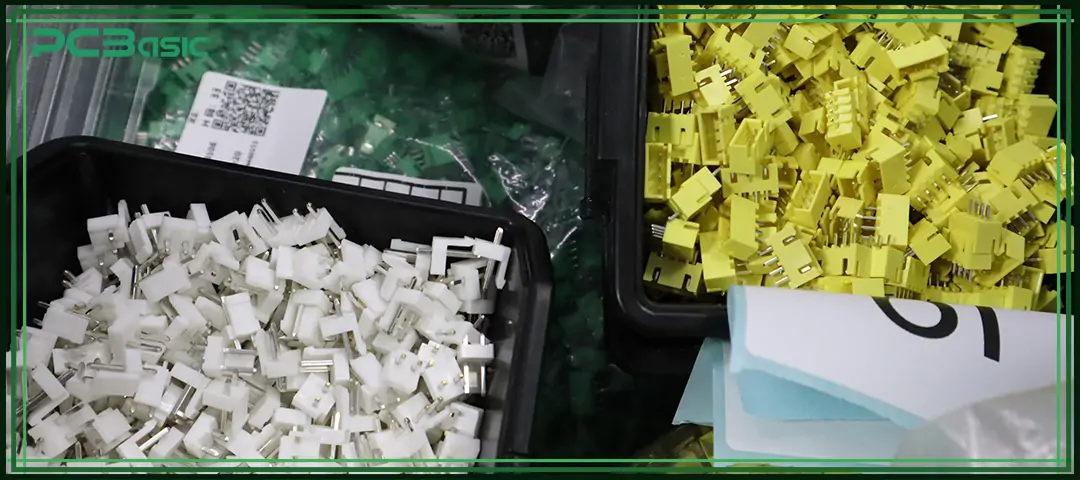
Electronic components can be simply divided into two major categories, which is the most fundamental core concept among all the basic components of electronics classifications.
• Passive Components: These components can work without an external power supply.
• Active Components: They must rely on an external power supply to amplify signals or control how signals behave.
Understanding the differences between these two major categories is an important step in mastering basic electrical knowledge, and it also helps you judge how different circuit components interact with each other and work together in real circuits.
Passive Components
Passive electrical components cannot amplify signals. Their main functions are to block, store or filter electrical energy. As the most fundamental basic components of electronics, passive components can be seen everywhere in analog circuits, digital circuits and power supply systems. They are indispensable parts of all circuits.
Resistors
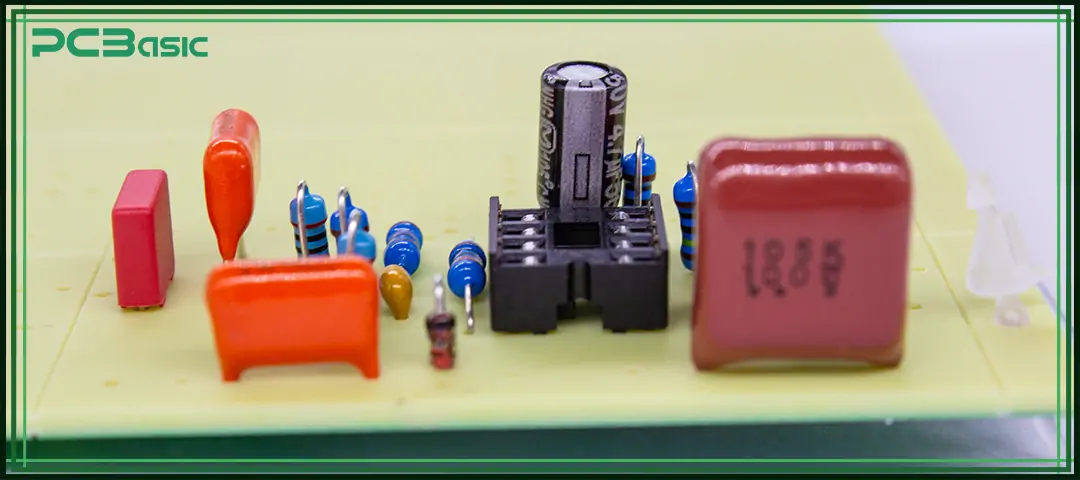
Resistors are one of the most common and important basic electronic components. Their function is very straightforward: to limit current, divide voltage, or provide stable bias conditions in the circuit. Because of these basic functions, resistors are almost present in all schematics and are the most typical electrical components.
Key functions:
• Current limiting
• Voltage division
• Signal conditioning
Resistors follow Ohm’s Law: V = I × R, a core principle in basic electrical knowledge.
Common applications:
• LED protection
• RC filters
• Microcontroller biasing
Whether through-hole or SMD, resistors are indispensable circuit board components.
Capacitors
Capacitors are a type of electronic basic components that can store and release electrical energy. They consist of two metal plates and an insulating material in the middle. As a key electronic component, capacitors play a very obvious role in power supply stability, noise processing and signal control.
Functions:
• Energy storage
• Filtering and smoothing
• Coupling and decoupling
• Timing and oscillation
The capacitance value follows: C = εA/d, relating to plate size and dielectric properties.
Applications:
• Power supply stabilization
• Noise suppression on PCBs
• Oscillator timing circuits
Capacitors are vital circuit components in both analog and digital systems.
About PCBasic
Time is money in your projects – and PCBasic gets it. PCBasic is a PCB assembly company that delivers fast, flawless results every time. Our comprehensive PCB assembly services include expert engineering support at every step, ensuring top quality in every board. As a leading PCB assembly manufacturer, we provide a one-stop solution that streamlines your supply chain. Partner with our advanced PCB prototype factory for quick turnarounds and superior results you can trust.
Inductors
An inductor is a type of electronic component that uses a magnetic field to store energy. Its main characteristic is that it can resist sudden changes in current, so it is often used in power supplies, electromagnetic compatibility and radio frequency circuits. This makes it an important part of many basic components of electronics.
Functions:
• Filtering
• Energy storage
• Impedance matching
Applications:
• Buck and boost converters
• RF tuning circuits
• EMI suppression
Inductors, though often larger than other circuit board components, are critical in any design involving power conversion.
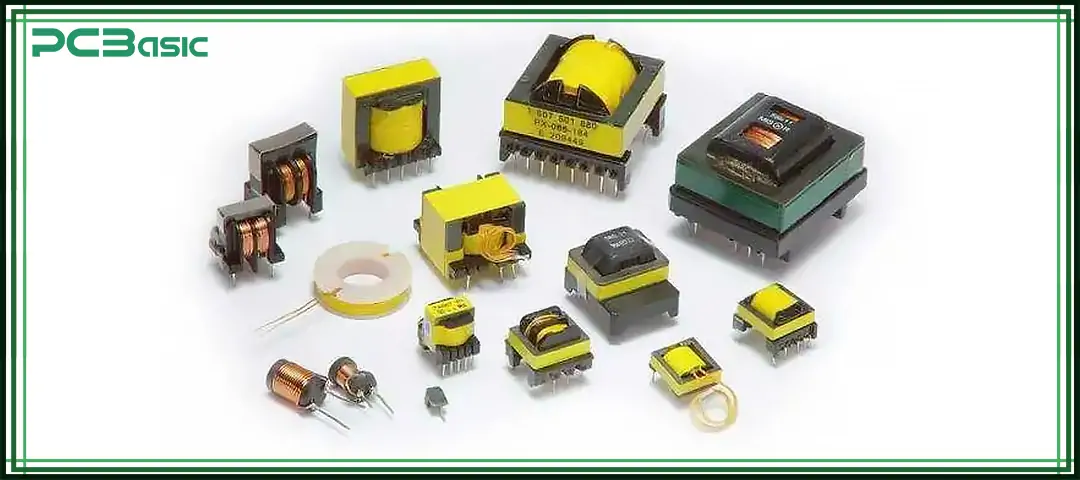
Transformers
Transformers are also an extended type of passive electrical component. Their most important capability is to change voltage and provide electrical isolation.
Functions:
• Step-up or step-down voltage
• Provide galvanic isolation
• Enable energy transfer through mutual inductance
Applications:
• Power supplies
• Audio equipment
• Industrial machinery
Transformers play a major role in power distribution and remain essential electronics basic components in AC systems.
Active Components
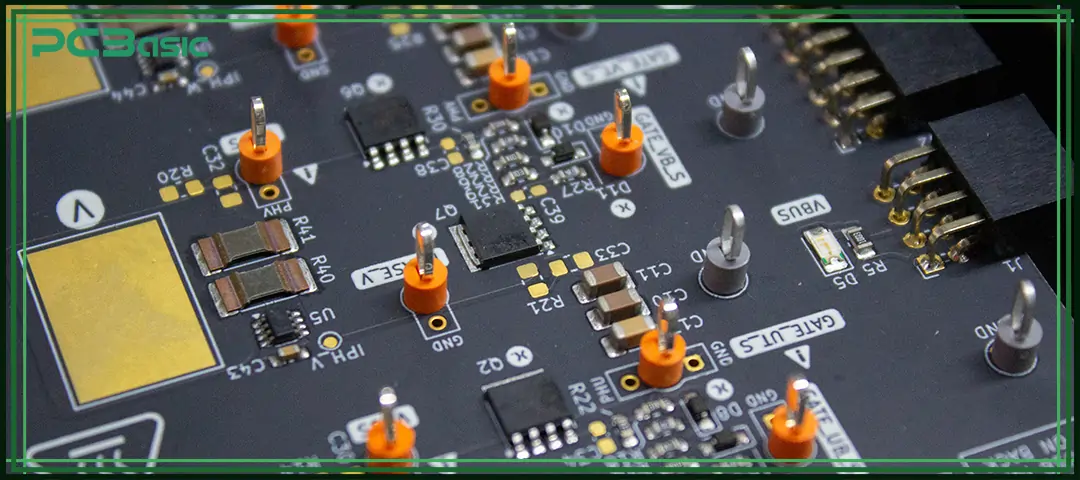
Active electronic components require an external power supply to operate. They are capable of controlling, amplifying or modifying electrical signals and are the core components of digital logic circuits, computing devices and communication systems.
Diodes
A diode is a common basic electronic component. It only allows current to flow in only one direction, making it the most fundamental component in rectification, voltage control and circuit protection.
Functions:
• Rectification (AC to DC)
• Voltage regulation (Zener diodes)
• Signal clipping
• Reverse polarity protection
Applications:
• Power adapters
• Surge protection
• Digital logic interfaces
Diodes remain vital circuit components in almost every device.
Transistors
The transistor is one of the most important electronic components. It can not only amplify signals but also be used as a switch. It is the foundation of modern computers and all electronic products.
Functions:
• Signal amplification
• Digital switching
• Oscillation and modulation
Common types:
• BJT
• MOSFET
• JFET
Applications:
• Power regulators
• Audio amplifiers
• Logic gates
Because they can store ON/OFF states, transistors are foundational electrical components in CPUs and memory circuits.
Integrated Circuits (ICs)
Integrated circuits integrate a large number of miniature electronic components, such as resistors, capacitors, and transistors, onto a single silicon chip, thereby achieving a higher functional density.
Functions include:
• Signal processing
• Timing generation
• Voltage regulation
• Data computation
Applications:
• Microprocessors
• Operational amplifiers
• Logic controllers
ICs dramatically reduce size and cost, becoming essential circuit board components in every field of technology.
Microcontrollers
A microcontroller (MCU) is a programmable electronic component that integrates a processor, memory, and various input/output interfaces onto a single chip to control external devices or systems.
Functions:
• Embedded control
• Sensor management
• Real-time data processing
Applications:
• Robotics
• IoT devices
• Smart appliances
MCUs transform basic electronic components into complete intelligent systems.
Sensors
Sensors can convert physical quantities-such as temperature, light and pressure-into electrical signals. As important electronics basic components, they enable machines to “sense” the outside world and are the basis of automation and intelligent applications.
Types include:
• Temperature sensors
• Motion detectors
• Light sensors
• Pressure sensors
Applications:
• Industrial automation
• Medical diagnostics
• Smart home products
Sensors bridge the physical and digital worlds, making them indispensable circuit components today.
Circuit Symbols for Common Components
Understanding circuit symbols is an important prerequisite for reading schematic diagrams and mastering basic electrical knowledge. These symbols help us accurately identify and connect various electronic components in circuit diagrams.
Common IEC/ANSI standard circuit symbols include:
Resistor – zigzag or rectangular line
Capacitor – parallel plates
Inductor – coil shape
Diode – triangle + bar
Transistor – NPN/PNP or FET symbol
IC – rectangular block
Switch – open/closed break symbol
Connector – pins or terminal block symbols

Conclusion
Mastering basic electronic components is the starting point of all electronic designs. Whether you are learning electronics basic components, using various electrical components, or designing more complex integrated circuits, every engineer must understand these most fundamental and important building blocks. From resistors and capacitors to microcontrollers and sensors, each electronic component has its own clear and irreplaceable role.
With the continuous advancement of technology, the importance of these basic components of electronics has also been continuously increasing. As long as one has a solid foundation of basic electrical knowledge and is familiar with the practical uses of different circuit components, anyone can start to make functional circuits, explore embedded systems, and even design professional-level PCBs.
When you truly understand the individual working modes of various electronic components and how they cooperate with each other in the system, you will possess the ability needed to innovate, debug and build the next generation of electronic systems.