Table of Contents
1. Diagnostic Device Boards Carry More Than Assembly Risk
2. The Build Details That Keep Medical PCBA Repeatable
3. Process Controls for Medical electronics assembly
4. Test Records That Catch Problems Before Shipment
5. How PCBasic Fits a Controlled Medical PCBA Workflow
6. Conclusion
7. FAQs
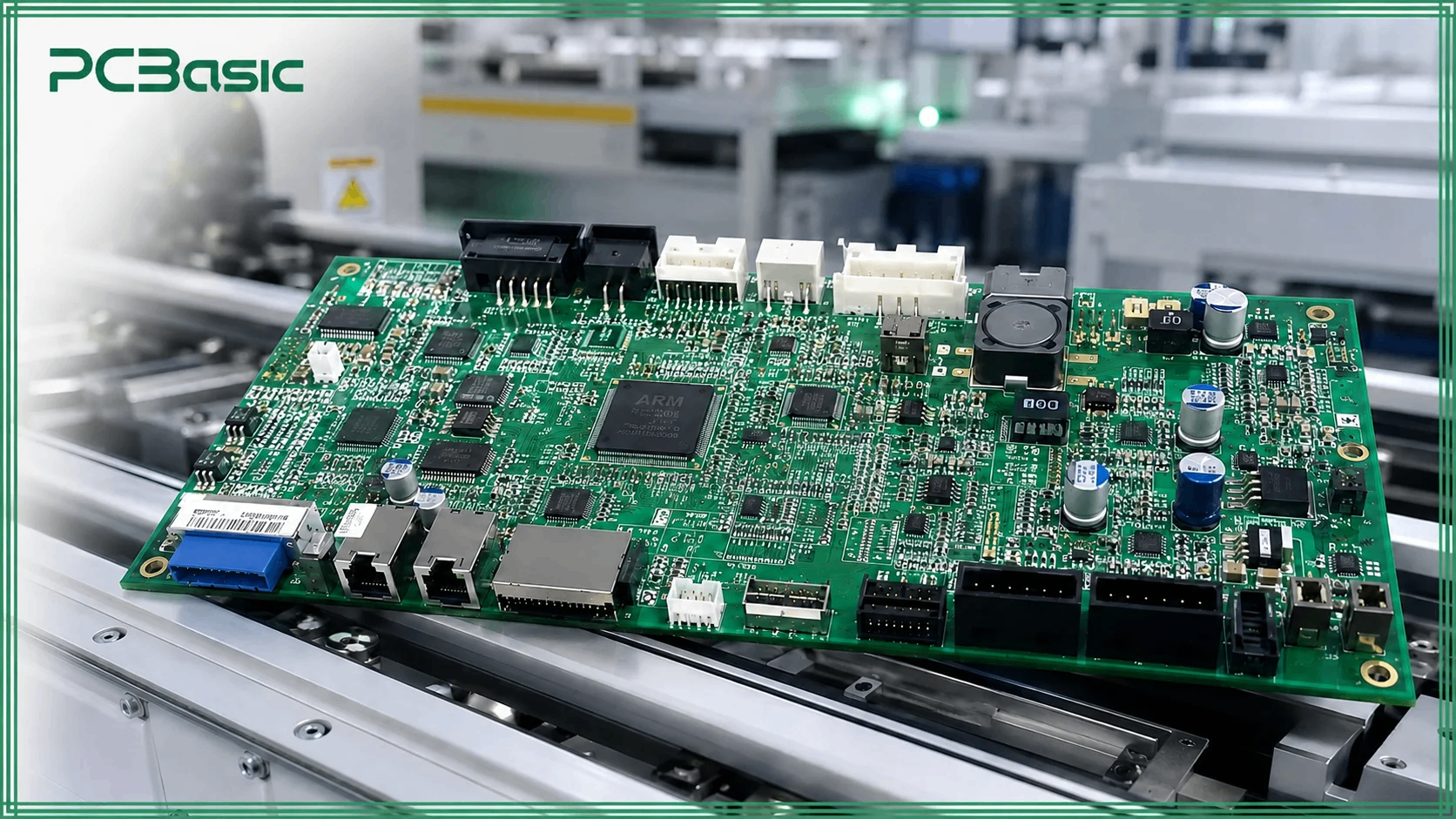
Medical diagnostic equipment PCB assemblies are subject to stricter and more targeted risk management rules than typical electronic devices. A medical diagnostic PCB frequently has to do several tasks at once, including reading sensor signals, operating pumps or motors, managing display panels, controlling LEDs, storing firmware, and interacting with the host device. Soldering defects are one potential problem. The consistent production of subsequent batches is often impacted by unrecorded component modifications, insufficient cleaning control, missing firmware data, or untraceable retest results. These hazards typically increase when the confirmed prototype product moves into the repeated manufacturing stage.
Many engineering teams and procurement teams will look for medical PCB assembly partners after the prototype verification is successful. However, the success of the prototype does not mean that the production conditions are already fully in place. At this point, the project might still need to incorporate test data, batch management specifications, and process records.
Therefore, in addition to whether component mounting can be completed, the supplier evaluation should focus on whether the manufacturing process, comprising BOM, process flow, inspection records, firmware version, and functional test data consistency, can be reliably replicated across batches. For medical PCBA production, both batch stability and defect tracking are essential.
PCBasic helps the medical equipment team create a more reliable and consistent production process during the project development and mass production phases by providing integrated manufacturing services that include PCB manufacture, component procurement, PCBA assembly, and testing verification. For medical PCB assembly projects, by integrating different manufacturing processes, the team can identify potential risks earlier and ensure that test results, version records and batch
traceability information remain continuous and consistent throughout the
production process.
Diagnostic
Device Boards Carry More Than Assembly Risk
From
an appearance perspective, the circuit board of a diagnostic device may not be
overly complex in structure. However, its manufacturing requirements are often much higher than those of electronic products. After assembly, the circuit board not only needs to provide a stable power supply and reliable sensor data, but also must ensure that the firmware runs normally, the communication process is controlled, and it can maintain consistent performance under the expected working conditions.
Signals, fluids, and firmware often meet on one board
Some diagnostic devices process low-level analog signals, digital data, and various control functions simultaneously on the same circuit board. When high-precision signal measurements coexist with functions such as pumps, valves, heaters, or optical modules, even minor deviations in the circuit board layout and assembly process can affect the final measurement results. In high-impedance analog circuits, precision sensor interfaces, or low-current measurement paths, excessive flux residue may contribute to leakage currents, noise, or measurement drift if cleaning requirements are not properly controlled.
This is why medical PCB assembly cannot be regarded as a simple process of component mounting. A reliable medical PCBA process requires the management of critical areas, controlled materials, and test records. Suppliers need to clearly identify which locations are sensitive to performance, which key components must be manufactured in accordance with the BOM requirements, which alternative materials need to be approved, and which test data need to be included in the batch traceability system.
The batch record should answer real production questions
The practical value of batch records lies in that they can assist the project team in recreating the manufacturing process of each batch of products: which BOM version was used? Which batches of components were put into production? Which PCB version and firmware version passed the tests? Which products were repaired and what re-tests were ultimately conducted? If this information is scattered across emails, photos, or personal memories, it will be difficult to maintain
consistency in subsequent repeated production.
The
Build Details That Keep Medical PCBA Repeatable
A
reliable medical PCBA RFQ should include enough information to guarantee a
controlled manufacturing process in addition to information for the quotation. The complete data package usually also should include assembly drawings, pad coordinate files, polarity requirements, test specifications, cleaning requirements, firmware management requirements, as well as overall design requirements that affect the assembly of connectors, shielding covers, display components, batteries and sensor modules.
|
RFQ area
|
Why it matters
|
What to provide
|
|
BOM
control
|
Unapproved
alternates can change readings, firmware behavior, or mechanical fit.
|
Locked
manufacturer part numbers, approved alternates, sourcing channel, lifecycle
notes
|
|
Assembly
data
|
SMT,
through-hole, and fixture planning depend on accurate files.
|
Gerber,
pick-and-place file, assembly drawing, polarity notes, panel details
|
|
Sensitive
areas
|
Low-level
analog or optical sections may need special handling.
|
Sensor
location, shielding area, cleaning limits, keep-out zones, test pads
|
|
Test
evidence
|
Visual
inspection cannot prove diagnostic board behavior.
|
Power-on
checks, firmware version, interface checks, calibration or load notes
|
|
Traceability
|
Repeat
orders need proof of what changed and what stayed fixed.
|
BOM
revision, board revision, component lots, repair and retest records
|
BOM control belongs in the first quote discussion
For medical device PCB assembly, the BOM not only needs to list the material list, but also should clearly indicate which components are controlled items and which materials can be substituted after approval. Some key components, such as microcontrollers, analog front-end ICs, sensor connectors, RF modules and memory, not only affect the circuit function, but also may affect the equipment calibration, performance stability and long-term supply. Therefore, stricter model locking and change management are usually required.
This does not mean that all components must adopt the most costly solution. Instead, it means that any alternative must undergo a clear assessment. An alternative component that appears to match in appearance and packaging may still affect calibration accuracy, standby power consumption, EMC performance, assembly compatibility, and the long-term reliability of the product if its key electrical parameters, mechanical characteristics, or material properties deviate from the requirements of the original design.
DFM review should include service access and testing
Design for Manufacturability (DFM) should not only focus on the design of pads, but also cover production testing and subsequent maintenance requirements. During the design stage of diagnostic equipment circuit boards, the following aspects may need to be considered:
• Programming interfaces (programming headers);
• Bed-of-nails access conditions;
• Gap between shielding covers;
• Direction of battery connectors;
• Routing of display cable;
• Accessible test points.
These details not only affect the design of test fixtures, but also influence the efficiency of subsequent testing and re-testing, especially after the first trial production is completed and enters the
repetitive production stage.
Process
Controls for Medical Electronics Assembly
Instead
of using a standard checklist, medical electronic assembly requires a unique
production flow for circuit board features. Different processing techniques can be needed for a patient monitor interface board, a blood analyzer control board, and a compact wearable board. Therefore, key control links in the process should also be planned based on product risks. The process flow should clearly define the arrangements for raw material inspection, management of moisture-sensitive components, welding sequence and key inspection nodes.
SMT and through-hole steps should not fight each other
The circuit boards of many diagnostic devices use both fine-pitch SMT elements as well as through-hole connectors, switches, relays, displays, and cable sockets. In this case, the assembly sequence becomes crucial.
Taking the high-leg connector as an example, if installed too early, it may obscure the nearby SMT area or make visual inspection more difficult. In this case, it is more practical to complete the inspection of the critical SMT area before installing the connector. The same planning method should be used when selective welding or manual welding is required. Protective measures may be required for the surrounding thermal elements before the PCB re-enters the welding process.

Inspection should be tied to defect type
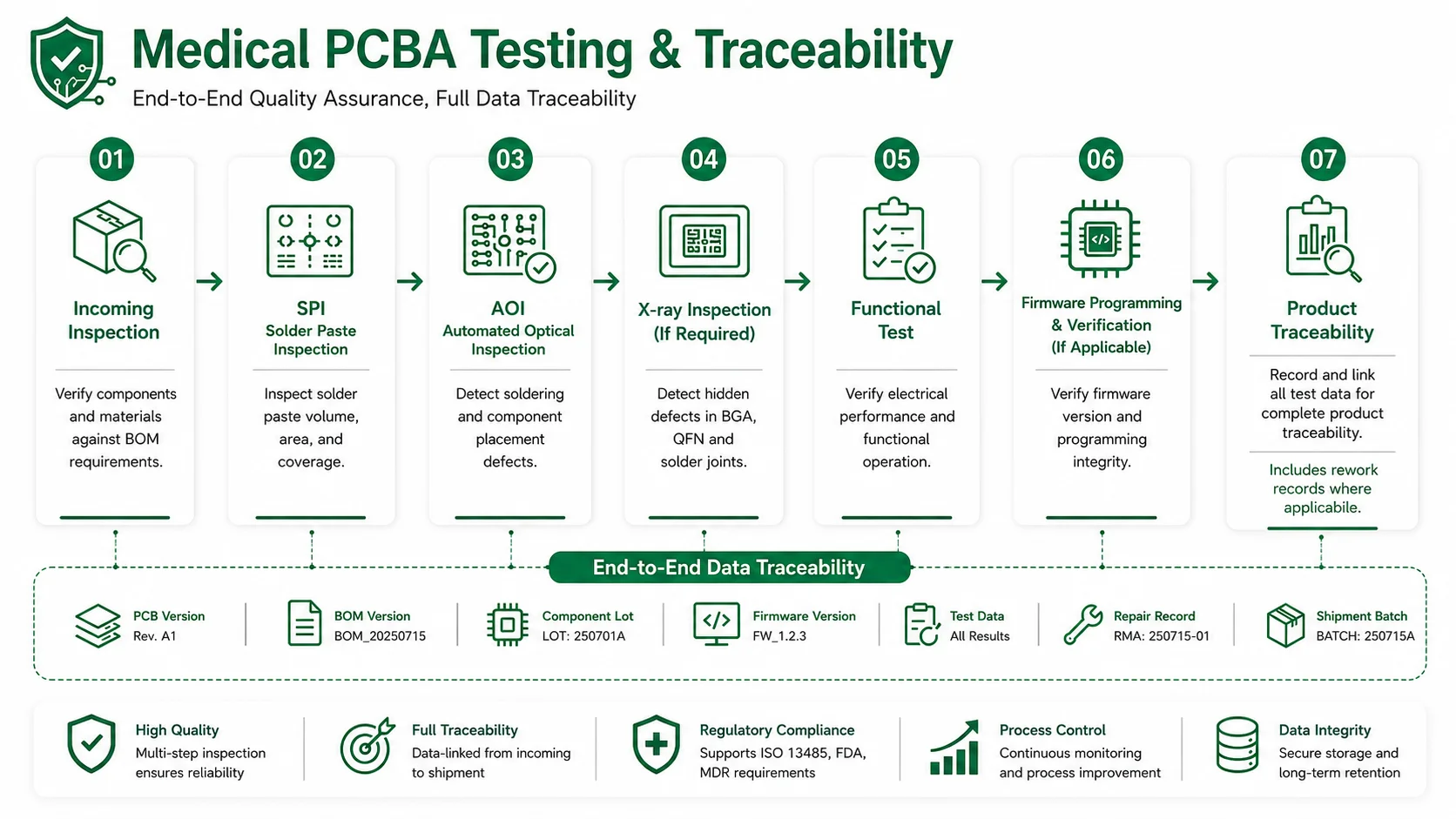
Different detection methods are used to cover the risks at different stages of the medical PCBA manufacturing process. Solder paste inspection (SPI), automatic optical inspection (AOI), X-ray inspection, and first article inspection (FAI) respectively undertake different verification tasks:
• SPI is used to evaluate the quality of solder paste printing before reflow soldering, including the amount, position and coverage of the solder paste;
• AOI is used to detect the position, polarity and visible welding defects of components;
• X-ray inspection is used to check hidden solder joints that cannot be confirmed by visual inspection, such as BGA, QFN or bottom terminal devices;
• First Article Inspection (FAI) is used to verify whether the first batch of produced products comply with the approved manufacturing documents, component requirements and key assembly specifications, providing a basis for subsequent mass production.
It doesn't matter how many inspection items there are; what matters is whether the major hazards have been successfully confirmed and comprehensive records have been created.
For ISO 13485 PCB assembly project, this is especially crucial. Buyers usually demand manufacturing papers that can be reviewed and located later, even if the PCBA supplier is not
in charge of the final medical device certification.
Test
Records That Catch Problems Before Shipment
Many
testing issues do not arise during the testing process itself, but rather are already latent before the testing begins. If the information received by the supplier is merely a single sentence like "functional testing is required", the resulting test records are often difficult to be used as references for subsequent batches. In contrast, a more effective approach is to clearly define the testing scope before production, such as which signals need to be verified, the acceptable range of key parameters, which firmware version to use, and the corresponding test fixtures. This not only helps to identify assembly issues but also enables subsequent batches to follow the same testing standards.
Functional tests should mirror the device risk
For diagnostic circuit boards, the functional test items usually focus on key functions and potential risks. Depending on the product design, the test contents may include power rails, current consumption, firmware burning, display response, sensor channels, communication interfaces, battery charging behavior, and pump or motor drive outputs, etc.
The focus of the test is not to replicate all actual application scenarios, but to detect problems introduced during assembly as early as possible and ensure that the PCBA has completed necessary verification before leaving the factory. If the product involves calibration, the supplier should clearly record the test fixtures, test methods and firmware versions used in the production records. If a certain PCBA fails the test and requires repair, the repair measures and re-test results should also be saved in the corresponding product records or batch records.
By doing this, the production of diagnostic type PCBA is no longer just a simple soldering service, but becomes a controlled manufacturing process that can support the purchasing party's subsequent quality record management and problem traceability.
Traceability should connect part lots, firmware, and retest results
In actual production, the significance of traceability is not to keep more logs, but to enable key manufacturing information to be quickly correlated. When a quality issue occurs, the project team usually needs to confirm:
• Which PCBA used a certain batch of analog ICs;
• Which products loaded firmware version 1.2.3;
• Which set of test fixtures was used during production;
• Whether the repaired products passed the final test consistent with the products of the same batch.
If these pieces of information cannot be correlated, a seemingly simple problem may
take several days to identify the cause.
How
PCBasic Fits a Controlled Medical PCBA Workflow
The value of medical PCB assembly services lies not only in completing the soldering process, but also in whether a stable and traceable manufacturing process can be established. For projects that require controlled procurement, repeated testing, and batch tracking, manufacturers need to coordinate multiple aspects such as PCB manufacturing, component procurement, SMT assembly, through-hole assembly, inspection, testing, and production record management.
PCBasic integrates these manufacturing processes into a unified workflow, providing complete manufacturing support for medical electronics projects. For projects that require controlling BOM changes, managing approved substitute materials, maintaining consistent test results, or establishing cross-batch traceability records, this integrated manufacturing process can help reduce information gaps in the production process.
PCBasic employs manufacturing control systems such as MES, IQC, ERP, IoT monitoring, and ESD management in its production process. However, the value of these systems is not merely in recording production data; it is more importantly in the ability to effectively link with engineering information. Data such as PCB versions, BOM versions, firmware records, test plans, maintenance histories, and shipment batches, if they cannot be kept consistent across different systems, even the most sophisticated management tools will struggle to form a truly effective traceability chain.
When the design of diagnostic equipment or medical electronic products enters the procurement and production preparation stage, the engineering team can conduct PCBasic project reviews to assess manufacturing risks, testing requirements, documentation needs, and traceability requirements in advance. Completing the confirmation of these information before the official production begins helps coordinate design, procurement, and assembly requirements, reduces subsequent adjustments due to unclear manufacturing conditions, and also avoids the situation where suppliers only rely on price and delivery time as the main criteria for
selection.

Conclusion
The ideal state for the production of diagnostic circuit boards is to be able to establish a set of usable manufacturing evidence from the very first batch of production. Medical equipment PCBs not only require reliable welding quality, but also need controlled component management, clear DFM reviews, reasonable SMT and through-hole assembly sequences, detection processes that match defect risks, clear functional tests, and subsequent traceable production records. When choosing a medical PCBA partner, cost and delivery time are only some of the considerations. For projects that require long-term repetitive production, what is more important is whether the supplier has a complete document management, traceability, testing, and process control capability, because these factors will directly affect the production consistency and product quality among different batches.
Whether the supplier can clearly explain how a PCBA is manufactured, tested, recorded, repaired, and how subsequent batches can be reproduced in accordance with the same standards for production is an important reference when evaluating medical electronic manufacturing
partners.
FAQs
Q1: What makes medical PCBA different from standard PCB assembly?
A1: Medical PCBA usually needs tighter BOM control, clearer test criteria, stronger traceability, and better documentation because diagnostic and monitoring boards often depend on stable signals, firmware, calibration, and repeatable test records.
Q2: Does ISO 13485 PCB assembly mean the PCBA supplier certifies the final medical device?
A2: No. The final device approval remains the responsibility of the medical device company. For a PCBA supplier, ISO 13485 PCB assembly discussions usually focus on controlled processes, documentation, traceability, and quality records that support the buyer's system, but it does not by itself constitute regulatory approval for a finished medical device.
Q3: What should be included in an RFQ for medical device PCB assembly?
A3: The RFQ should include Gerber files, BOM, approved alternates, pick-and-place data, assembly drawings, polarity notes, sensitive circuit areas, firmware requirements, functional test criteria, and any cleaning, coating, packaging, or traceability expectations.