2.2k resistors are among the most widely used resistors in the electronics industry. To use 2.2k ohm resistors correctly, we need to have a precise understanding of the relevant basic knowledge about them. Next, in this article, we will introduce the meaning of 2.2k resistors, how to identify the 2.2k ohm resistors color code, and typical application scenarios in actual circuits, etc. First, let's understand the meaning of 2.2k resistors together!
What is a 2.2k Resistor?
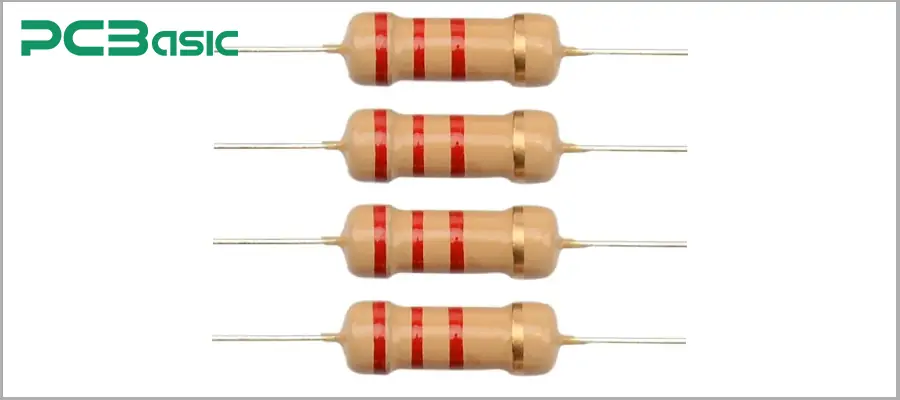
A 2.2k resistor is a fixed resistor, available in both axial-leaded and surface-mount packages. Its nominal resistance value is 2.2 kilo ohms, which is 2,200 ohms. In resistor notation, the letter "k" stands for kilo, meaning one thousand. Therefore, 2.2k represents 2.2×1,000, corresponding to a resistance value of 2,200Ω. This notation is widely used in circuit diagrams, BOM lists, and component markings.
However, in some circuit diagrams, the same resistance value may also be marked as 2k2. This notation uses a multiplier letter to replace the decimal point to avoid ambiguity in printing or handwriting. So, how do we identify a 2.2k ohm resistor color code?
2.2k Resistor Color Code (4-Band & 5-Band)
On a PCB, the most straightforward way to identify a resistor is by reading its color code bands. In practical applications, the 2.2k ohm resistor is most commonly found in 4-ring and 5-ring configurations. Before learning how to read the color code for a 2.2k resistor, we can first take a look at the following resistor color code table, which is applicable to the identification of all color codes:
|
Color
|
Digit Value
|
Multiplier
|
Tolerance
|
Temperature Coefficient (ppm/°C)
|
|
Black
|
0
|
×1 (10^0)
|
—
|
—
|
|
Brown
|
1
|
×10 (10^1)
|
±1%
|
100
|
|
Red
|
2
|
×100 (10^2)
|
±2%
|
50
|
|
Orange
|
3
|
×1,000 (10^3)
|
—
|
15
|
|
Yellow
|
4
|
×10,000 (10^4)
|
—
|
25
|
|
Green
|
5
|
×100,000 (10^5)
|
±0.5%
|
—
|
|
Blue
|
6
|
×1,000,000 (10^6)
|
±0.25%
|
—
|
|
Violet
|
7
|
×10,000,000 (10^7)
|
±0.1%
|
—
|
|
Grey
|
8
|
×100,000,000 (10^8)
|
±0.05%
|
—
|
|
White
|
9
|
×1,000,000,000 (10^9)
|
—
|
—
|
|
Gold
|
—
|
×0.1
|
±5%
|
—
|
|
Silver
|
—
|
×0.01
|
±10%
|
—
|
|
No Color
|
—
|
—
|
±20%
|
—
|
|
Note:
· Always read the color bands starting from the end opposite the tolerance band, which is usually gold or silver.
· 4-ring: The 1st, 2nd rings represent significant numbers, the 3rd ring is the multiplier, and the 4th ring is the tolerance.
· 5-ring: The 1st~3rd rings represent significant numbers, the 4th ring is the multiplier, and the 5th ring is the tolerance.
· 6-ring: The 1st-3rd rings indicate the significant number, the 4th ring is the multiplier, the 5th ring is the tolerance, and the 6th ring is the temperature coefficient (often used for high-precision resistors) in ppm/°C (parts per million of resistance change per degree Celsius).
|
Now, let's separately explain the typical color code markings and calculation methods for the 4-ring 2.2k ohm resistor and the 5-ring 2.2k ohm resistor:
4-Band 2.2k Resistor Color Code
Typically, the standard four-band 2.2k ohm resistor color code is:
Red – Red – Red – Gold, as shown in the following diagram:
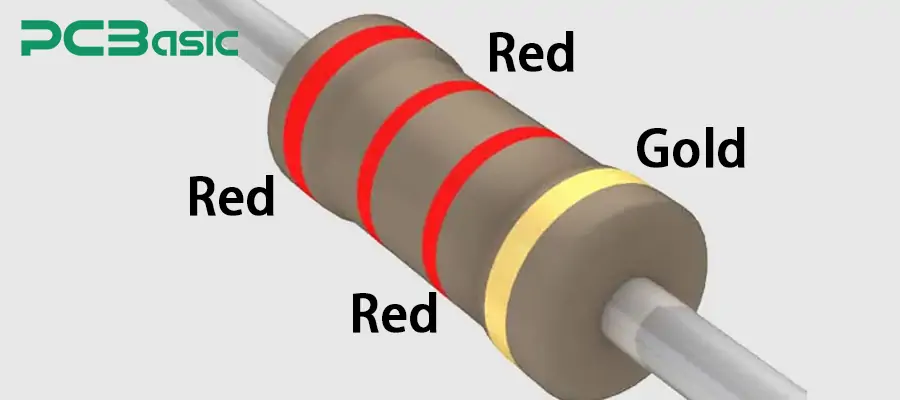
From the above table, we can see that in the four-band resistor, the first two color bands represent the significant digits, the third band represents the multiplier, and the fourth band represents the tolerance of the resistance value.
|
Band
|
Meaning
|
Value
|
|
1st Band
|
First digit
|
2
|
|
2nd Band
|
Second digit
|
2
|
|
3rd Band
|
Multiplier
|
×100
|
|
4th Band
|
Tolerance
|
±5%
|
Calculation method:
22 × 100 = 2,200 Ω (i.e. 2.2k ohms)
This is the most common 2.2k ohm resistor color code, usually found on plug-in resistors with a ±5% tolerance. When we see the first three bands as red–red–red, we can basically determine that this resistor is a 2.2k resistor, and then confirm its tolerance through the fourth band.
5-Band 2.2k Resistor Color Code
Usually, the five-ring marking is used for high-precision resistors. The color code for a common 2.2k ohm resistor is:
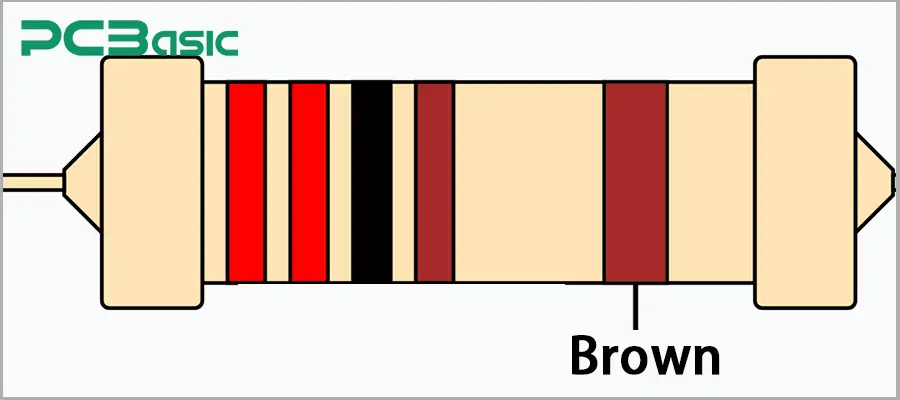
Red - Red - Black - Brown - Brown, as shown in the following diagram:
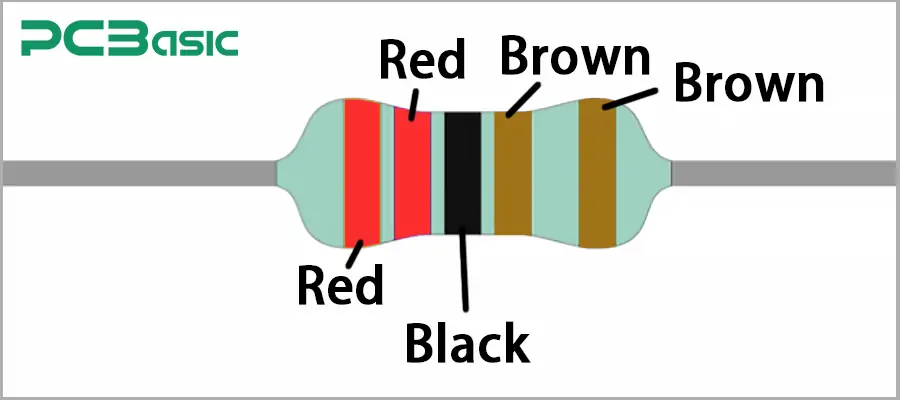
In the five-ring resistor, the first three color bands represent the significant digits, the fourth band represents the multiplier, and the fifth band represents the tolerance of the resistance value.
|
Band
|
Meaning
|
Value
|
|
1st Band
|
First digit
|
2
|
|
2nd Band
|
Second digit
|
2
|
|
3rd Band
|
Third digit
|
0
|
|
4th Band
|
Multiplier
|
×10
|
|
5th Band
|
Tolerance
|
±1%
|
Calculation method:
220 × 10 = 2,200 Ω (i.e. 2.2k ohms)
This 2.2k resistor color code is commonly seen in metal film resistors with a ±1% tolerance. Compared to the four-band resistor, the five-band structure increases the number of significant digits by one, thereby improving the accuracy of the resistance value representation. Therefore, note that although they both represent a 2.2k ohm resistor, the accuracies are different. When using them, be sure to identify them.

Resistance Tolerance of a 2.2k Resistor
Resistance tolerance refers to the allowable deviation range of the actual resistance value from the nominal value. In the color code of resistors, the last color band represents the tolerance. It is an important parameter for judging the accuracy and stability of resistors.
Common tolerances for 2.2k ohm resistors include:
±5% tolerance (gold band)
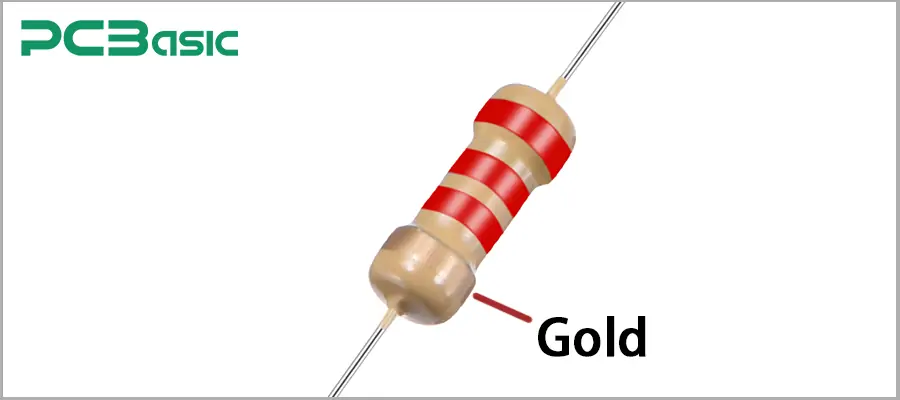
Actual resistance range: 2090Ω – 2310Ω
This is the most common specification and is suitable for general electronic circuits with not very high precision requirements.
±1% tolerance (brown band)
Actual resistance range: 2178Ω – 2222Ω
It is commonly used in control circuits, signal processing, and applications requiring good consistency.
±0.1% tolerance (violet ring, precision resistor)
It is mostly used in instruments and meters, calibration circuits, and analog circuits with high requirements for resistance value accuracy.
When selecting resistors, we should determine the tolerance grade based on the specific application. The tolerance color bands determine the accuracy of the resistance value in actual operation.
How Is a 2.2k Resistor Different from Other Values
Below is a comparison table showing the 2.2k resistance and the adjacent common resistance values:
|
Resistor Value
|
Current Level
|
Signal Stability
|
Common Issues
|
Typical Assessment
|
|
1kΩ
|
High
|
Moderate
|
Excess current, increased heat
|
Value too low
|
|
2.2kΩ
|
Moderate
|
Good
|
Balanced overall performance
|
Practical middle-ground choice
|
|
4.7kΩ
|
Low
|
Good
|
Weak bias, slower response
|
Slightly high
|
|
10kΩ
|
Very low
|
Good
|
Reduced drive strength, slow response
|
Too high
|
Through this table, we can have a clearer understanding of the position and advantages of the 2.2k resistor in circuit design. Compared with larger resistances (such as 10kΩ), the 2.2k ohm resistor has a lower resistance value, allowing for a greater current to pass through. And compared with smaller resistances (such as 1kΩ), the 2.2k resistor does not cause excessive current, which helps to improve signal stability.
In actual design, 2.2k resistors are often chosen as a "compromise value", and the main reasons for this include:
The 1kΩ resistor is too low in value, which can easily result in excessive current and increased heat generation.
The 4.7kΩ or 10kΩ resistors are too high, which may result in insufficient biasing and slower signal response.
2.2k ohm resistance combines both current capacity and stability, making it a very practical and versatile choice for intermediate resistance values.

Common Uses of 2.2k Ohm Resistors
2.2k ohm resistors have a wide range of applications. They are commonly used in:
Voltage Divider
A 2.2k ohm resistor is often used in conjunction with resistors of other values to form a stable and predictable voltage division ratio. It is commonly found in ADC inputs, voltage detection, and reference signal circuits.
Current Limiting
Before the LED, power input terminal or IC pin, a 2.2k ohm resistor is often used to limit the current. It is a common and reliable protective measure.
Transistor Biasing
In BJT or MOSFET circuits, the 2.2k resistor can be used as a bias resistor for the base or gate, helping the transistor operate within a stable operating range.
Pull-up / Pull-down Resistors
Although 10kΩ is a commonly used value for pull-up or pull-down resistors, in situations where there are higher requirements for response speed, anti-interference ability, or driving capability, a 2.2k ohm resistor is also used as a pull-up or pull-down resistor.
Tips for Using 2.2k Resistors in Circuits From PCBasic
The 2.2k resistor application is not inherently complex. However, incorrect identification or improper parameter selection can easily lead to debugging problems. Here are some common and practical precautions in engineering:
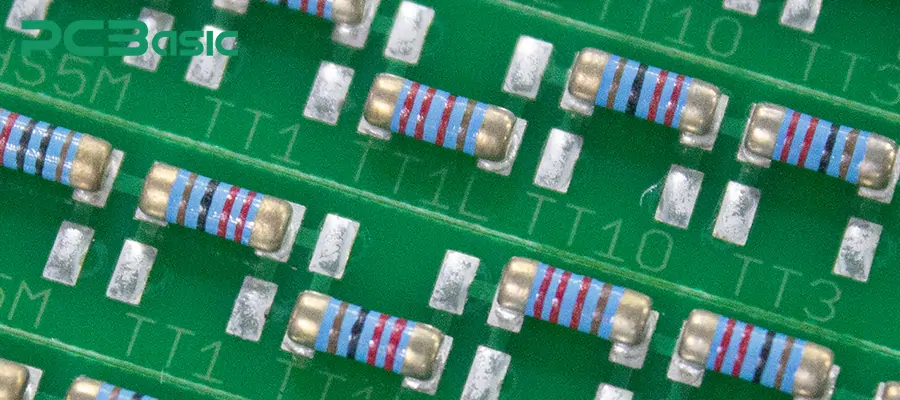
1. Check the color bands before soldering
For the plug-in resistors, carefully verify the color bands of the 2.2k resistor, especially to avoid confusing the red (2) color with the brown (1) color.
2. Based on the application matching tolerance level
For analog circuits, voltage divider or bias circuits, it is recommended to use a 2.2k ohm resistor with an accuracy of ±1%; while in general functional circuits, the ±5% specification is usually sufficient.
3. Pay attention to the power rating
The common power rating for 2.2k resistors is 1/8W or 1/4W. When designing, it is necessary to confirm that the power of the resistor has sufficient margin based on the actual voltage and current conditions, to avoid operating at the critical state for a long time.
4. SMT design is based on the BOM
For surface mount resistors, the resistance value specified in the BOM should be used for selection and assembly, rather than relying on appearance or silk-screening for judgment.
Conclusion
A 2.2kΩ resistor has a "mid-range" resistance value and is widely used and highly practical. To use it correctly and avoid problems during design and assembly, we must first understand the meaning of a 2.2k resistor and correctly identify the color code bands of a 2.2 K resistor. Overall, although the 2.2k resistor is a basic component, a clear understanding of its characteristics and usage points is also very important.

About PCBasic
Time is money in your projects – and PCBasic gets it. PCBasic is a PCB assembly company that delivers fast, flawless results every time. Our comprehensive PCB assembly services include expert engineering support at every step, ensuring top quality in every board. As a leading PCB assembly manufacturer, we provide a one-stop solution that streamlines your supply chain. Partner with our advanced PCB prototype factory for quick turnarounds and superior results you can trust.