Printed
Circuit Boards (PCBs) are the most fundamental and crucial part of electronic
products. On the one hand, it is used to fix and support electronic components;
on the other hand, it undertakes the role of transmitting electrical signals.
Whether it is consumer electronics, industrial automation equipment, automotive
control systems or medical devices, whether the products can operate stably for
a long time directly depends on the quality and performance of the circuit
boards.
Although
there have been significant advances in materials, design software and
manufacturing processes in recent years, PCB failure is still a common issue in
actual production and application. With the continuous development of
electronic products towards miniaturization, high density and high performance,
the risk of PCB damage, abnormal PCB operation, and hidden defects that are
difficult to detect with the naked eye is also constantly increasing. In many
cases, even a seemingly minor PCB fault can lead to system malfunctions, safety
risks, and even result in high costs such as rework or recall.
Therefore,
PCB failure analysis has become particularly important in electronic
manufacturing. Unlike simple repair, printed circuit board failure analysis
focuses more on understanding
why failures occur by identifying the true root causes and failure mechanisms, and
finally, fundamentally avoiding the recurrence of similar problems.
This
article will focus on PCB failure analysis, combining failure analysis
techniques in actual production, common PCB defects, and mature and effective
prevention methods to systematically sort out the PCB failure issues and
provide engineers and manufacturing manufacturers with a clear and practical
reference framework.
What Is
PCB Failure Analysis?
PCB
failure analysis is a systematic engineering analysis method, mainly used to
identify the true causes of PCB failure. During the analysis process, visual
inspection, electrical testing, material analysis, and various microscopy
analysis techniques are usually combined to determine why the printed circuit
board cannot work properly as originally designed.
Unlike
simple troubleshooting, printed circuit board failure analysis pays more
attention to the nature of the problem, such as:
• How did the failure occur?
• Which physical, electrical, or
chemical mechanisms caused the issue?
• How can effective solutions be
implemented to address similar PCB problems in future designs or mass
production?
By
systematically applying various failure analysis techniques, engineers can turn
a single failure into valuable improvement data, thereby continuously enhancing
the reliability of the product and the overall manufacturing quality.
When
and Why PCBs Fail
Common Sources of PCB Failures
Most PCB failures usually result from one
or more of the following factors:
|
Failure
Source Category
|
Specific
Causes
|
Explanation
|
|
Design-related
issues
|
Insufficient
spacing, poor thermal design, impedance mismatch, and incorrect material
selection
|
Problems
introduced during the design phase often escalate later, ultimately leading
to PCB failure
|
|
Manufacturing defects
|
Over-etching,
drill misalignment, plating voids, contamination
|
Poor
process control during fabrication can result in various PCB defects
|
|
Assembly
problems
|
Soldering
defects, component misalignment, residual flux
|
Common
issues during assembly that may lead to a PCB fault
|
|
Environmental factors
|
Moisture,
corrosion, vibration, temperature cycling
|
Long-term
environmental stress can cause progressive PCB damage
|
|
Operational
stress
|
Overvoltage,
overcurrent, mechanical shock
|
Operating
beyond design limits can accelerate PCB failure
|
These factors often interact, turning originally
small PCB defects into gradually serious failures over long-term use.
Typical Failure Timing
When
conducting PCB failure analysis, it is crucial to understand the time points
when failures occur:
|
Failure Stage
|
Common Issues
|
Characteristics
|
|
PCB fabrication stage
|
Inner-layer defects, plating issues,
material flaws
|
Root manufacturing-related problems
typically identified during PCB failure analysis through cross-sectioning or
X-ray inspection
|
|
Assembly
stage
|
Solder
joint cracks, pad lifting, component damage
|
Often
associated with thermal stress or inadequate process control
|
|
Testing stage
|
Latent electrical faults exposed under
stress testing
|
Considered “hidden defects” that may
not be visible during initial inspection
|
|
Field
operation stage
|
Thermal
fatigue, corrosion, electromigration leading to PCB damage
|
Typically
long-term degradation, where abnormal PCB behavior may appear only after
extended use
|
Many
abnormal PCB behaviors often appear after prolonged use, so accurately
identifying the root cause of failure is particularly crucial.

Common
PCB Failure Mechanisms
Solder Joint Failures
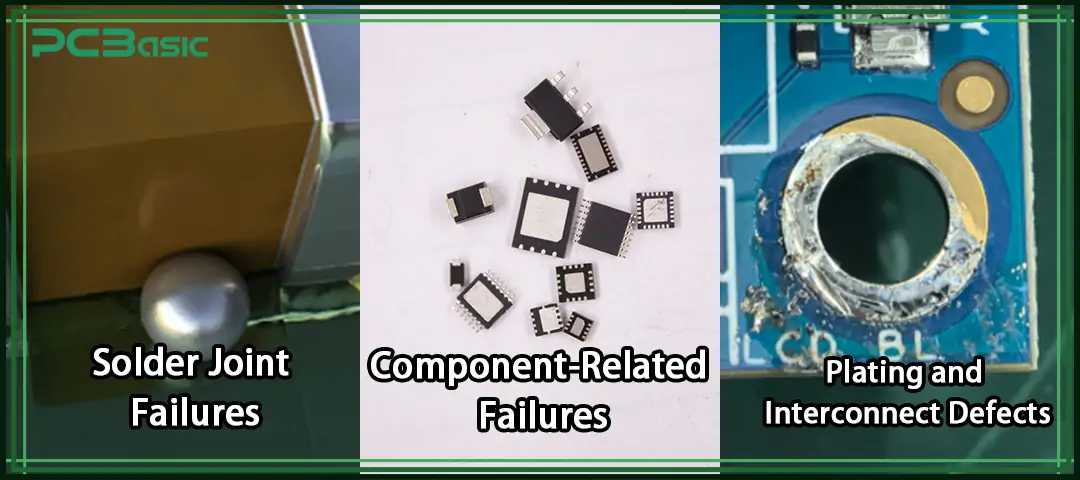
Solder joint issues are one
of the most common causes of PCB failure. Cracks, internal voids, cold solder joints, or fatigue caused by long-term thermal
cycling and vibration can all lead to poor electrical contact. Sometimes appears as intermittent malfunction, and sometimes it directly leads to a
complete PCB fault.
Open Circuits and Short Circuits
Broken traces, lifted pads, and incomplete through-hole platin can
all cause open circuits. Solder bridges, surface
contamination or CAF (conductive anodic filament) growth may cause short circuits. These problems are typical printed circuit board defects. Many times, it
is difficult to detect with the naked eye and usually requires X-ray or
electrical testing for confirmation.
Component-Related Failures
Overvoltage,
aging components, counterfeit parts or incorrect component selection can all
lead to PCB failure. In actual work, problems are often blamed to the circuit
board itself, but the real cause might be the insufficient component
reliability or unstable part quality.
Thermal-Related Failures
Poor thermal design, insufficient thermal
relief (starved thermals), or uneven copper distribution will all cause localized
temperature to rise. Long-term thermal stress can accelerate PCB damage, such
as delamination, racked solder joints, or reduced long-term reliability.
Plating and Interconnect Defects
Problems
such as plating voids, barrel cracks, and inner-layer separation can affect
electrical continuity. Such hidden PCB defects are often not easily detected
directly and are the key objects to be investigated in printed circuit board
failure analysis, especially more common in multilayer boards.
Environmental and Chemical Failures
Moisture,
ionic contamination, flux residues and corrosive environments can all cause
leakage current, corrosion and even electromigration problems. Such PCB
problems and solutions often require a combination of chemical analysis or
surface analysis methods to identify the true cause.
Mechanical Failures
Problems such as board warpage,
pad lifting, delamination, and measling are mostly related to mechanical stress
or mismatched material expansion
rates. This type of PCB damage not only increases the difficulty of assembly
but may also affect the yield and subsequent reliability.
Signal Integrity and EMI Issues
In
high-speed circuit designs, impedance mismatch, crosstalk, electromagnetic
interference (EMI), and signal reflection problems are all relatively common.
These electrical PCB faults may not immediately shut down the system, but they
will gradually affect performance and even leave long-term hidden dangers.
PCB
Failure Analysis Workflow (Step-by-Step)
Establishing
a clear and standardized workflow is the foundation of conducting an effective PCB
failure analysis. This not only enhances the analysis efficiency but also
avoids secondary damage to the samples during the detection process, which
could otherwise affect the judgment results.
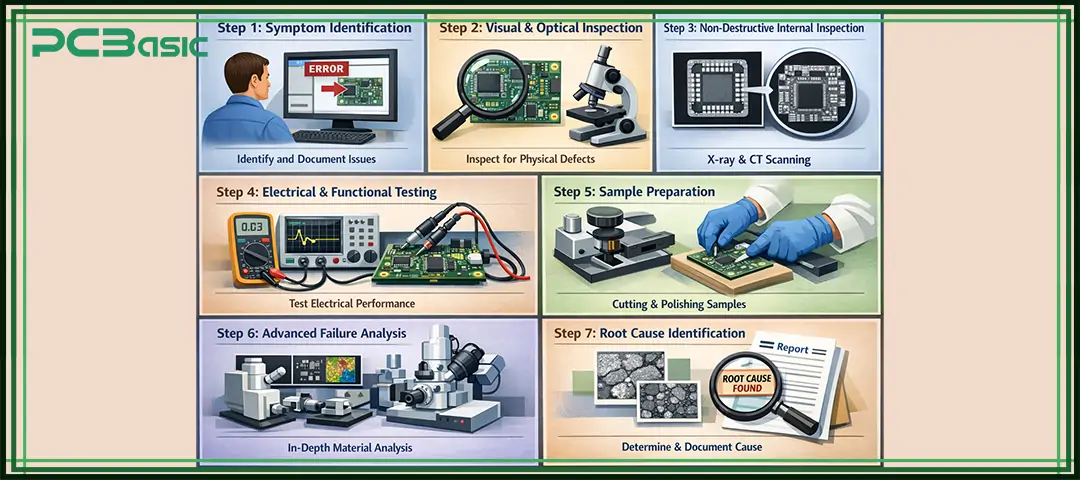
Step 1: Symptom Identification
The
first step in analysis is to clarify the problem. Common symptoms include functional
malfunction, intermittent failure, visible changes, or localized overheating.
Recording
the symptoms clearly can help us narrow down the possible causes of PCB failure
and avoid blind disassembly or excessive testing.
Step 2: Visual and Optical Inspection
Next
comes basic inspection. Obvious visible problems such as corrosion,
contamination, cracked solder joints, and other visible issues can be detected
by the naked eye, magnifiers or optical microscope. This step can often
directly identify some PCB defects.
Step 3: Non-Destructive Internal Inspection
If
there are no obvious problems with the appearance, further internal inspection
is required. Hidden problems such as voids, delamination, or internal cracks
can be discovered without damaging the circuit board through X-ray or scanning acoustic
microscopy.
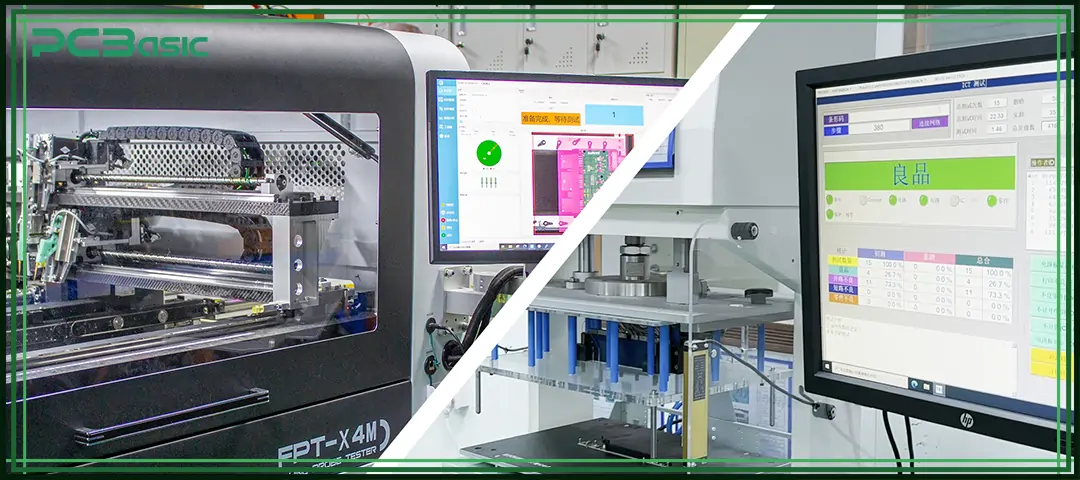
Step 4: Electrical and Functional Testing
Through
continuity testing, in-circuit testing (ICT), and full functional testing, it
can be confirmed whether there are electrical PCB faults, and it can be
determined whether the problem is an open circuit, short circuit, or component
failure.
Step 5: Sample Preparation for Advanced Analysis
When
a deeper analysis is required, sample preparation is extremely crucial. If
cutting or polishing is not operated properly, defects may be artificially
introduced, which affects the judgment result of printed circuit board failure
analysis. Therefore, this step must be carried out carefully.
Step 6: Advanced Failure Analysis Techniques
When
it is confirmed that in-depth research is needed, more professional failure
analysis techniques can be used, such as:
• Using SEM and SEM-EDS to examine
microstructural morphology and elemental composition
• Using XPS to analyze surface chemistry
and oxidation conditions
• Using FT-IR to detect organic
contamination
• Using DSC and TMA to evaluate thermal
properties and material behavior
These
means can help us identify the real cause from the microstructural and material
levels.
Step 7: Root Cause Identification and Documentation
Finally,
all the test results need to be summarized, compared and analyzed to confirm
the true root cause of the failure. A complete and clear report can ensure that
subsequent improvement measures truly address the essential causes of PCB
failure, rather than merely dealing with surface phenomena.
About PCBasic
Time is money in your projects – and PCBasic gets it. PCBasic is a PCB assembly company that delivers fast, flawless results every time. Our comprehensive PCB assembly services include expert engineering support at every step, ensuring top quality in every board. As a leading PCB assembly manufacturer, we provide a one-stop solution that streamlines your supply chain. Partner with our advanced PCB prototype factory for quick turnarounds and superior results you can trust.
Key PCB
Failure Analysis Techniques Explained
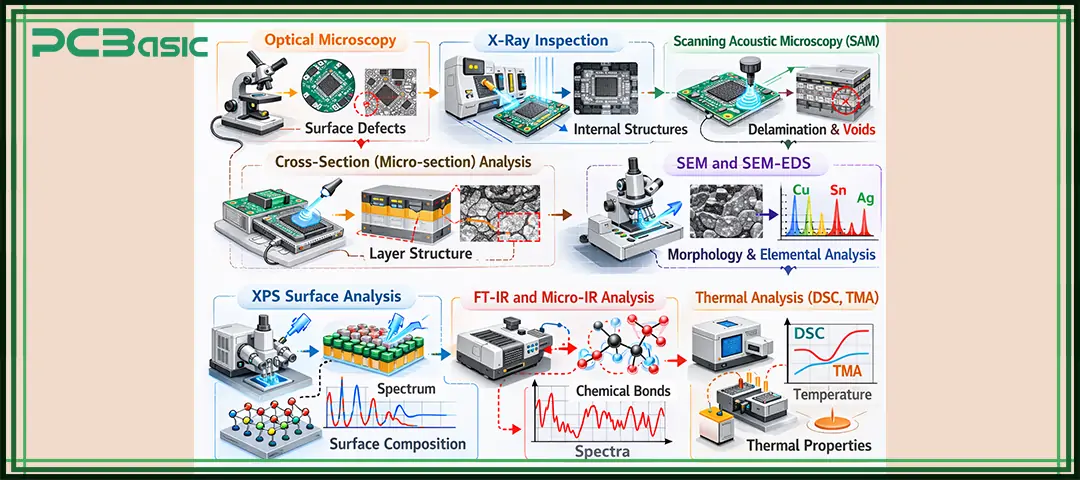
|
Analysis Technique
|
Primary Purpose
|
Typical Applications
|
|
Optical Microscopy
|
Detect surface defects and assembly
issues
|
Used to identify corrosion, cracks,
contamination, and visible PCB defects
|
|
X-Ray
Inspection
|
Analyze
internal structures and solder joint integrity
|
Essential
for inspecting BGA solder joints, via defects, and internal interconnect
problems
|
|
Scanning Acoustic Microscopy (SAM)
|
Detect delamination and internal voids
|
Used to identify delamination, internal
bubbles, and moisture-related PCB damage
|
|
Cross-Section
(Micro-section) Analysis
|
Examine
internal microstructures
|
A
destructive method used to evaluate barrel quality, plating thickness, and
internal cracks
|
|
SEM and SEM-EDS
|
High-resolution imaging and elemental
analysis
|
Core tools in PCB failure analysis for
microstructural observation and material composition analysis
|
|
XPS
Surface Analysis
|
Analyze
surface chemical states
|
Ideal
for investigating oxidation, corrosion, and contamination affecting
solderability
|
|
FT-IR / Micro-IR Analysis
|
Identify organic contamination
|
Used to detect flux residues or other
organic contaminants causing abnormal PCB behavior
|
|
Thermal
Analysis (DSC, TMA)
|
Evaluate
material thermal properties
|
Used
to measure glass transition temperature (Tg), curing quality, and thermal
expansion characteristics for reliability assessment
|
Preventing
PCB Failures: Design and Manufacturing Best Practices
Design for Reliability, DfR
Proper
layout, controlled impedance, adequate spacing, and solid thermal design can
effectively reduce the risk of PCB failure. Thorough consideration during the
design stage is the key to avoiding problems later on.
Material Selection
The
selection of the right laminate, surface finish, and solder alloy directly
affects the long-term reliability of the product. Improper material selection
can easily lead to PCB damage or performance degradation in the later stages.
Manufacturing and Assembly Control
Strict
process control, maintaining good cleanliness and adhering to IPC standards can
reduce the generation of PCB defects. Many problems often stem from production
details.
Testing and Reliability Validation
Through
ICT, functional testing, burn-in, and environmental stress testing, PCB faults
can be detected in advance to prevent problems from entering the market.

Conclusion
PCB
failure analysis is not merely a tool for troubleshooting problems; it is an
essential part of quality control in itself. As long as the common causes of
PCB failure are clarified, various failure analysis techniques are reasonably
used, and combined with the preventive measures in the early stage, PCB damage
can be effectively reduced, and the production yield can be improved. It can
also make the product more stable.
Conducting
a systematic printed circuit board failure analysis is essentially turning each
failure into an opportunity for improvement. The more thoroughly a problem is
solved, the lower the probability of subsequent problems occurring, and the
easier it is for an enterprise to achieve long-term stable development in the
field of electronic manufacturing.
FAQs
Q1:
What is the most common cause of PCB failure?
Solder
joint defects and thermal stress are among the most common causes of PCB
failure.
Q2:
Can PCB failure analysis prevent future problems?
Yes.
Effective PCB failure analysis identifies root causes and supports design and
process improvements.
Q3:
Are all PCB defects visible to the naked eye?
No.
Many printed circuit board defects require X-ray, SEM, or other advanced
failure analysis techniques.
Q4:
When should destructive analysis be used?
Destructive
methods like cross-sectioning should be used only after non-destructive options
are exhausted.