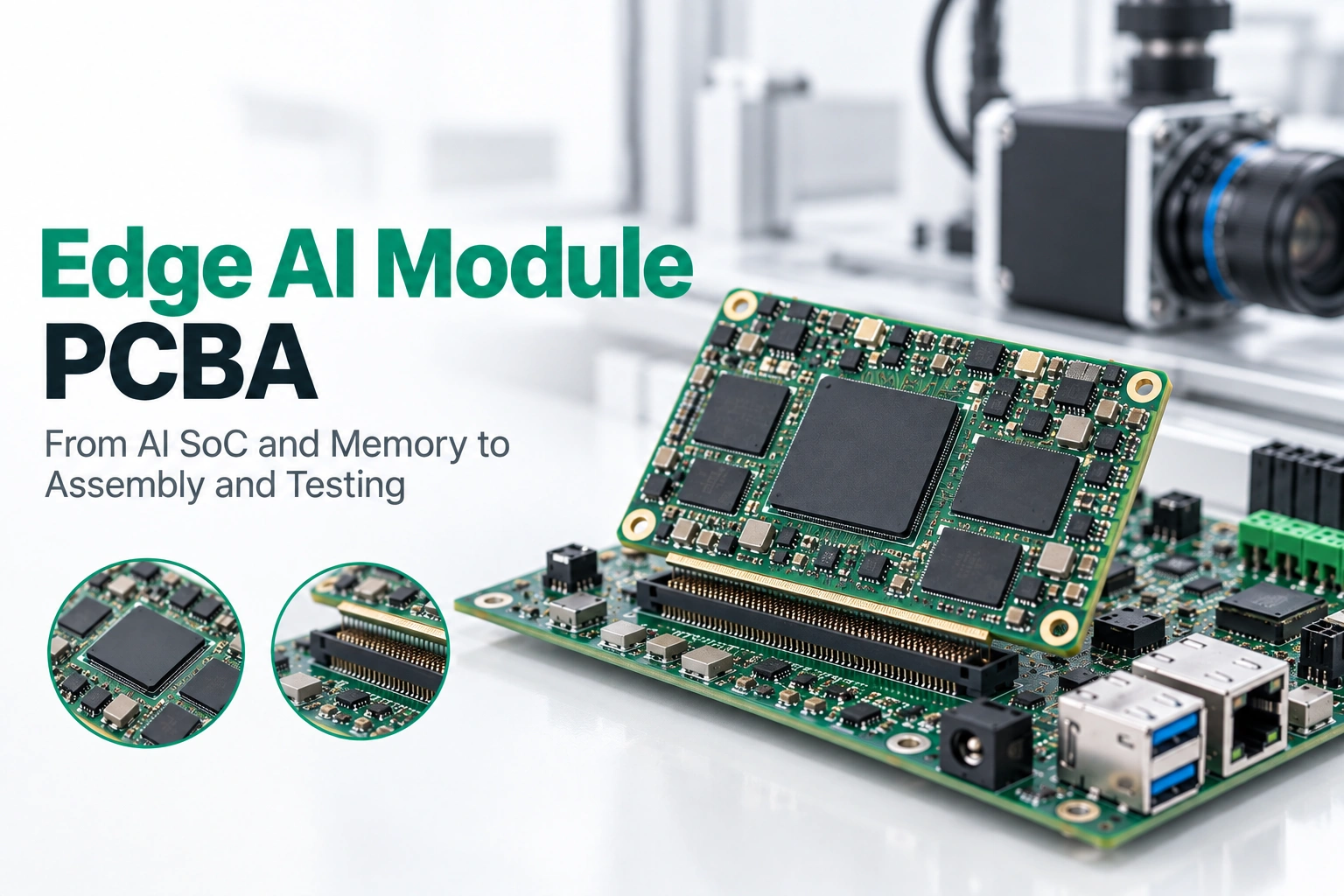
In today's era where electronic products are everywhere, the core of almost all high-end devices relies on multilayer PCBs. In fact, there is no standard PCB. Each circuit board is specially designed for a specific product, with different functions and structures.
As electronic products become smaller, faster and more powerful, traditional single-layer or double-layer PCBs can no longer meet the demands of complex routing, high-speed signal transmission and electromagnetic compatibility (EMC). In this case, multilayer PCB boards have gradually become the mainstream solution.
This article will provide you with a comprehensive understanding of multilayer PCBs in an easy-to-understand way, including their basic structure, development background, technological features, application fields, design considerations, and production process. Whether you are an engineer, a product developer, or in charge of procurement and project management, you can gain a clearer understanding of the role of multilayer PCBs in modern electronic manufacturing through this article.
What is a Multilayer PCB?
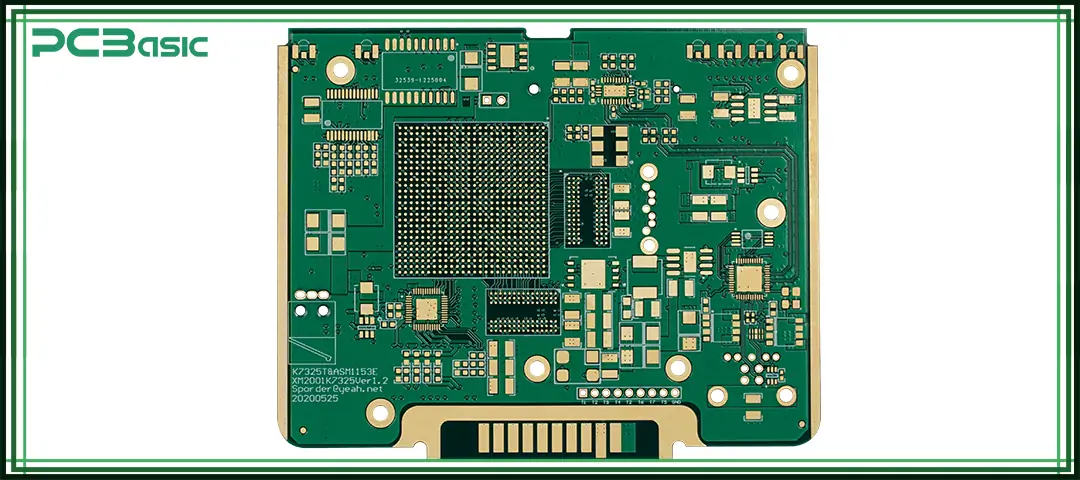
A multilayer PCB is a board with multiple layers of copper circuits stacked within a single circuit board. Its copper layers are usually more than three, separated by insulating materials in the middle, and then bonded together through a lamination process.
Its top and bottom layers are similar to those of a double-sided board and are mainly used for mounting components. The inner layers are mainly responsible for signal routing, power distribution, and ground planes.
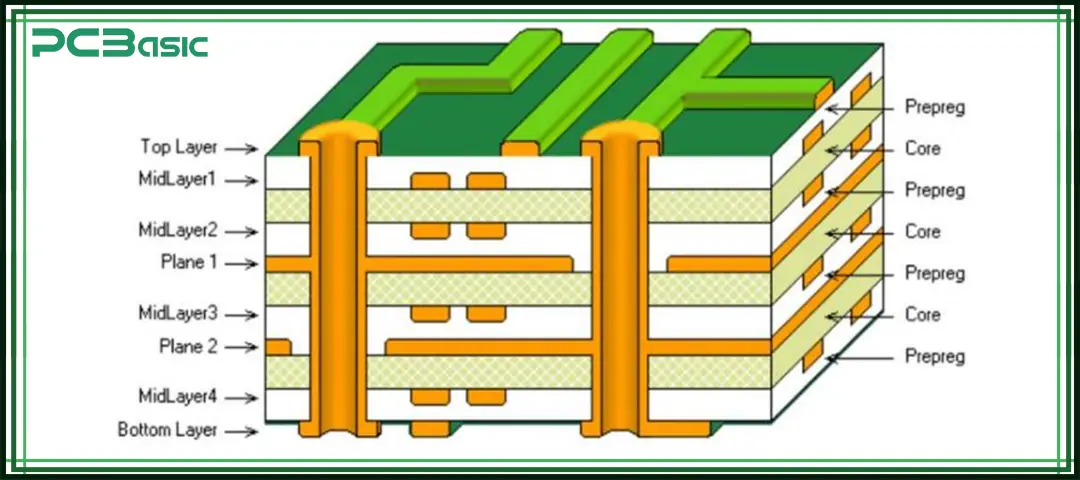
A common multilayer PCB board usually includes:
• Signal layers
• Ground layers
• Power layers
• Insulating layers
• Plated Through-Holes (PTH)
• Blind vias
• Buried vias
During the process of multilayer PCB fabrication, these layers are carefully aligned first and then laminated together under high temperature and pressure, eventually forming a complete and integrated multilayer circuit board.
Depending on the product requirements, common multilayer PCBs include 4, 6, and 8 layers. They can also be 20 layers, 40 layers, or even more, mainly depending on the complexity of the circuit and performance requirements.

Historical Development of Multilayer PCBs
The multilayer PCB began to be widely used in the 1980s. From that time on, electronic products have become smaller and smaller, but have more and more functions. With the continuous advancement of chip technology, more and more signals need to be transmitted in circuits, but the physical size of circuit boards cannot be expanded indefinitely.
Single-sided and double-sided boards were no longer sufficient. The solution that the engineer came up with was to stack the circuit layers vertically. In this way, more routing space can be created without increasing the board's footprint. This approach eventually led to the development of multilayer printed circuit boards. Through vias, traces on different layers can be connected to each other.
Later, the technologies of plated through-holes, blind vias, and buried vias gradually matured, making multilayer PCB design more flexible. In addition, with the continuous improvement of lamination technology and the increasing stability of the multilayer PCB manufacturing process, multilayer circuit boards with high-layer counts can now be mass-produced, and the cost is gradually controllable.
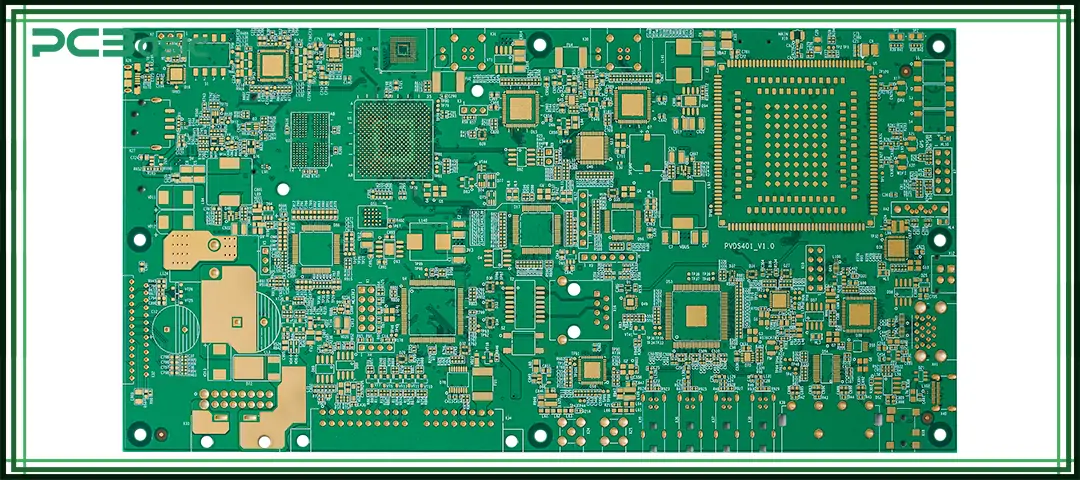
Up to now, multilayer PCBs have become the standard configuration in many high-performance electronic products, such as high-speed digital devices, RF systems, automotive electronics, aerospace equipment, and industrial control systems.
Anatomy of a Multilayer PCB
To finish an effective multilayer PCB design, it is first necessary to understand how a multilayer PCB board is structured.
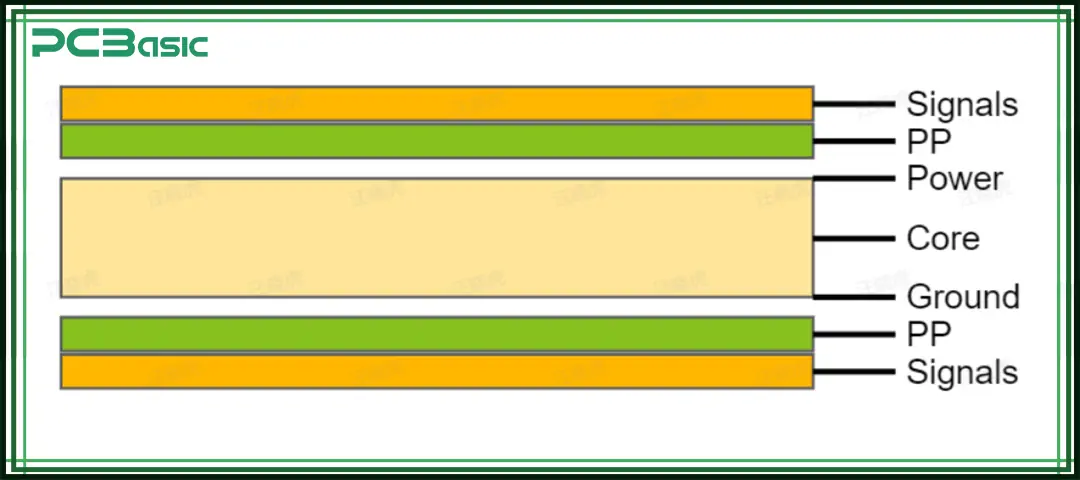
Taking the common 4-layer multilayer PCB as an example, the typical stack-up usually includes:
• Top signal layer
• Power layer
• Ground layer
• Bottom signal layer
In simple terms, the top and bottom layers carry signals, while the inner layers are used for grounding and power distribution. Of course, different products will adjust the stacking structure as needed.
Between each copper layer, an insulating material is added, such as standard FR-4 or high-frequency materials like Rogers for high-frequency applications. These materials not only serve as electrical isolation but also firmly bond each layer together.
Main Components of a Multilayer PCB
Copper Layers
They are used to route signal and power traces, serving as a pathway for electrical current.
Dielectric Materials (Prepreg and Core)
These are used to separate the copper layers and hold them together during the lamination process.
Vias
• Through-hole vias: connect all layers from top to bottom
• Blind vias: connect an outer layer to a specific inner layer
• Buried vias: connect only inner layers
In the process of multilayer PCB fabrication, these layers must be aligned precisely and then laminated into a whole under high temperature and pressure. Only in this way can the signal transmission of the multilayer printed circuit board be stable and its structure be reliable enough.
The more layers there are, the more complex the structure of a multilayer PCB becomes. Therefore, it is essential to plan the stacking structure in advance during the multilayer PCB design stage.
About PCBasic
Time is money in your projects – and PCBasic gets it. PCBasic is a PCB assembly company that delivers fast, flawless results every time. Our comprehensive PCB assembly services include expert engineering support at every step, ensuring top quality in every board. As a leading PCB assembly manufacturer, we provide a one-stop solution that streamlines your supply chain. Partner with our advanced PCB prototype factory for quick turnarounds and superior results you can trust.
Technological Features of Multilayer PCBs
Modern multilayer PCBs are not merely about stacking several more copper layers; they also employ some key technologies to improve overall performance.
1. High-Density Interconnection, HDI
In multilayer PCB design, if more components need to be placed, HDI technology will be adopted. By using smaller microvias and finer traces, more circuitry can be placed on a board of the same size, thereby enhancing integration density.
2. Controlled Impedance
For high-speed circuits, signal stability is significant. In multilayer PCB fabrication, the stack-up structure and dielectric thickness are planned in advance to ensure that traces achieve the required impedance, thereby ensuring more stable signal transmission.
3. Electromagnetic Compatibility, EMC
A multilayer PCB board usually has solid ground and power planes inside the structure. These layers act as shielding, reducing electromagnetic interference (EMI) and making the circuit work more stably.
4. Thermal Management
During the multilayer PCB manufacturing process, metal layers or dedicated heat-dissipation layers can be added to help circuits dissipate heat more efficiently. This is very important for products with higher power.
5. Hybrid Material Structures
In some high-frequency or high-speed applications, multilayer PCB fabrication combines standard FR-4 materials with high-frequency materials (such as Rogers) to create a multilayer circuit board with a hybrid structure. This way, costs can be controlled while meeting performance requirements.
Benefits of Multilayer PCBs
Nowadays, electronic products are getting smaller and smaller, but they have more and more functions. This is the reason why multilayer PCBs are widely used.
Compact Size
By stacking the circuits in layers vertically, a multilayer PCB can accommodate more circuitry without increasing the board's footprint.
Improved Signal Integrity
In a multilayer structure, signal layers and the ground layers are closer to each other, which can reduce interference and make signal transmission more stable.
Reduced EMI
Inside a multilayer printed circuit board, there are usually solid ground planes. These layers act like shields and can reduce electromagnetic interference (EMI).
Higher Functionality
A single multilayer PCB board can integrate functions that previously required multiple boards into one, making its structure simpler and more reliable.
Lightweight Construction
Although the number of layers has increased, through a reasonable multilayer PCB design, the overall product can actually be lighter.
It is precisely because of these advantages that multilayer PCB manufacturing has become an indispensable part of many high-end electronic products, especially in industries that have high requirements for speed, size and reliability.
Disadvantages of Multilayer PCBs
Although multilayer PCBs have many advantages, there are also some practical problems that need to be considered:
|
Issue
|
Explanation
|
|
Higher Cost
|
Multilayer PCB fabrication requires multiple lamination cycles, precision drilling, and advanced equipment, so the overall cost is usually higher than that of standard boards.
|
|
More Complex Design
|
Multilayer PCB design requires careful stack-up planning, impedance control, and thermal management, demanding more experience from designers.
|
|
Longer Lead Time
|
The multilayer PCB manufacturing process involves many production stages and complex procedures, resulting in longer turnaround times.
|
|
Difficult Repair
|
The internal layers of a multilayer circuit board are embedded inside the board, making troubleshooting and repair more challenging.
|
|
Limited Manufacturer Capability
|
High-layer-count multilayer PCB fabrication requires advanced equipment and mature processes, and not all PCB factories have this capability.
|
Applications of Multilayer PCBs
Multilayer PCBs have a wide range of applications and are used in many industries.
Consumer Electronics
Products such as mobile phones, tablets and smartwatches have small internal spaces but many functions. Therefore, multilayer PCB boards are used to concentrate circuits together.
Telecommunications
5G equipment, base stations and various network devices require high-speed and stable data transmission, which is inseparable from multilayer printed circuit board technology.
Automotive Industry
Systems like ADAS, engine control units, and in-vehicle entertainment systems all require complex and stable circuit designs, and thus multilayer PCB design (multilayer PCB design) is used.
Medical Devices
Medical devices such as CT and monitors have very high requirements for stability, so reliable multilayer PCB manufacturing solutions will be chosen.
Aerospace and Defense
Equipment operating in high temperatures, vibrations or other harsh environments requires highly reliable multilayer circuit boards. The multilayer structure can better ensure stability.
Multilayer PCB Production Process
The process of multilayer PCB manufacturing is similar to that of single-layer PCBs, but it has some additional procedures.
1. Pre-Production
First, conduct an engineering review to check if the documents are suitable for production (DFM), and at the same time, prepare the materials required for multilayer PCB fabrication.
2. Inner Layer Processing
Make the inner copper circuit first. Through imaging and etching, the circuit pattern is transferred onto the copper layers to form the internal structure of the multilayer circuit board.
3. Lamination
All the circuit layers and insulating materials are stacked together and bonded under high temperature and high pressure to form a single solid structure.
4. Drilling
Drill holes in the board to create connections between different layers.
5. Plating
Copper is plated inside the drilled hole walls to ensure electrical conductivity between each layer.
6. Outer Layer Imaging
Make the final circuit pattern on the outer layer of the multilayer PCB board.
7. Solder Mask
Apply a protective coating on the surface to prevent short circuits and also protect the copper surface from oxidation.
8. Surface Finish
Apply surface treatments such as ENIG, HASL or OSP to improve solderability and reliability.
9. Profiling
The board is processed into its final dimensions through CNC routing or V-scoring.
10. Quality Control
Conduct electrical testing and visual inspections on each multilayer PCB to ensure it meets specifications.
The entire multilayer PCB manufacturing process must strictly control quality. Any issue at any step will affect the stability of the final product.

Conclusion
Multilayer PCB enables electronic products to be made smaller and more powerful, and thus has changed the development direction of the entire electronics industry. From reasonable multilayer PCB design to stable and mature multilayer PCB fabrication processes, the current multilayer PCB manufacturing has been able to meet the higher requirements of electronic products for speed, size and reliability.
With the continuous upgrading of 5G, the Internet of Things (IoT), automotive electronics and medical devices, the importance of multilayer printed circuit boards will only increase. Choosing professional multilayer PCB design and reliable multilayer PCB fabrication solutions can make the product more stable in long-term use and reduce the risk of failure.
FAQs about Multilayer PCBs
Q1: How many layers can a multilayer PCB have?
A multilayer PCB typically ranges from 4 to 40 layers, though advanced multilayer PCB fabrication can exceed this.
Q2: Why are multilayer PCBs more expensive?
Because multilayer PCB manufacturing requires multiple lamination cycles and precise drilling processes.
Q3: What materials are used in multilayer PCBs?
Common materials include FR-4 and high-frequency laminates used in advanced multilayer PCB design.
Q4: Can multilayer PCBs support high-speed signals?
Yes, properly designed multilayer circuit boards provide excellent impedance control and EMI shielding.
Q5: What industries rely on multilayer PCB technology?
Telecommunications, automotive, aerospace, medical, and consumer electronics all depend on multilayer PCBs.