
Global high-mix volume high-speed PCBA manufacturer
9:00 -18:00, Mon. - Fri. (GMT+8)
9:00 -12:00, Sat. (GMT+8)
(Except Chinese public holidays)





HomePage > Blog > Knowledge Base > Energy Storage PCB Assembly: Building BMS, Power, and Control Boards
1. The PCB Assemblies Inside a Battery Energy Storage System
2. Battery Management Boards: Precision and Thermal Protection
3. Power Conversion Boards: Managing High Currents and Thermal Stress
4. Control and Communication Boards: Signal Integrity and Automated Testing
5. Strategic Value of Turnkey Energy Storage PCB Assembly Services
The global energy transition has placed Battery
Energy Storage Systems (BESS) at the center of modern grid infrastructure,
industrial backup facilities, and residential power setups. As these
installations scale from residential kilowatt-hour units to utility-scale
megawatt-hour containers, the underlying hardware architecture faces stringent
demands regarding safety, thermal endurance, and operational longevity.
Behind every reliable BESS is a high-density electronic assembly capable of managing high currents, executing real-time data processing, and operating safely under harsh environmental conditions. For hardware design engineers and strategic procurement leaders, sourcing energy storage PCB assembly services is far more than a routine manufacturing procurement step—it is a critical reliability decision. A single component defect, solder void, or insulation fault in a high-voltage battery storage ecosystem can result in field failures, costly downtime, or severe thermal events.
To build robust, industrial-grade storage hardware, both engineering and sourcing teams must understand the manufacturing complexities of the core circuit boards inside a modern energy storage system: the Battery Management System (BMS), the Power Conversion System (PCS / Inverter), and the main System Control and Communication units.
A commercial or utility-scale BESS is a complex system of interconnected sub-assemblies. The electronics inside must seamlessly bridge low-voltage high-precision digital computing with ultra-high-voltage power electronics.
|
Board Classification |
Core Technical Function |
Key Manufacturing Challenges |
|
BMS Board |
Cell voltage/temperature monitoring, charge balancing, safety protection |
AFE measurement precision, high-voltage isolation, heavy copper layout |
|
Power Conversion Board (Inverter/PCS) |
Bidirectional DC/AC conversion, grid synchronization |
High current density, thermal reflow profile control, creepage/clearance distance |
|
Control & Communication Board |
System orchestration, telemetry transmission, industrial fieldbus interfacing |
High-voltage EMI/EMC shielding, fast secure flashing, DFM/DFT testability |
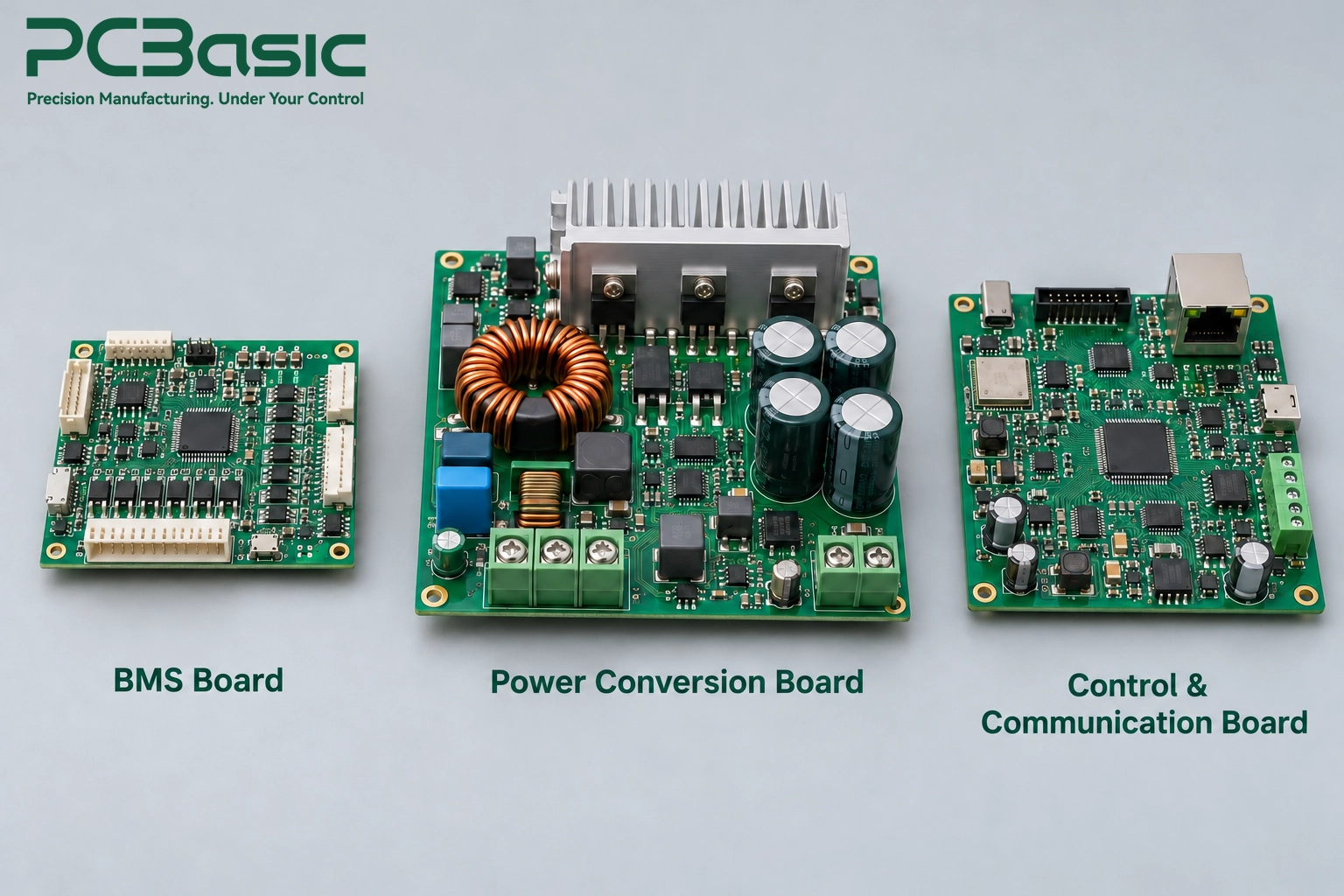
The BMS acts as the central safety manager of any lithium-ion or sodium-ion battery pack. A failure at the BMS level directly compromises cell health, battery lifetime, and overall operational safety.
Modern BESS architectures require cell monitoring down to single-millivolt accuracy to calculate State of Charge (SoC) and State of Health (SoH) precisely. During battery management system PCB assembly, component selection and SMT placement must be carefully controlled:
• Analog Front-End (AFE) Placement: AFE chips must be decoupled from noisy switching regulators to prevent signal distortion.
• Low Parasitic Layout: Traces connected to current-sense shunts require precise differential routing to eliminate parasitic inductance and ambient noise interference.
Cell balancing circuits (whether passive or active) convert excess energy into heat. Advanced BMS PCB assembly designs incorporate heavy copper layers (ranging from 2 oz to 6 oz or more) alongside matrix thermal vias. Contract manufacturers must adjust SMT thermal profiles to accommodate these thick copper planes, ensuring proper solder wetting without damaging surrounding temperature-sensitive microcontrollers.
BESS units are often deployed in unconditioned outdoor enclosures exposed to moisture, airborne dust, and extreme temperature cycling. Applying automated, IPC-compliant conformal coating (such as acrylic, silicone, or polyurethane) over sensitive analog lines prevents dendrite growth, moisture corrosion, and unexpected short circuits.
For BMS projects requiring additional environmental protection, PCBasic offers conformal coating, with coating areas and connector masking defined according to the assembly requirements.

The inverter board converts high-voltage DC current stored in the battery rack into grid-compliant AC electricity, and vice versa during charging cycles. Dealing with voltages often exceeding 800V to 1500V DC requires specialized manufacturing processes.
Inverter PCB assembly involves large surface-mount and through-hole components, including SiC/GaN MOSFETs, IGBT modules, high-power inductors, and busbar connectors. Controlling solder voiding is a vital requirement for engineering teams:
• Solder Void Control: Voiding under power MOSFET thermal pads reduces heat transfer efficiency, leading to localized hotspots and early power transistor failure. Advanced manufacturers use vacuum reflow technology to keep thermal voiding well under standard threshold limits.
• Selective Soldering for Heavy Terminals: Heavy copper busbars and high-current connectors require selective soldering equipment with precise fluxing and preheating to form reliable gas-tight intermetallic joints.
To comply with global safety standards (such as UL 1973, UL 9540, and IEC 62619), high-power energy storage PCBA designs strictly maintain creepage (surface distance) and clearance (air distance) rules. SMT lines must ensure zero solder-beading or flux-residue bridging across high-voltage isolation channels.
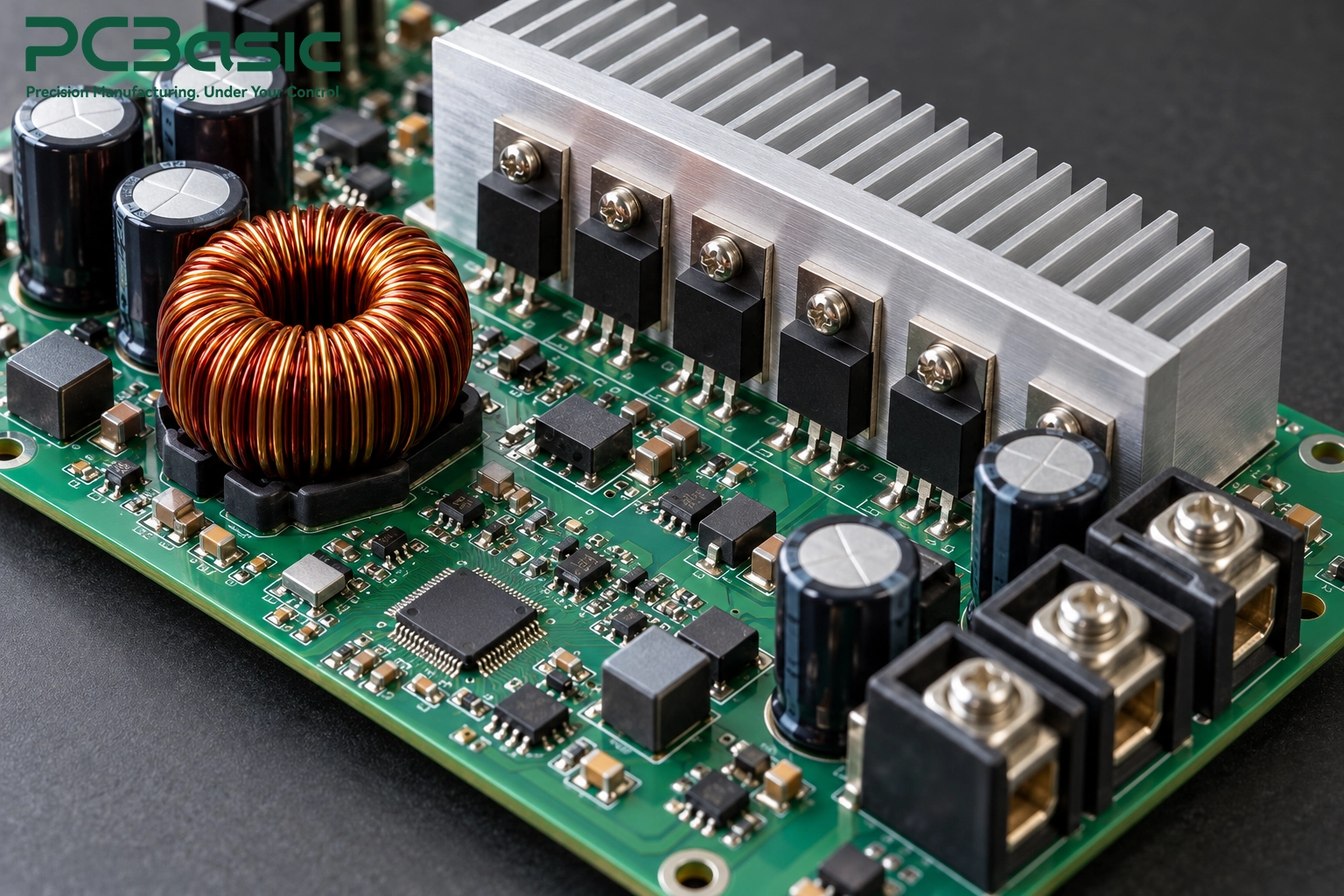
The central control board assembly functions as the brain of the storage system, collecting data from various BMS modules and inverter drivers, processing logic, and communicating with cloud platforms, Microgrid Controllers, or Energy Management Systems (EMS).
Operating adjacent to high-speed switching power electronics subjects the control unit to severe electromagnetic noise. Engineers implement differential pair routing, ground planes, and physical metallic shielding cans. Contract manufacturers must ensure that automated optical inspection (AOI) and visual checks confirm complete solder wetting along shield boundaries without warping the PCB.
Procurement and engineering teams benefit significantly when EMS partners review board designs early via DFM/DFT analysis. Key manufacturing checkpoints include:
• Test Point Accessibility: Ensuring adequate test pad size and spacing for automated In-Circuit Testing (ICT) bed-of-nails fixtures.
• Automated X-Ray Inspection (AXI): Verifying hidden solder joints under high-density BGAs and quad-flat no-lead (QFN) control processors.
• Automated Firmware Flashing & FCT: Implementing secure automated programming environments followed by Functional Circuit Testing (FCT) that simulates actual load, temperature, and communication responses before final packaging.
PCBasic combines DFM review with SPI, AOI, X-ray inspection, and project-specific ICT or functional testing to address assembly risks and verify agreed electrical requirements.

For procurement managers navigating volatile component markets and complex supply chains, managing separate suppliers for BMS, inverter, and control boards increases lead time risks and total cost of ownership. Sourcing integrated energy storage PCB assembly services from an experienced Electronics Manufacturing Services (EMS) provider yields distinct strategic advantages:
High-reliability industrial projects demand complete component traceability. Specialized EMS providers source directly from franchised distributors or original component manufacturers (OCMs), maintaining full lot traceability down to individual reel numbers. This mitigates counterfeit component risks and protects long-term warranties.
Through component sourcing, incoming quality inspection, and MES-based production records, PCBasic supports material verification and manufacturing traceability for energy storage board projects.
Leading EMS vendors offer turnkey box-build services beyond board-level assembly. This includes assembling thermal pads, mounting heavy heatsinks, integrating custom wiring harnesses, installing busbars, and housing assemblies into ruggedized IP67/NEMA-rated metal enclosures.
When evaluating manufacturing partners for an energy storage system PCB assembly, engineering and procurement teams should verify key quality certifications:
• ISO 9001: Quality Management Systems standard.
• IATF 16949: Automotive quality standard for high-reliability manufacturing environments.
• IPC-A-610 Class 3: Acceptability standard for high-reliability electronic assemblies where continuous performance or performance-on-demand is imperative.

Developing competitive, high-performance battery energy storage systems requires close alignment between hardware design, supply chain strategy, and manufacturing execution. From high-precision BMS PCB assembly to heavy-copper inverter PCB assembly and robust control board assembly, every stage of production demands rigorous quality control and specialized manufacturing capabilities.
By partnering with an experienced EMS partner offering comprehensive energy storage PCB assembly services, engineering teams can safeguard their product designs against premature field failures, while procurement professionals achieve competitive unit costs, dependable component supply, and scalable production capacity.
Planning an energy storage PCBA project? Send PCBasic your BOM, Gerber files, assembly drawings, and testing requirements to discuss manufacturing options and request a quote.
1. What IPC standard is mandatory for utility-scale energy storage PCBA?
Utility-scale and commercial energy storage applications typically require IPC-A-610 Class 3 standards, ensuring high reliability, zero tolerance for downtime, and resilience in harsh operating environments.
2. How are thermal issues mitigated on high-current inverter PCBAs?
Thermal management combines layout techniques (heavy copper traces, thermal via arrays, and IMS) with advanced manufacturing processes (vacuum reflow soldering to eliminate voids, application of liquid TIM, and custom heatsink integration).
3. Why is full component traceability essential in BMS PCB manufacturing?
For 10–20 year BESS lifespans, full traceability tracks exact component lot numbers and sources. This enables engineers to instantly isolate affected serial numbers during a defect notice, avoiding expensive product recalls.

Assembly Enquiry
Instant Quote


Phone contact

+86-755-27218592
In addition, we've prepared a Help Center. We recommend checking it before reaching out, as your question and its answer may already be clearly explained there.
Wechat Support

In addition, we've prepared a Help Center. We recommend checking it before reaching out, as your question and its answer may already be clearly explained there.
WhatsApp Support

In addition, we've prepared a Help Center. We recommend checking it before reaching out, as your question and its answer may already be clearly explained there.
