
Global high-mix volume high-speed PCBA manufacturer
9:00 -18:00, Mon. - Fri. (GMT+8)
9:00 -12:00, Sat. (GMT+8)
(Except Chinese public holidays)





HomePage > Blog > Knowledge Base > What Is a BGA Chip? BGA Chips, Packages, Assembly, and X-ray Inspection Explained
A BGA chip, simply put, is an integrated circuit in a BGA package. Different from traditional chips that connect to the PCB through leads around the edges, this kind of chip has solder balls on its bottom, through which it forms electrical connections with the PCB.
You can usually see it in compact, high-performance products that require higher reliability, such as smartphones, electric vehicles, industrial control boards, communication devices, and computer systems. It plays an important role in modern IC packaging. Therefore, it requires more complex design, more precise BGA assembly, and a more controlled BGA soldering process. You can learn more details about this type of chip in the following article if you are interested in IC packaging or PCB assembly. In this article, we will explain how a BGA chip works, how it is assembled, what defects may occur, and why X-ray inspection is important.
|
Item |
Explanation |
|
Full name |
Ball Grid Array |
|
Common name |
BGA chip |
|
Package type |
Surface-mount IC package |
|
Connection method |
Solder balls under the package |
|
Common types |
PBGA, FBGA, CBGA, TBGA |
|
Main challenge |
Hidden solder joints |
|
Required inspection |
X-ray inspection |
|
Related process |
BGA assembly, BGA soldering, PCBA testing |
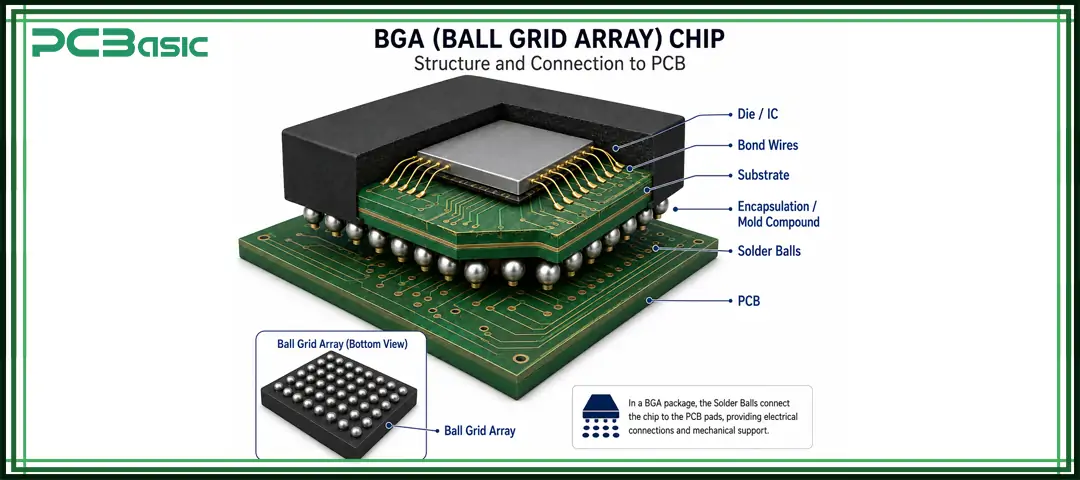
From a manufacturing perspective, a BGA chip is not just an IC with solder balls. It is a complete package structure made up of the die, substrate, internal traces, protective material, and solder ball array. Each part affects how the component performs electrically, thermally, and mechanically during BGA assembly.
This structure allows more I/O connections in a smaller space, which means more electrical connection points are on a tiny chip, so more signals can be transmitted between the chip and the PCB. That is why BGA components are commonly used in advanced electronic products where size, speed, and reliability matter.
A typical BGA chip includes the IC die, substrate, solder balls, internal traces, and protective packaging material. The IC die performs the main electrical function, while the substrate routes signals between the die and the solder balls. During BGA assembly, the solder balls are aligned with the PCB pads and melted during reflow soldering to form permanent electrical and mechanical connections.
In simple terms:
A BGA chip is an IC package that uses solder balls instead of external leads to connect with a PCB.
This design makes Ball Grid Array packaging especially suitable for high-density BGA electronics, including processors, memory chips, communication modules, embedded systems, and industrial control boards.
A BGA chip works by transferring electrical signals from the IC die to the PCB through a grid of solder balls. These solder balls are located on the underside of the BGA package.
The working path is usually:
IC die → bonding wires or flip-chip connection → substrate traces → solder balls → PCB pads → circuit traces on the PCB.
During BGA soldering, the BGA chip is placed on the PCB pads. The board then passes through a reflow oven. Under a controlled temperature profile, the solder balls melt and form solder joints between the BGA package and the PCB.
One benefit of a Ball Grid Array design is self-alignment. When the solder balls melt, surface tension helps pull the BGA chip into the correct position. This does not mean alignment is easy, but it does improve placement reliability when the SMT process is well controlled.
A BGA socket may also be used in some testing, development, or removable-module applications. Unlike permanent BGA soldering, a BGA socket allows a BGA IC to be inserted, tested, or replaced without directly soldering it to the PCB. This is flexible. However, in mass PCBA manufacturing, most BGA components are soldered directly to the board.

The terms BGA chip and BGA package are often used together, but they are not exactly the same.
A BGA chip usually refers to the electronic component itself, especially when people talk about the IC used on a PCB. A BGA package refers more specifically to the packaging structure that uses a Ball Grid Array connection method.
For example, when an engineer says “this board uses a BGA chip,” they may be talking about a processor, memory IC, or controller. When they say “this is a BGA package,” they are usually referring to the physical package type and its solder ball layout.
In PCBA manufacturing, both terms are important:
BGA chip focuses on the component.
BGA package focuses on the package structure.
BGA assembly focuses on mounting the component onto the PCB.
BGA soldering focuses on forming reliable solder joints.
BGA IC is commonly used when referring to the integrated circuit in a BGA format.
For SEO and customer communication, it is useful to include both BGA chip and BGA package, because users may search for either term when looking for technical information or PCBA manufacturing support.
BGA chips are widely used because they solve many limitations of traditional leaded packages.
First, a BGA package supports higher connection density. Because the solder balls are placed under the component, the package can contain more connections without increasing the component size too much. This is important for compact BGA electronics and high-performance PCB designs.
Second, a BGA chip has better electrical performance. Shorter connection paths help reduce inductance and signal loss. For high-speed circuits, this can improve signal integrity and make the design more stable.
Third, BGA components usually offer better thermal performance. The solder ball array and package structure can help transfer heat from the IC to the PCB. In high-power applications, thermal vias, copper planes, and heat sinks may also be used to improve heat dissipation.
Fourth, BGA assembly can improve manufacturing density. More functions can be placed on a smaller PCB area, which is helpful for products with limited space.
Common advantages include:
Higher I/O density
Smaller PCB footprint
Better high-speed signal performance
Improved heat dissipation
Better mechanical stability
Suitable for compact and advanced electronics
Reduced risk of bent leads compared with QFP-style packages
However, these advantages also bring manufacturing challenges. Since the solder joints are hidden under the BGA chip, visual inspection is not enough. This is why X-ray inspection is critical in reliable BGA assembly.

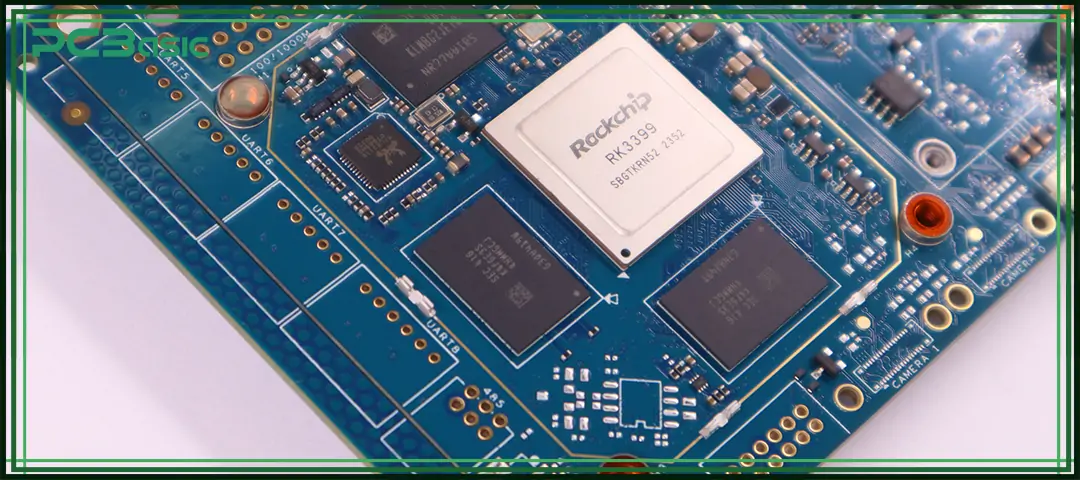
BGA assembly is part of the SMT assembly process. The goal is to accurately place the BGA chip on the PCB and form reliable solder joints between the solder balls and PCB pads.
The typical BGA assembly process includes:
Solder paste printing
SPI inspection
SMT placement
Reflow soldering
X-ray inspection
Electrical testing or functional testing
Rework if required
During solder paste printing, solder paste is applied to the PCB pads through a stencil. For BGA components, stencil design, paste volume, and pad accuracy are very important. Too much paste can cause bridging, while too little paste can cause opens or weak joints.
Next, the BGA chip is placed by a pick-and-place machine. Accurate placement is essential, especially for fine-pitch FBGA or small BGA package designs. Although molten solder can help with self-alignment, the process still depends on equipment accuracy and stable board handling.
Then the PCBA enters the reflow oven. During BGA soldering, the temperature profile must be carefully controlled. If the heating is insufficient, solder joints may not fully form. If the temperature is too high, the BGA chip, PCB, or nearby BGA components may be damaged.
After reflow, X-ray inspection is used to check hidden solder joints under the BGA package. This step is especially important because many BGA defects cannot be found by normal visual inspection.
|
Process Step |
Key Control Point |
Risk if Poorly Controlled |
|
Solder paste printing |
Paste volume and stencil design |
Insufficient solder, bridging |
|
SPI inspection |
Paste height, area, offset |
Hidden soldering risk later |
|
SMT placement |
Placement accuracy |
Misalignment, open joints |
|
Reflow soldering |
Temperature profile |
Voids, cold joints, warpage |
|
X-ray inspection |
Hidden joint quality |
Defects missed before shipment |
|
Testing |
Electrical and functional performance |
Field failure risk |
Because a BGA chip has solder joints hidden under the package, defects can be more difficult to detect and repair than defects on leaded components.
Common BGA assembly defects include:
Voiding means air pockets or gas voids inside the solder joints. Small voids
may be acceptable depending on the standard and application, but excessive
voiding can reduce thermal and mechanical reliability.
Bridging occurs when solder connects two adjacent balls or pads. This can cause
short circuits and functional failure. It may be caused by excessive solder
paste, poor pad design, misalignment, or an incorrect reflow profile.
An open joint occurs when the BGA chip does not properly connect to the PCB pad. This may result from insufficient
solder, pad contamination, poor coplanarity, or warpage.
This defect happens when the solder ball and solder paste touch but do not
fully merge during reflow. It can create intermittent failures, which are
especially dangerous because the board may pass basic testing but fail later.
If the BGA package is not accurately
placed on the pads, some solder balls may not connect correctly. Fine-pitch FBGA packages are especially sensitive
to placement accuracy.
During reflow, the PCB or BGA chip may warp due to thermal stress. Warpage can cause open joints, weak solder
joints, or head-in-pillow defects.
Some BGA components may arrive with
missing, oxidized, or damaged solder balls. Incoming inspection and proper
handling are important before BGA
assembly.
These defects show why BGA soldering is not just a simple placement process. It requires process control, inspection equipment, and experienced engineering support.
X-ray inspection is one of the most important quality control steps for BGA chips. Since the solder joints are located under the BGA package, operators cannot fully inspect them by eye or standard AOI.
X-ray inspection allows engineers to see hidden solder joints and identify defects such as voiding, bridging, missing balls, poor wetting, and abnormal solder shape. For high-reliability BGA electronics, this inspection step can reduce the risk of field failure.
AOI is still useful for checking visible components, polarity, markings, and surrounding solder joints. However, AOI cannot clearly see the solder joints hidden under a BGA chip. That is why X-ray inspection is usually required for reliable BGA assembly.
For complex PCBAs with multiple BGA components, inspection strategy should be planned before production. The manufacturer should understand the BGA package type, ball pitch, board thickness, component density, and testing requirements.
|
Defect Type |
Can Visual Inspection Detect It? |
Can X-ray Detect It? |
|
Surface contamination |
Yes |
Limited |
|
BGA bridging |
Usually no |
Yes |
|
BGA voiding |
No |
Yes |
|
Missing solder balls |
Sometimes |
Yes |
|
Open joints |
Difficult |
Often detectable |
|
Head-in-pillow |
Difficult |
Sometimes detectable |
|
Misalignment |
Sometimes |
Yes |
BGA assembly and BGA reballing are related, but they are not the same.
BGA assembly refers to mounting a new BGA chip or BGA IC onto a PCB during PCBA manufacturing. This is part of the normal SMT production process.
BGA reballing refers to removing old solder balls from a BGA chip and replacing them with new solder balls. This is usually done during repair, rework, or component recovery. Reballing may be needed if a BGA package has damaged solder balls, poor solderability, or needs to be reused after removal.
For new PCBA production, the goal is to avoid unnecessary rework by controlling BGA soldering from the beginning. Rework can be useful, but it also introduces risk. Excessive heating may damage the PCB, nearby BGA components, pads, laminate, or the BGA chip itself.
A BGA socket may be used during development or testing when repeated removal is needed. But for final products, direct BGA assembly is more common because it provides stable electrical and mechanical connection.
Time is money in your projects – and PCBasic gets it. PCBasic is a PCB assembly company that delivers fast, flawless results every time. Our comprehensive PCB assembly services include expert engineering support at every step, ensuring top quality in every board. As a leading PCB assembly manufacturer, we provide a one-stop solution that streamlines your supply chain. Partner with our advanced PCB prototype factory for quick turnarounds and superior results you can trust.
Choosing the right PCBA manufacturer is important when your project includes BGA chips, FBGA, PBGA, or other fine-pitch BGA components.
A reliable manufacturer should have strong SMT process control, accurate placement equipment, reflow profile management, X-ray inspection, and testing capability. They should also understand how to handle different BGA package types and how to reduce risks during BGA soldering.
When evaluating a supplier, ask these questions:
Can they assemble fine-pitch BGA components?
Do they have X-ray inspection for BGA assembly?
Can they provide reflow profile control?
Do they inspect solder paste before placement?
Can they support prototype and batch production?
Do they have experience with BGA IC assembly?
Can they handle rework if a BGA chip defect is found?
Do they provide PCBA testing after assembly?
For high-reliability products, you should not choose a manufacturer only based on price. Poor BGA soldering can create hidden defects that are difficult to detect later. A low-cost assembly supplier may become expensive if the final product fails in the field.
PCBasic supports PCBA manufacturing projects that involve BGA chips, BGA package assembly, SMT placement, reflow soldering, inspection, and testing. For customers using BGA components, process control is especially important because many solder joints are hidden under the component body.
In BGA assembly, PCBasic focuses on key production stages such as solder paste printing, SMT placement accuracy, reflow temperature control, and X-ray inspection. These steps help reduce common risks in BGA soldering, including bridging, voiding, open joints, and poor wetting.
For projects involving FBGA, PBGA, or other compact BGA IC packages, engineering review before production is also important. The PCB pad design, stencil opening, component pitch, board thickness, and thermal requirements can all affect the final assembly quality.
PCBasic can also help customers review manufacturing risks before production, especially when a board contains multiple BGA components, dense layouts, or high-reliability requirements.
A BGA chip is widely used in modern BGA electronics because it offers high connection density, compact size, strong electrical performance, and better thermal characteristics. But these advantages also create manufacturing challenges.
Unlike leaded components, a BGA package hides its solder joints underneath the chip. This makes BGA soldering, inspection, and process control much more important. To build reliable PCBAs with BGA chips, the manufacturer must control solder paste printing, SMT placement, reflow profile, X-ray inspection, and final testing.
If your project includes BGA components, FBGA, PBGA, or other BGA IC packages, choosing an experienced PCBA manufacturer can reduce hidden soldering risks and improve long-term product reliability.
1. What is a BGA chip?
A BGA chip is an integrated circuit package that uses a grid of solder balls on the bottom side to connect with a PCB. BGA means Ball Grid Array.
2. What is the difference between a BGA chip and a BGA package?
A BGA chip usually refers to the component itself, while a BGA package refers to the packaging structure that uses solder balls for PCB connection.
3. What is BGA assembly?
BGA assembly is the SMT process of placing and soldering a BGA chip onto a PCB. It usually requires accurate placement, controlled BGA soldering, and X-ray inspection.
4. What are common BGA types?
Common types include PBGA, FBGA, CBGA, TBGA, and flip-chip BGA package designs. PBGA is widely used in many electronic products, while FBGA is common in compact, fine-pitch applications.
5. Why is X-ray inspection needed for BGA chips?
X-ray inspection is needed because the solder joints of a BGA chip are hidden under the package. X-ray can help detect voids, bridging, missing balls, and other hidden BGA soldering defects.
6. Do BGA chips need solder paste?
Yes. In most SMT processes, solder paste is printed onto the PCB pads before the BGA chip is placed. During reflow, the solder paste and solder balls form the final joints.
7. What is a BGA socket?
A BGA socket is a connector used to hold a BGA IC without permanently soldering it to the PCB. It is often used for testing, development, or replaceable module applications.
8. Can BGA chips be repaired?
Yes, some BGA chips can be repaired or replaced through BGA rework or reballing. However, rework requires careful temperature control to avoid damaging the PCB, pads, or nearby BGA components.

Assembly Enquiry
Instant Quote


Phone contact

+86-755-27218592
In addition, we've prepared a Help Center. We recommend checking it before reaching out, as your question and its answer may already be clearly explained there.
Wechat Support

In addition, we've prepared a Help Center. We recommend checking it before reaching out, as your question and its answer may already be clearly explained there.
WhatsApp Support

In addition, we've prepared a Help Center. We recommend checking it before reaching out, as your question and its answer may already be clearly explained there.
