
Global high-mix volume high-speed PCBA manufacturer
9:00 -18:00, Mon. - Fri. (GMT+8)
9:00 -12:00, Sat. (GMT+8)
(Except Chinese public holidays)





HomePage > Blog > Knowledge Base > The Comprehensive Guide to 4 Layer PCB
Modern electronics are described as becoming smaller, faster, and more capable simultaneously. Therefore, circuit board design is faced with greater difficulties compared to previous eras. Engineers are challenged with spacing limitations, signal integrity problems, and heat dissipation complications when working on dense layouts. The miniature sizes of smartphones make performance a more important consideration in minimalist circuit design. It becomes much more challenging to accommodate all of the required design constraints in one circuit board layout.
This explains the use of a four-layer PCB design. Expected results include enhanced signal integrity, better power distribution, and improved performance.
A four-layer PCB consists of four layers of copper with an insulating layer between each pair. The difference from a single and double-layer PCB is that a four-layer PCB provides more efficiency when it comes to designing circuits since there are more layers which help to make better use of them electrically.
Typically, the outer layers (top and bottom) will be used for components and routing, whereas the inner layers will serve as power and ground planes, respectively. Such a design helps to stabilize the voltage in the system and reduces electromagnetic interference (EMI). Having such a design also allows functional separation between signal routing and power distribution, improving overall design reliability.
Such a layer arrangement is known as a four-layer PCB stack-up.
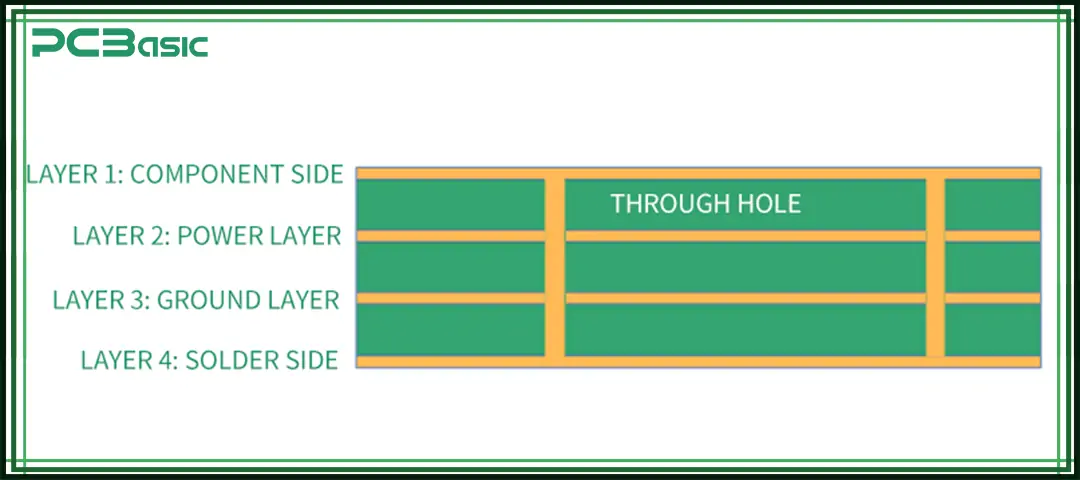
However, for a four-layer design, the signal traces should be placed right on the top of the reference layer, which implies the need for proximity between the two types of layers. In this way, it will be possible to reduce loop area, suppress electromagnetic interference (EMI) while ensuring effective transmission of signals at the same time.
Taking into account the positioning of components on the PCBs, it is necessary to take into account the routing after placing signals. Needless to say, the main requirement regarding the matter is to ensure appropriate spacing, trace route length, and proper routing topology to avoid crosstalk. However, for high-speed signal design, it is crucial to ensure proper impedance control.
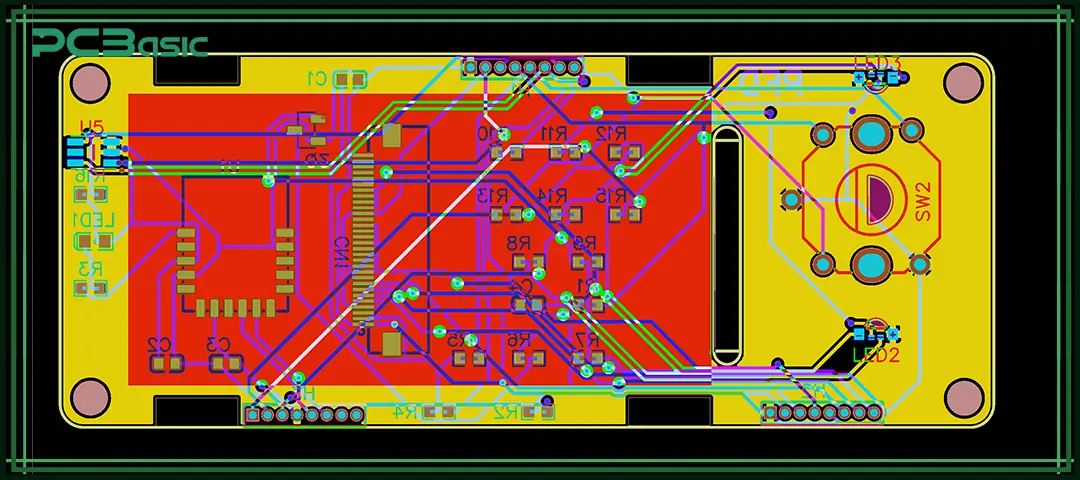
At the same time, another highly significant issue of circuit board design, which should not be overlooked, relates to thermal management. Thus, it is important to position components adequately and facilitate their cooling through thermal vias, copper pours, and other approaches. Besides, it is necessary to ensure the manufacturability of the circuit board.
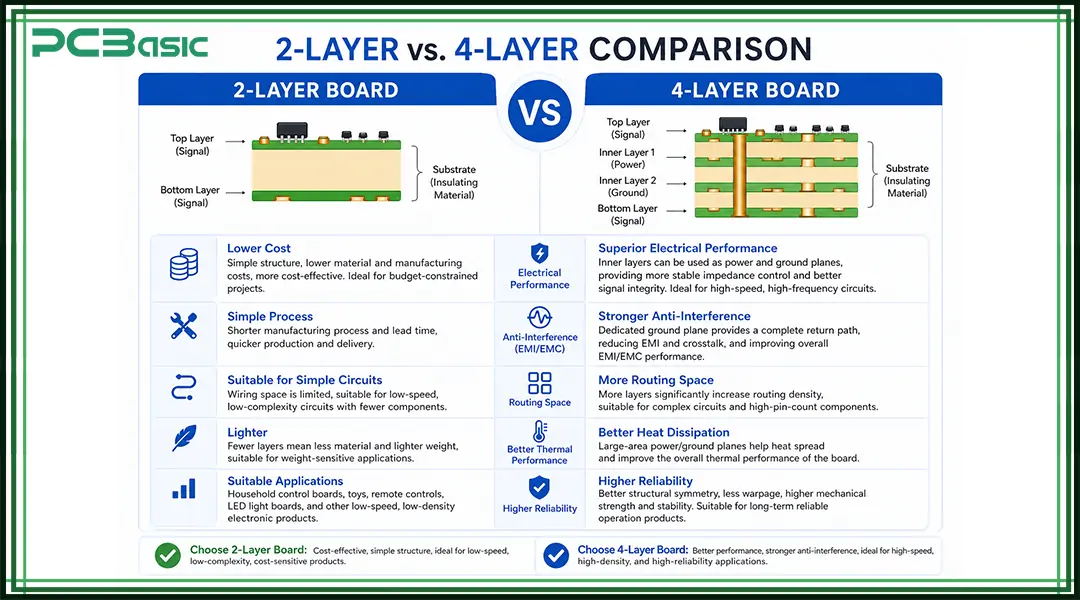
Another benefit of designing a four-layer PCB is its great performance capabilities. In case the PCB includes dedicated power and ground planes, then due to the use of these planes, it will be possible to achieve higher performance compared to two-layer PCBs since the signals exhibit better integrity and lower noise in the circuit.
Apart from the high performance capabilities, there is one more feature of a four-layer PCB which deserves attention – improved routing efficiency. Due to the greater number of layers in such PCB design, it is possible to increase the efficiency of the organization of traces and wires. Combining the ability to transmit signals faster with high organizational efficiency results in increasing the reliability of PCB; therefore, it will be possible to make fewer mistakes and debug the board more easily.
At last, there are a lot of benefits regarding the durability of the device manufactured with the help of a four-layer PCB stackup. Firstly, such a board is more resistant to external conditions that can affect it negatively, and secondly, with the help of this technology, it is possible to invent new technologies aimed at the development of more compact electronic devices. Although the initial cost of the PCB seems rather high, it can reduce redesign and debugging costs in complex designs.
Comparing the production process of a two-layered PCB with a four-layered one, we can say that the latter involves several more steps. However, knowledge of the process will allow understanding of the advantages of such a board.
Firstly, it should be stated that the first step in the manufacture of a four-layer PCB is designing the board. It is usually carried out with the help of a computer-aided design program, where designers draw a circuit board, its stack-up, and routing. It is crucial to pay close attention to this stage because any mistake in designing affects further work.
Then, the second stage involves processing the inner layers. In the case of a four-layer PCB, it means the processing of power and ground planes. Thus, a copper-clad laminate is used, where unnecessary parts are removed via photolithography and chemical etching. It should be mentioned that both layers have to be tested separately before moving to the next stage.
Then, the next step is the bonding of layers. Prepreg is used, which is a kind of fiberglass material covered with a special resin. Thus, the process is conducted at high temperature and under great pressure in a vacuum lamination press.
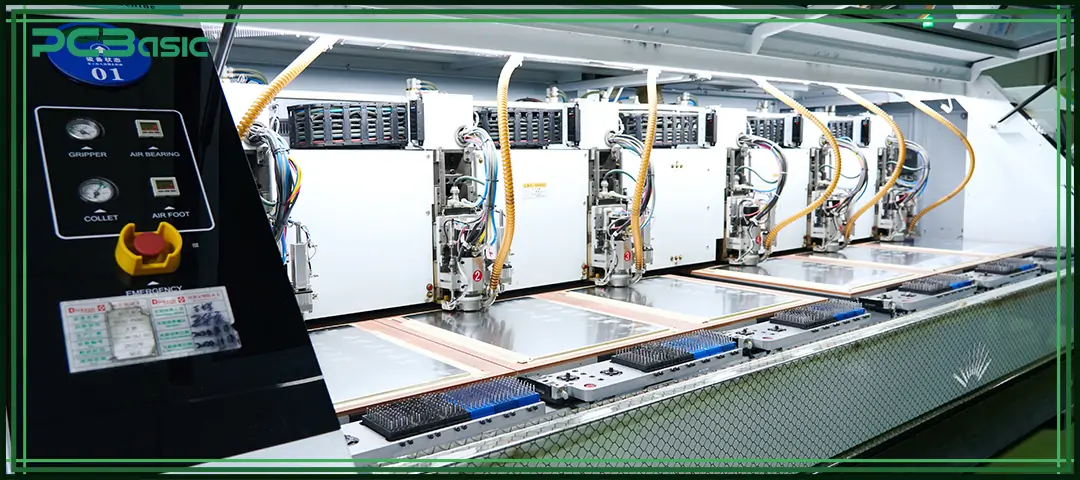
Then, holes have to be drilled through layers in order to form connections between them. Next, they are electroplated with copper in order to make the conduct of the current through the boards possible.
When the process described above is carried out, outer layers are patterned through imaging, copper plating, and etching. Then, a solder mask is applied in order to protect copper from oxidation and avoid solder bridges. Finally, silkscreen is printed onto the board.
It remains to carry out testing of the board. It implies electrical testing when all short circuits or problems with connections are fixed. Besides, some manufacturers also perform impedance testing.
The four-layer printed circuit board is ideal for modern high-performance electronic devices that are highly compact. The common uses of such printed circuit boards include cell phones, laptop computers, telecommunications, industrial machines, cars, medical devices, and networking equipment.
Mobile phones and tablet devices are highly compact and thus need separate power planes to ensure reliable high-speed and wireless communication. Laptop computers need highly effective power distribution networks (PDN) across power and ground planes due to their compact casing.
Industrial control and machine equipment can make use of continuous ground planes to reduce electromagnetic interference (EMI). Car electronics use 4-layer boards for reliability in varying weather conditions and many different devices. Medical precision equipment requires highly reliable boards.
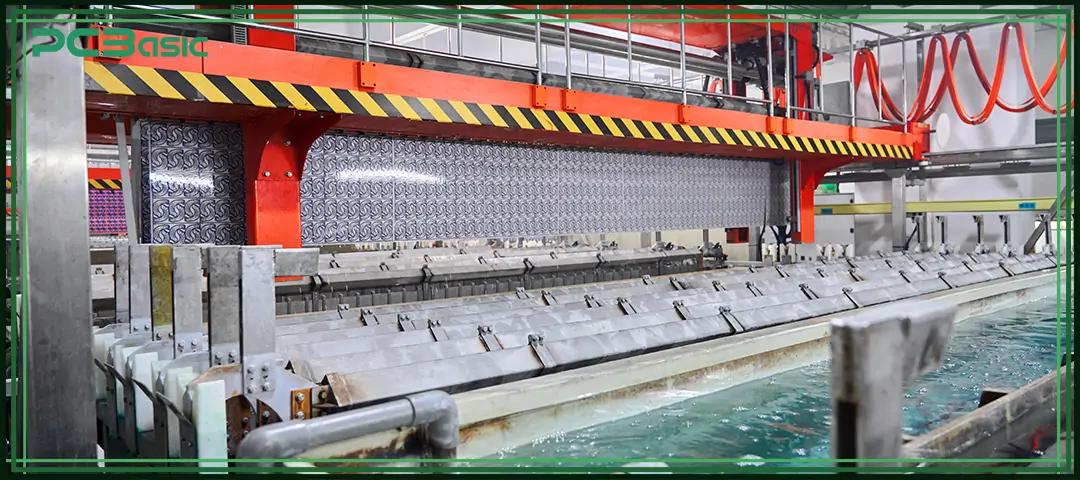
Even though it is assumed that the four-layer printed circuit board should have high quality and a strong structure, errors might be made during the process of designing the circuit, which would result in making the board non-functional. Those errors that should be avoided in the designing phase of a four-layer printed circuit board are:
·Poor choice of stack-up. It is important to choose the board type and its layers before considering the signals, since otherwise return paths become longer, increasing loop inductance and EMI risk.
·Ignoring the impedance value. Since impedance depends on trace width, distance thickness between layers, material properties (Dk), and stack-up configuration, it should be calculated accurately.
·Poor via design. Incorrect placement of the vias causes interruptions in the ground plane and disrupts return current paths. On the other hand, correct via location makes the system work properly.
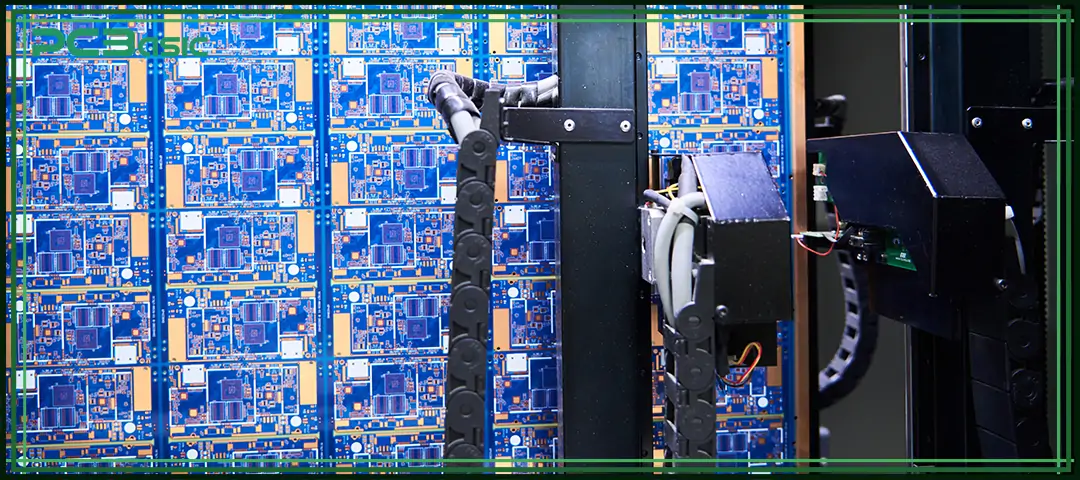
The selection of the right manufacturing company should not be considered as only a transactional purchase. It should be seen as the search for a supplier that has the necessary abilities and expertise across key stages of the manufacturing process, including the ability to produce multilayer printed circuit boards.
It is crucial to understand that a quality control system is the most important element of a reliable manufacturer. Good manufacturers always have top-notch testing and inspection tools. It would be useful to cooperate with the manufacturer who would be willing to build up the communication and give technical assistance during the entire design process. It is reasonable to select the manufacturer that has experience in handling such material and stackup configurations.
Undoubtedly, some issues could arise while cooperating with the manufacturer. Still, a reliable manufacturer strives to fulfill its duties punctually; hence, the occurrence of issues would be low.

Four-layer PCBs allow saving money when producing new electronics since multi-layering technology can be more cost-effective in complex designs by reducing routing difficulty, EMI issues, and rework. Effective connection of conductors and other components is very important to develop compact electronic devices in the present day. By using proper technology, a four-layered PCB will allow receiving desirable results by applying current technologies.
The four-layered technology works well when reliability, size, and cleanliness of signals are crucial to receive good results. Four layers make up a balance between architectural complexity and economic costs.

Assembly Enquiry
Instant Quote





Phone contact

+86-755-27218592
In addition, we've prepared a Help Center. We recommend checking it before reaching out, as your question and its answer may already be clearly explained there.
Wechat Support

In addition, we've prepared a Help Center. We recommend checking it before reaching out, as your question and its answer may already be clearly explained there.
WhatsApp Support

In addition, we've prepared a Help Center. We recommend checking it before reaching out, as your question and its answer may already be clearly explained there.

