
Global high-mix volume high-speed PCBA manufacturer
9:00 -18:00, Mon. - Fri. (GMT+8)
9:00 -12:00, Sat. (GMT+8)
(Except Chinese public holidays)





HomePage > Blog > Knowledge Base > What NDA and Quality Controls Does PCBA Contract Manufacturing Need?
Table of Contents
1. What Must the Contract Fix Before the First Build?
3. Which Quality Records Should the Buyer Require?
4. How Should Changes and Traceability Be Controlled?
5. Should the PCBA Contract Manufacturer Be Offshore or Regional?
You confirmed the prototype. The bench test was fine, and the first few boards were also normal. But when it came to the next batch, one capacitor was replaced with a substitute material. The test limits used by the production line were inconsistent with the version previously confirmed by the engineers. Even when one board was returned from the client, no one could immediately determine which batch of materials it actually used. Sound familiar? Such situations are not uncommon in PCBA contract manufacturing.
The problem may not lie in the soldering or assembly itself. More often, it is the unclear responsibility boundaries, change processes, and record requirements between the buyer and the manufacturer. Therefore, before the first formal production, both parties need to confirm not only the price and delivery date, but also who has the authority to approve the substitute materials, which design files and BOM information need to be kept confidential, which records need to be retained for inspection and testing, and how each batch of products can be traced back to the corresponding design version and production history. These controls determine whether a "working prototype" can truly become stable and repeatable production.
This article focuses on the NDA, quality records, change management, and traceability requirements related to assembled boards in the PCBA contract manufacturing process. Bare PCB manufacturing belongs to another independent manufacturing scope, and its defect types, acceptance standards, and supplier requirements are also different.
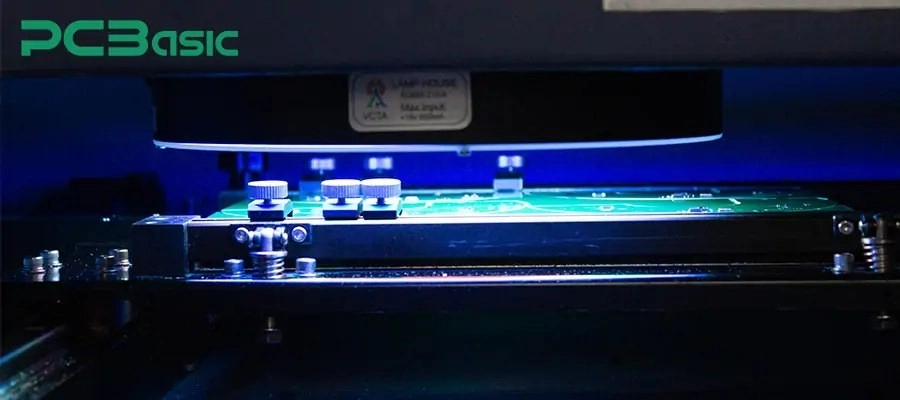
A label such as turnkey or consigned says almost nothing about where responsibility changes hands. Two projects can carry the same label and produce very different exposure, because the label does not state who buys each part, who approves a deviation, or who keeps the evidence afterwards.
The supplier side is easiest to define as a list of tasks, not as a service name. For an assembled board, that list normally covers component sourcing, solder paste printing and placement, reflow and wave soldering, inspection, functional testing, and the release records agreed for shipment. A PCBA contract manufacturer that writes those tasks into the quotation is easier to audit than one that answers with a service label.
PCBasic describes a one-stop manufacturing flow that runs from design support through SMT and DIP assembly, testing, final assembly, and burn-in testing. Components are sourced through original manufacturers and authorized first-tier distributors, and BOM import is part of the quotation workflow. Production is supported by self-developed IQC incoming-material inspection, first-article inspection, and digital management systems that include MES, ERP, IoT, and ESD control.
Those systems matter for one reason: they make the supplier's half of the boundary checkable. A quotation that says only "assembly included" leaves the buyer guessing which steps are inside the price and which arrive as a change order. The wider picture of electronic manufacturing services puts that boundary in context when a program spans more than one production stage.
The buyer keeps the decisions that define what "correct" means. The approved design revision, the performance requirements, the regulatory obligations, and the final release decision do not transfer with the service label.
Two controls deserve to be written down before the first purchase order. A written scope of PCBA manufacturing services settles the sourcing rule first: which parts the supplier may buy freely, which must come from a named distributor, and what happens when a part is short. The substitution rule follows: who may propose an alternate, what data must accompany the proposal, and who signs it off. A substitution approved verbally during a shortage is the same as no rule at all.
A practical input list for the first build includes the released Gerber set, the current BOM with manufacturer part numbers, reference designators and package requirements, the approved stack-up, the test specification and limits, and which parts or processes remain customer-directed.
Confidentiality is the first control to settle, because design files, BOM data, and process parameters move before any purchase order does. A generic clause that promises "confidential treatment" leaves both sides unable to say what is protected.
The definition is what makes the rest of the agreement usable. It should identify the covered information and include material passed verbally, not only files sent as attachments. Authorized use belongs in the same clause, so the manufacturer may evaluate and build the product without holding a general license to the design.
A schedule attached to the agreement can carry the specifics: Gerber and stack-up data, the full BOM with manufacturer part numbers, mechanical drawings, test specifications and limits, fixture and stencil data, sample board photographs, process parameters developed for the product, and any firmware or configuration handover. Each entry should be marked with the purpose it serves and the people allowed to see it.
Breach handling belongs in the same section: what the manufacturer must do if protected information is exposed, who is notified, and what remedy the buyer can rely on.
Origin changes the access question. Cross-border PCBA contract manufacturing may involve multiple teams, sites, suppliers, or shifts, which makes “employees only” an incomplete access-control rule.
The workable version names who may open which files, limits access to the people who need the data, and sets expectations for equipment use and copies. It also says what happens at the end of the program: whether the manufacturer returns or destroys the information, and how the buyer can confirm that step was completed. A survival period keeps the duty alive after the last shipment instead of expiring with the purchase order.
Acceptance disputes rarely start with a bad process. They start with an undefined record. If the buyer never fixes which inspections run and which results are recorded, the supplier can meet the purchase order and still leave the buyer without the evidence needed for warranty, complaint, or field investigation.
Incoming inspection answers a narrow question: is what arrived the part that was specified? A useful incoming-inspection record should identify the lot, part number, inspection result, and the responsible operator or inspection station where applicable. For parts with handling requirements, the same record set should show that storage and preparation steps were followed before the material reached the line.
First-article approval is the gate between setup and routine production: Where first-article approval is required, routine production should begin only after the first article has been verified against the approved revision. A useful agreement states what the first article covers, what happens if it fails, and what evidence is retained when it passes.
The record set behind these two gates - incoming material inspection, first-article approval, and the quality control system that holds them - is what makes the requirement enforceable rather than aspirational.
The equipment route is worth naming in the agreement. Incoming-material inspection and X-ray component counting sit in the warehouse, SMT lines run SPI solder paste inspection with online AI AOI and X-ray inspection, and DIP runs pre-wave and post-wave AI AOI inspection before depaneling. Naming the stage where each check happens makes it obvious which records the buyer should expect for a given board.
A PCBA manufacturing process is easiest to audit when each stage is tied to the record it produces: material and first-article approval gate the start; Solder-paste printing may generate SPI records, assembly stages may generate AOI records, and X-ray results may be retained where hidden-joint inspection is required; through-hole assembly and wave soldering produce the applicable insertion, inspection, and soldering records, and final test and pre-shipment QA release the lot. A certification clause answers two different questions. Management-system certifications such as ISO 9001, IATF 16949, ISO 13485, ISO 14001, and ISO 45001 describe aspects of the manufacturer's certified management systems. UL certifications or recognitions, where applicable, relate to specific products, components, materials, or manufacturing scopes. Neither type automatically certifies the buyer's finished product.
In-process inspection catches defects while the board can still be corrected cheaply. The documented PCBA route covers solder paste printing, SPI or visual inspection of the deposit, placement, pre-reflow inspection, reflow soldering, AOI inspection, rework, and an SMT-stage quality check before the board moves to wave soldering and final assembly.
Test coverage is the second half of the record set. At the end of the line, the documented route runs visual inspection, functional testing, rework where required, and a pre-shipment QA inspection before the boards are packed. The agreement should state the test conditions and limits, who supplies the fixture or test program, and what a failed board is allowed to do next. Covering those conditions in the functional testing plan keeps acceptance tied to the approved revision instead of the sample that happened to work.
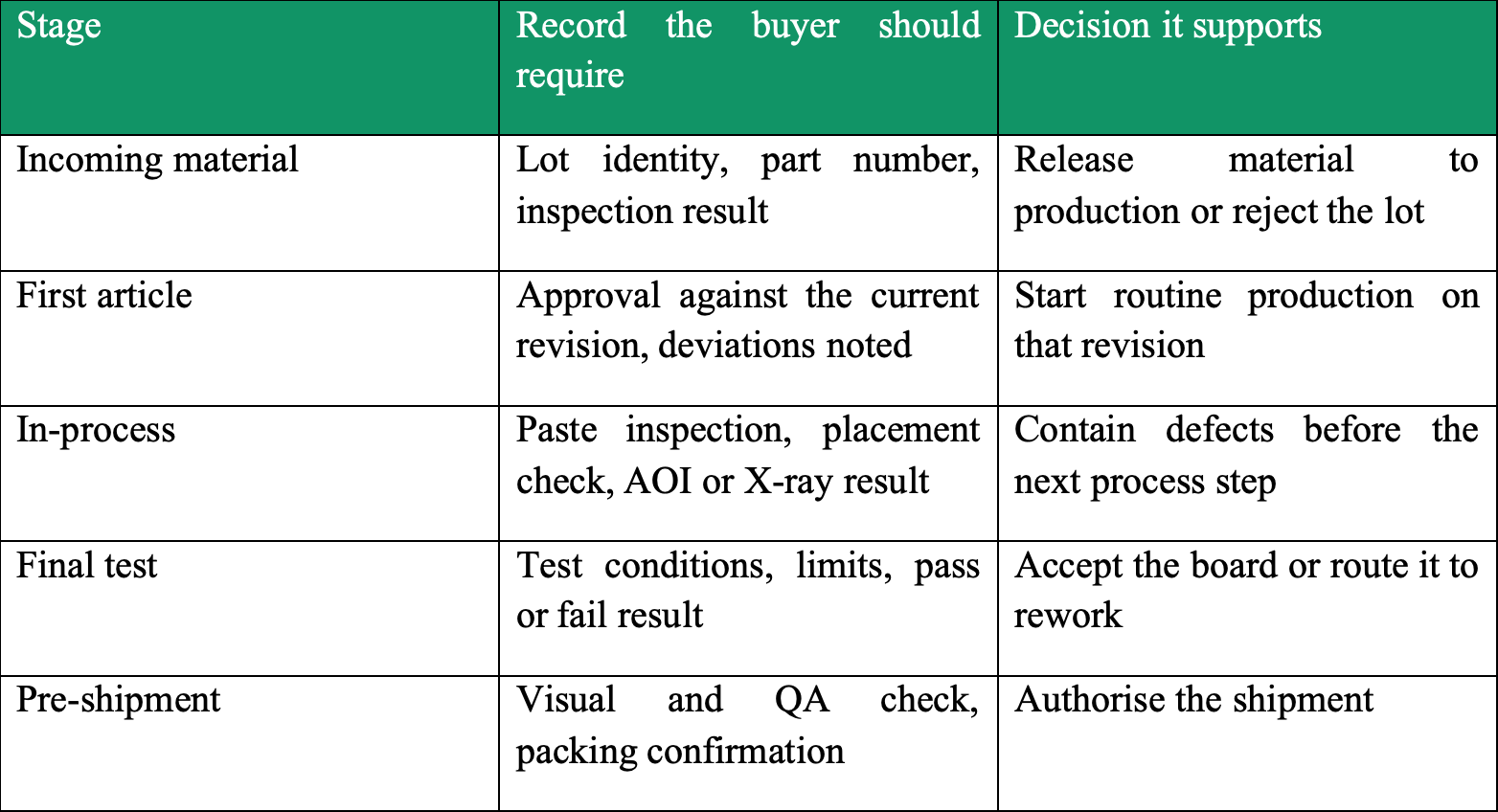
Repeat production fails when the shipped lot cannot be tied back to the revision that was approved. Two controls prevent that: a change route and a record set.
A change rule should answer four questions: who may propose the change, what technical data must accompany it, who approves it, and what has to be re-qualified afterwards. The last question is the one buyers most often skip. Replacing a capacitor with a different supplier can be harmless or can change the thermal behavior of the assembly, and only a defined re-qualification step separates the two cases.
BOM error-checking and first-article inspection are the two points where a revision is verified rather than assumed. A practical agreement should define which changes trigger renewed first-article approval or other requalification activities. Component, supplier, process, fixture, or test-limit changes should not enter a shipped lot until the required review and approval have been completed.
Traceability is only useful when it points at something. The record set should connect each shipped unit or lot to the incoming material, the process route, the test result, and the revision of the documentation it was built against.
PCBasic records production activity through a self-developed MES, an IQC incoming-material inspection system, a first-article inspection system, and a sample board photo system. Order placement and production-process tracking and traceability run through the digital management system, and samples, small batches, and volume production use dedicated lines.
Those records still need a retention rule. Identify how the lot is marked, which records are kept, where they are stored, and how long they stay available, so a field question can be answered months later instead of reconstructed from memory.

Origin is not a quality verdict. It decides how the earlier controls can be verified, and it changes audit access, factory review, and continuity more than solder quality.
A buyer who needs to stand on the line before a program starts is choosing a different supplier profile than one who reviews documents only. A manufacturer based in the eastern United States shortens travel for a first-article review or a problem visit; an offshore site may require planned trips and a documented remote-review process instead. Either can work, but the expectation has to be written down rather than assumed at the moment a problem appears.
Ask what access is granted, how far in advance a visit has to be arranged, which records can be reviewed remotely, and who hosts the review; an agreement that describes a visit but not a deadline for arranging it tends to fail when a line is down.
Continuity covers the boring risks: replenishment, packaging, shipping method, and what happens if the site or line changes. A regional supplier shortens the reaction time when a batch has to be corrected. A distant supplier may need a buffer quantity, a defined shipping method, and a faster communication loop to keep the same schedule.
The practical question is not which origin is cheaper on paper, but which one keeps the earlier controls intact - inspection, change approval, and traceability - when a shortage, a schedule slip, or a field issue appears.
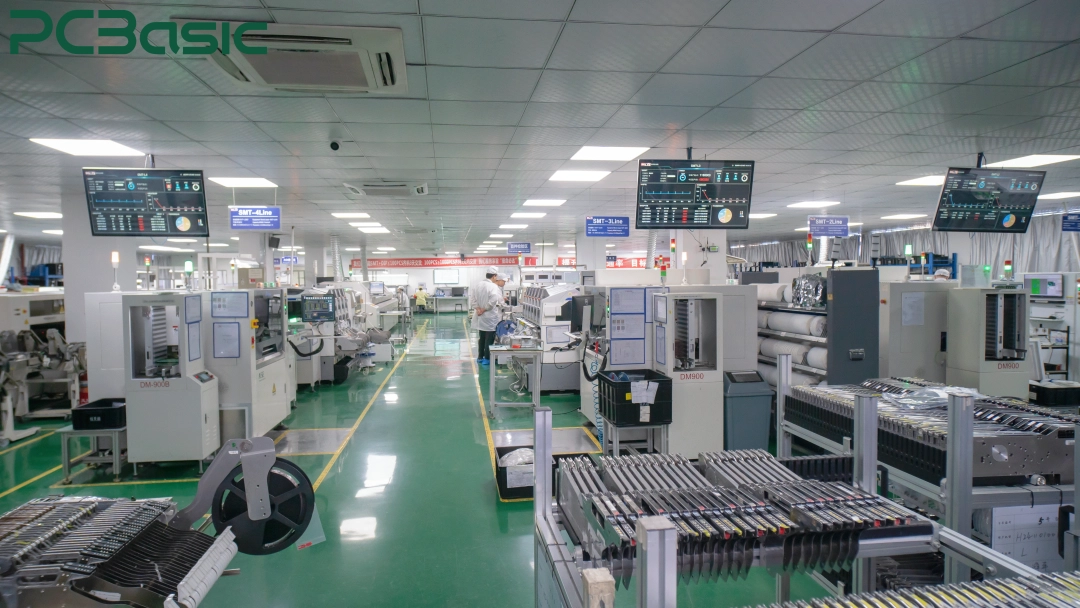
The controls are not exotic: NDA coverage, sourcing and substitution rules, a defined inspection and test record set, a written change route, and a traceability rule that survives the shipment. Once they are fixed, the outsourcing decision becomes a comparison of suppliers against one checklist instead of a comparison of service descriptions.
Before the first build, write that checklist into the project documents, send it with the current Gerber and BOM, and ask each supplier to confirm the boundary it accepts. Buyers who want to take the next step can review the turnkey PCBA assembly path and request a quote based on the exact scope of sourcing, assembly, testing, and support required for their project.
Q1: What should an NDA cover in a PCBA contract manufacturing agreement?
A1: It should define the covered information, including material passed verbally, and list the files in a schedule - Gerber data, the full BOM, drawings, test specifications, fixture data, and process parameters developed for the product. It should also state the authorized use, limit who may access the information, and set out what happens on breach and after the project ends.
Q2: Which quality records should a buyer require before approving mass production?
A2: Require the incoming-material inspection result, the first-article approval against the current revision, the in-process inspection records, the functional test conditions and results, and the pre-shipment QA check. Approving those records before routine production starts means the acceptance decision rests on evidence instead of on the sample that happened to work.
Q3: What traceability records should be retained for a shipped PCBA lot?
A3: Keep the link between the shipped lot and its incoming material, process route, test result, and the revision the boards were built against. Agree on how the lot is marked, which records are stored, and how long they stay available, so a field question can be answered later without rebuilding the history from shipping paperwork.

Assembly Enquiry
Instant Quote


Phone contact

+86-755-27218592
In addition, we've prepared a Help Center. We recommend checking it before reaching out, as your question and its answer may already be clearly explained there.
Wechat Support

In addition, we've prepared a Help Center. We recommend checking it before reaching out, as your question and its answer may already be clearly explained there.
WhatsApp Support

In addition, we've prepared a Help Center. We recommend checking it before reaching out, as your question and its answer may already be clearly explained there.
