
Global high-mix volume high-speed PCBA manufacturer
9:00 -18:00, Mon. - Fri. (GMT+8)
9:00 -12:00, Sat. (GMT+8)
(Except Chinese public holidays)





HomePage > Blog > Knowledge Base > The Crucial Role of Precision in Elevator Control PCB Assembly
Table of Contents
1. Where Does Precision Matter Most in Elevator Control PCB Assembly?
2. Why Should Material and First-Article Control Come Before SMT?
3. How Do SPI and AOI Control Different Assembly Risks?
4. Why Do Mixed SMT and Through-Hole Parts Need Separate Attention?
5. When Is X-Ray Necessary, and When Is It Not Enough?
6. Why Does Functional Testing Matter After the Board Looks Correct?
7. How Can Buyers Keep Precision from Dropping After the Prototype?
8. Conclusion: Why Does Precision Matter Beyond the First Build?
Have you ever seen this happen? The first batch of prototypes works perfectly, but when it came to subsequent production, occasional problems began to occur. For ordinary electronic products, such problems are already troublesome, but the impact can be even greater with elevator control boards.
The elevator control board needs to continuously receive sensor and button signals, process control logic, communicate with other units and drive outputs. Therefore, in elevator control PCB assembly, precision is about much more than placing components in the right position. Material control, soldering, inspection, functional testing, and production records all play a part.
For buyers, the more important question is not "can this prototype work now", but whether the next batch, and the batch after that, can maintain the same quality. A reliable industrial control PCB assembly process should make that consistency repeatable, measurable, and easier to trace when something goes wrong.
An elevator control board usually integrates components such as logic circuits, communication interfaces, power modules, relays, terminal blocks, and field I/O. The tricky part is that each area can fail in a different way. For instance, a slight deviation of passive components may affect the soldering quality, a connector not being fully in place may cause unstable contact, and even if a relay appears to be normal in appearance, the solder joints in the bottom through-holes may still have issues.
That is to say, the precision in the assembly of the elevator control PCB is not guaranteed by a single process. The industrial PCB assembly process should conduct inspections and controls for different risks at different production stages. The following table lists several common risks and the more appropriate inspection and control methods for each.
|
Risk area |
Useful control |
What the buyer should expect |
|
Wrong or mixed components |
IQC, BOM checking, first article verification |
Correct part identity and revision |
|
Solder paste variation |
Stencil control and SPI |
Stable paste deposit before placement |
|
SMD placement error |
Placement control and AOI |
Position, polarity, missing-part checks |
|
Hidden joints |
X-ray when required |
Visibility beyond surface inspection |
|
Relay, connector, terminal joints |
Through-hole assembly and inspection |
Stable mechanical and electrical joints |
|
Logic and interface faults |
Functional testing |
Board behavior under defined conditions |
|
Repeat-build drift |
MES and production records |
Traceable process and rework history |
Many of these controls actually need to be completed before the component mounting process begins. Production files, BOM versions, approved substitute materials, test requirements, and critical components should all be confirmed before the circuit board is sent for SMT.
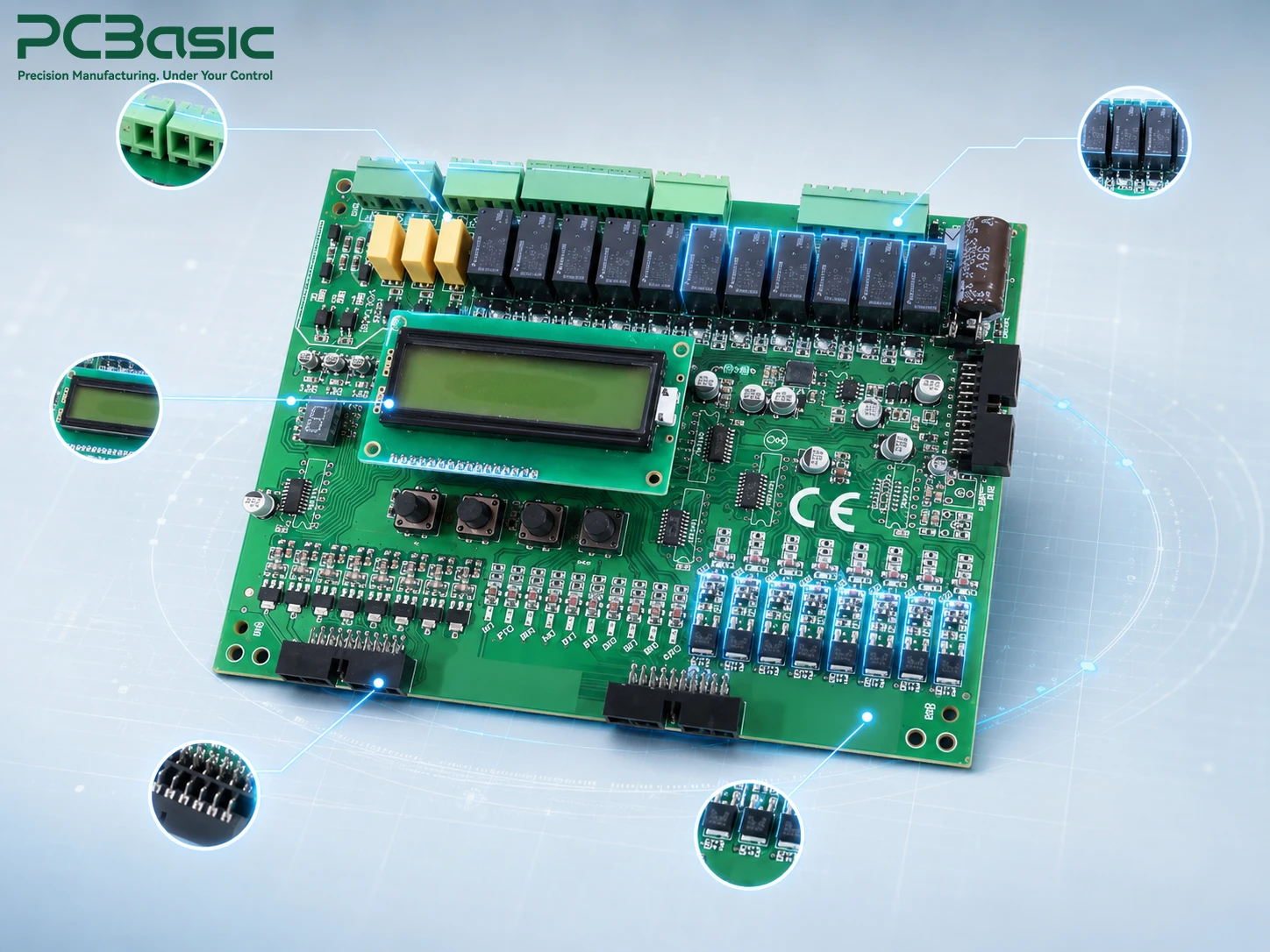
Some problems that seem to be caused by soldering actually originated long before the SMT process. For instance, using incorrect components, unapproved substitutes, moisture exposure, or discrepancies between production materials and the latest design version.
For industrial PCB assembly projects, components need to be confirmed and managed before entering the production process. ESD-sensitive components require anti-static treatment as per the requirements, while hygroscopic components need to be dried and stored according to their packaging status, exposure time and MSL requirements. In some cases, they may also need to be baked.
PCBasic manages materials through methods such as incoming inspection by IQC, intelligent warehousing, drying cabinets, ESD control and X-ray component counting. The production system also checks the BOM. These controls help catch wrong parts, mixed materials, and material-condition issues before assembly starts, instead of waiting until the finished boards need troubleshooting.
The first article is the very first step in converting design data into an actual PCBA. Before the rest of the batch continues, the manufacturer can confirm through the first piece whether the component part numbers, values, orientation, placement, and process settings are consistent with the production data.
PCBasic uses an self-developed first-article inspection system and records relevant production data through MES. For control board assembly, when the PCB version, BOM, mounting data, or process changes, or when approved substitute materials are used, reconfirming the first article can help identify problems promptly and prevent errors from continuing into subsequent batch production.
The PCB assembly service process gives buyers a practical view of how preparation, assembly, inspection, and test can be linked.
SPI and AOI are not interchangeable. They inspect different stages and answer different questions.
The application of solder paste before component mounting can affect the subsequent soldering quality. Insufficient solder paste may lead to false soldering or open circuits, while excessive solder paste will increase the risk of bridging. For fine-pitch components, the amount of solder paste and the uniformity of its application are particularly important.
PCBasic uses 3D SPI for detecting solder paste printing in SMT production and discovers abnormal solder paste quantity, position or shape before mounting. This enables timely adjustments before the problem enters the mounting and reflow soldering process, thereby reducing subsequent soldering defects.
AOI is mainly used to detect missing components, component placement deviations, polarity errors, and visible welding abnormalities. PCBasic uses AOI for inspection after SMT reflow soldering. Appearance inspections for through-hole assembly and wave soldering processes are also scheduled accordingly.
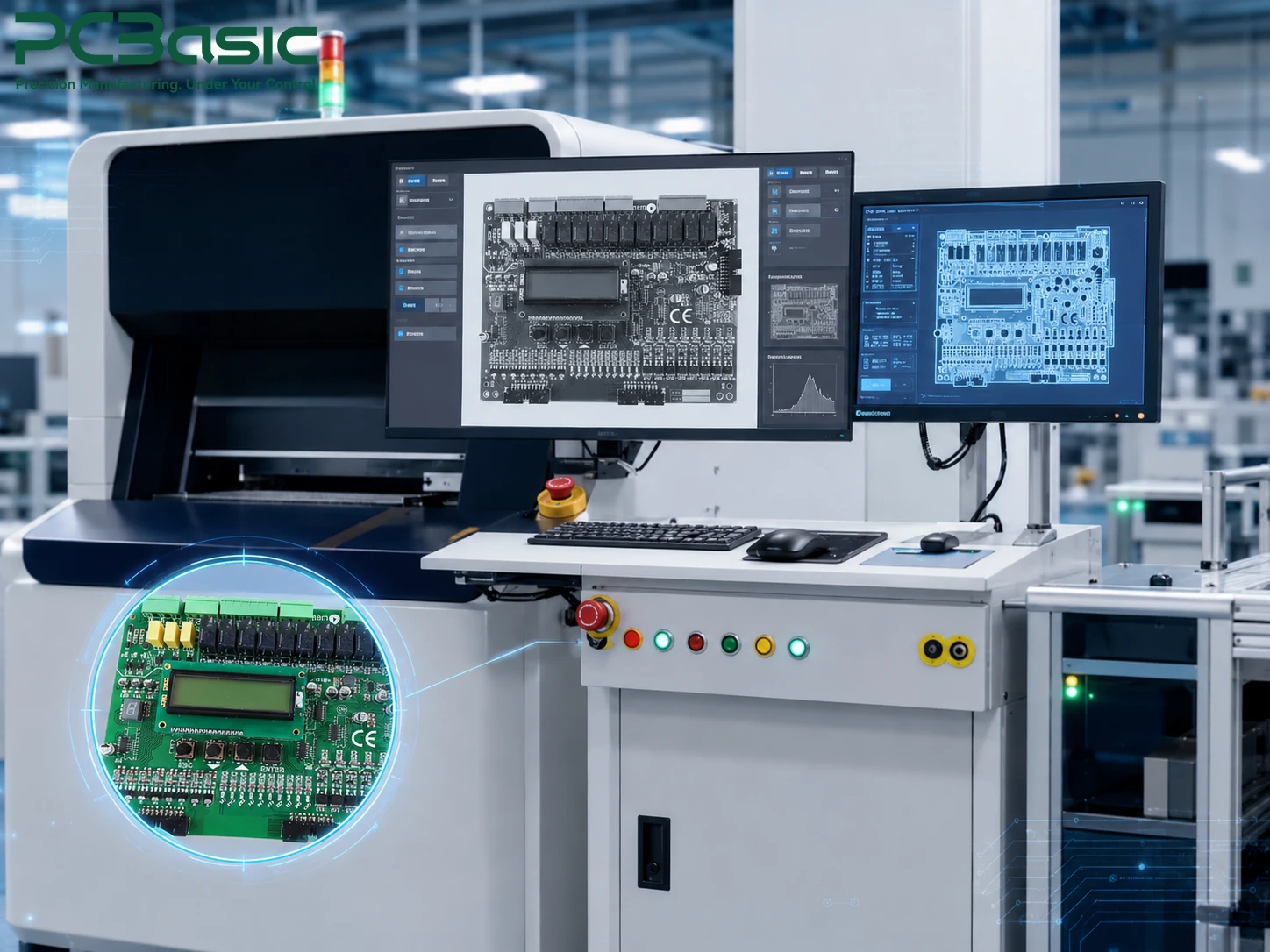
However, AOI can only detect surface-visible issues. For the assembly of elevator control PCBs, whether the hidden solder joints are reliable and whether the communication interfaces are functioning properly cannot be confirmed solely by AOI. Therefore, AOI is an important part of quality control, but it cannot replace X-ray or functional testing.
The elevator control board usually does not only contain SMD components. Connectors, relays, terminal blocks, and other components that require higher mechanical strength are often installed using through-hole mounting. This also means that during the production process, different risks brought by SMT and through-hole assembly need to be considered simultaneously.
As a result, an industrial control PCB may go through multiple stages such as solder paste printing, SMT assembly, reflow, through-hole insertion, wave soldering, touch-up, and final inspection. PCBasic supports SMT, through-hole/DIP assembly, testing, and final assembly, and its PCBBA production process also includes wave soldering.
For buyers, what really deserves attention is not just whether the supplier "can do SMT", but how it connects and controls the SMT and through-hole processes. For example, whether the connectors are installed properly, whether the board needs jig support, whether the welding position is easy to operate, and how to check and handle rework after wave soldering.
If the project involves mixed assembly, industrial I/O, communication interfaces, and functional testing, then the supplier's industrial PCB assembly capability is usually more worthy of attention than just the assembly capacity.
X-ray is valuable when solder joints are hidden under a package and cannot be judged from the surface. PCBasic has 3D X-ray inspection equipment in its manufacturing configuration and includes X-ray within its quality-control flow.
But X-ray cannot confirm that floor logic is correct, that a communication interface works as intended, or that an output changes correctly when the right input is applied. Those are electrical and functional questions.
This is an important distinction in industrial PCB assembly: inspection asks whether the assembly appears to have been built correctly; testing asks whether the board behaves correctly.
A control board may pass visual inspection and still fail in a real system. Power rails can be wrong. An input channel may not be read correctly. A relay output may fail to switch. A communication interface may not respond.
The test plan should come from the actual board function. Depending on the design, checks may include power-up behavior, current consumption, key voltage rails, digital or analog I/O, relay outputs, communication ports, programmed functions, and selected fault conditions. The limits should come from the customer's design and test specification, not from a generic elevator template.
PCBasic supports board-level and system-level functional testing and can develop test fixtures for PCBA projects. Its one-stop manufacturing scope also covers PCB fabrication, component sourcing, SMT, DIP, test, final assembly, and burn-in testing. Buyers who need more than optical inspection can review PCBA functional testing.
This is where the industrial PCB assembly process becomes tied to application behavior. A supplier should be able to explain which defects are screened by process inspection and which require electrical or functional test.
A prototype can work and the next batch can still fail if the production baseline is loose. Repeatability needs a controlled handoff from engineering to manufacturing.
Before the pilot production begins, the buyer and the manufacturer should first confirm the PCB version, BOM revision, approved substitutes, placement data, programming files, test specifications, fixture version, as well as special soldering or coating requirements. If any of these items change subsequently, clear records should be made and traceability should be ensured.
PCBasic records the production process through its MES and tracks it in combination with IQC, first-article inspection, ESD control, and sample board photos, etc. For industrial projects with multiple varieties and small batches, such records are particularly important because the same factory often produces multiple different versions and models of circuit boards simultaneously.
In addition, factory management system certification does not equate to product certification. PCBasic holds certifications including ISO 9001, ISO 13485, IATF 16949, ISO 14001, and ISO 45001, covering areas such as quality management, medical device quality management, automotive quality management, environmental management, and occupational health and safety management. These certifications can indicate that the enterprise operates under the corresponding management system, but do not mean that a certain elevator controller has automatically met the product safety certification or regulatory requirements of the final elevator system.
A vague RFQ usually produces a vague manufacturing plan. For elevator control PCB assembly, buyers should send enough information for process and test needs to be identified early.
A useful package normally includes Gerber data, BOM, centroid or pick-and-place data, assembly drawings, PCB specifications, expected quantity, target revision, and special process notes. Add programming files and a functional test specification when programming or testing is required. For through-hole parts, clarify connector orientation, mechanical constraints, and fixture needs.
If the project is moving from prototype to repeat production, include the approved first-article baseline and a clear rule for substitutions. That makes a control board assembly quote more meaningful because the supplier can price the actual inspection, fixture, testing, and traceability work.
Buyers can review PCBasic PCB and PCBA manufacturing services and then request a PCBA quote with the current manufacturing files. A complete package gives both sides a better basis for discussing test coverage before production.

In elevator control PCB assembly, precision is not just about whether the components are properly placed. What truly matters is keeping every stage under control, from materials, solder paste printing, SMT assembly, through through-hole soldering, to inspection, functional testing, and revision management. Only in this way can a test-ready prototype be more likely to maintain the same quality in subsequent production.
For buyers, a reliable manufacturer not only needs to produce the first batch of boards well, but also should be able to explain how different risks are identified, controlled, and recorded, and maintain consistency in subsequent batches. This is also the key to achieving stable mass production for industrial control PCB assembly.
Q1: What is the most important inspection method for elevator control PCB assembly?
A1: There is no single method that covers every risk. SPI is useful for solder paste, AOI for visible assembly conditions, X-ray for hidden joints when required, and functional testing for electrical behavior. The right combination depends on the board design and test requirements.
Q2: Why can an elevator control board pass AOI but still fail functional testing?
A2: AOI checks visible manufacturing conditions, not complete circuit behavior. A board may look correct while still having a power, programming, I/O, communication, or component-value problem. Functional testing exercises the control board assembly against defined electrical or operating conditions.
Q3: What should buyers check when comparing industrial PCB assembly suppliers?
A3: Check more than placement capacity. Review incoming material control, first article verification, SPI and AOI coverage, X-ray capability where needed, through-hole processing, functional test support, traceability, and change control. A disciplined industrial PCB manufacturing process is easier to scale than one that relies mainly on final inspection.

Assembly Enquiry
Instant Quote
Phone contact

+86-755-27218592
In addition, we've prepared a Help Center. We recommend checking it before reaching out, as your question and its answer may already be clearly explained there.
Wechat Support

In addition, we've prepared a Help Center. We recommend checking it before reaching out, as your question and its answer may already be clearly explained there.
WhatsApp Support

In addition, we've prepared a Help Center. We recommend checking it before reaching out, as your question and its answer may already be clearly explained there.
