In modern electronic devices, most systems need to convert alternating current (AC) into direct current (DC) in order to operate properly. This conversion is usually achieved through a rectifier circuit, where diodes play a key role in controlling the direction of the current flow.
Among various rectification methods, the half-wave rectifier and the full-wave rectifier are the two most common and fundamental types. Understanding the difference between half-wave and full-wave rectifiers is very important for power supply design, PCB layout and electronic product development.
This article will guide you to understand the working principles, structures and performance differences of the half-wave rectifier and the full-wave rectifier in a simple way, helping you to more easily decide how to choose in actual projects.

Half-Wave Rectifier
The half-wave rectifier is the simplest type of rectifier circuit. Its function is to convert one half of the alternating current waveform into pulsating direct current.
In terms of structure, a typical half-wave rectifier is usually composed of the following parts:
• A diode
• A load resistor
• A transformer (optional, used for voltage step-down)
Its working principle is based on the unidirectional conduction property of the diode:
During the positive half-cycle of the AC input, the diode is forward-biased, allowing current to pass through the load and generate an output voltage. During the negative half-cycle, the diode is reverse-biased, the current is blocked, and the output voltage becomes zero.
In other words, the half-wave rectifier only utilizes half of the sine wave for use, and the output is a discontinuous pulsating DC.
Half-Wave Rectifier Circuit Diagram
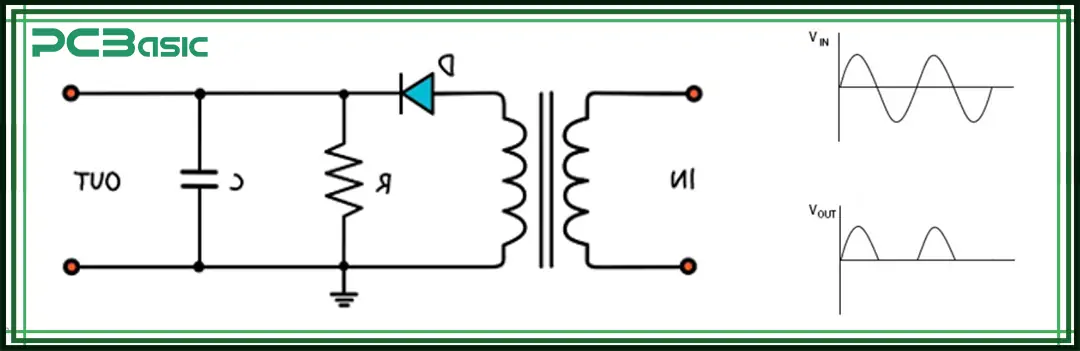
A typical half-wave rectifier diagram usually includes:
• A single diode in series with the load
• AC input source
• Output taken across the resistor
In the half-wave rectifier circuit diagram, the output waveform consists of positive pulses with zero output during the negative half-cycle.
Output Frequency of Half-Wave Rectifier
The output frequency of the half-wave rectifier is the same as the input AC frequency:
f (output) = f (input)
This is because during the rectification process, the diode only allows one half-cycle of the AC signal (typically the positive half-cycle) to pass, while the other half-cycle (the negative half-cycle) is completely blocked. Therefore, for each input cycle, only one pulse of output voltage is produced, and its repetition rate is naturally the same as the input frequency.
Advantages and Disadvantages of a Half-Wave Rectifier
Advantages
• Simple rectifier circuit design
• Low cost (only one diode required)
• Easy to implement
Disadvantages
• High ripple output
• Low efficiency (~40.6%)
• Poor transformer utilization
• Not suitable for stable power supplies
Full Wave Rectifier
A full-wave rectifier is a more efficient rectifier circuit. It can convert both the positive and negative half-cycles of an AC waveform into pulsating direct current (DC).
Structurally speaking, a typical full-wave rectifier usually consists of the following parts:
• Two diodes (center-tapped design) or four diodes (bridge rectifier)
• A load resistor
• A transformer (optional, used for voltage step-down or center-tap configuration)
Its working principle is that during the positive and negative half-cycles of the AC input, the current can pass through the load.
During the positive half-cycle, a group of diodes conduct, allowing current to pass through the load to generate the output voltage; during the negative half-cycle, another group of diodes conducts, redirecting the current path so that the current still flows through the load in the same direction.
In other words, the full-wave rectifier utilizes the entire sine wave, converting both positive and negative half-cycles into usable output, and its output voltage frequency is twice the input (2× frequency). Therefore, its output is a smoother pulsating DC with a higher average voltage and is easier to filter.
Full Wave Rectifier Circuit Diagram
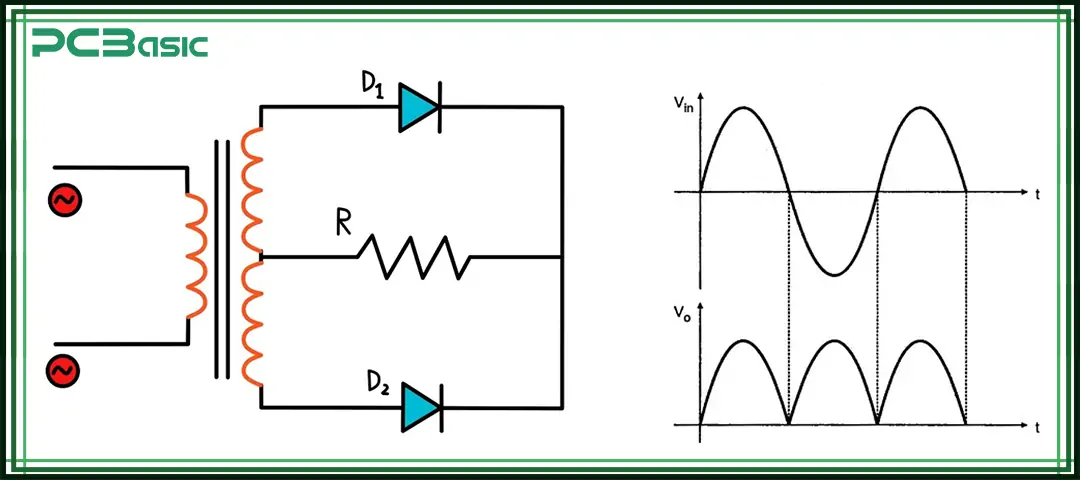
A typical full-wave rectifier diagram mainly includes:
• Two diodes (center-tapped design) or four diodes (bridge rectifier)
• A load resistor
• A transformer (optional, used for voltage step-down or center-tap configuration)
Compared with the half-wave rectifier diagram, the output waveform of the full-wave rectifier is more continuous, and the pulses are denser, so the ripple is significantly lower.
Types of Full Wave Rectifier
There are mainly two common types of full-wave rectifiers: The center-Tapped Full-Wave Rectifier and the Full-Wave Bridge Rectifier.
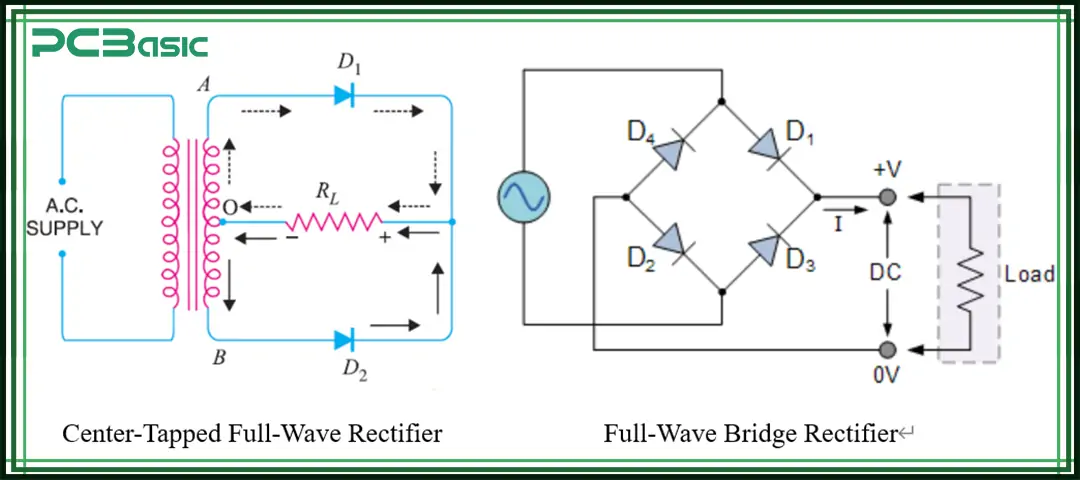
Center-Tapped Full-Wave Rectifier
• Uses two diodes
• Requires a center-tapped transformer
• More complex transformer design
Full-Wave Bridge Rectifier
The full-wave bridge rectifier is the most widely used configuration. Key features:
• Uses four diodes
• Does not require a center tap
• More efficient use of the transformer
Its working principle is also very simple:
In a bridge rectifier, during each half-cycle, two diodes conduct, allowing the current to flow through the load in the same direction.
It is precisely for this reason that the bridge rectifier is widely used in power supplies and PCBA power modules.
Output Frequency of Full Wave Rectifier
The output frequency of a full-wave rectifier is:
f (output) = 2f (input)
Since both the positive and negative half-cycles of AC are used, the ripple frequency doubles, making filtering easier and the output smoother.

About PCBasic
Time is money in your projects – and PCBasic gets it. PCBasic is a PCB assembly company that delivers fast, flawless results every time. Our comprehensive PCB assembly services include expert engineering support at every step, ensuring top quality in every board. As a leading PCB assembly manufacturer, we provide a one-stop solution that streamlines your supply chain. Partner with our advanced PCB prototype factory for quick turnarounds and superior results you can trust.
Advantages and Disadvantages of a Full-Wave Rectifier
Advantages
• Higher efficiency (~81.2%)
• Lower ripple
• Better transformer utilization
• More stable DC output
Disadvantages
• More components than a half-wave rectifier
• Higher cost
• Slightly more complex design
Half-Wave Rectifier vs. Full-Wave Rectifier
Here is a clear comparison of a half-wave rectifier and a full-wave rectifier:
|
Feature
|
Half-Wave Rectifier
|
Full Wave Rectifier
|
|
Diodes
|
1
|
2 or 4
|
|
Efficiency
|
Low (~40.6%)
|
High (~81.2%)
|
|
Output Frequency
|
f
|
2f
|
|
Ripple
|
High
|
Low
|
|
Output Voltage
|
Lower
|
Higher
|
The differences between a half-wave rectifier and a full-wave rectifier mainly lie in efficiency, waveform utilization and output stability.

Conclusion
Both the half-wave rectifier and the full-wave rectifier are the most basic circuits in power electronics. The half-wave rectifier has a simple structure and low cost, but the full-wave rectifier, especially the full-wave bridge rectifier, offers better efficiency and smoother DC output.
In practical applications such as power supplies, PCB power modules and industrial electronics, the choice between rectifier types generally depends on the following points:
• Power requirements
• Cost constraints
• Output stability needs
For most modern designs nowadays, the bridge rectifier is usually a more common choice because of its better performance and greater flexibility in use.
Understanding the difference between a half-wave rectifier and a full-wave rectifier can help engineers make circuits more stable and efficient.