
Global high-mix volume high-speed PCBA manufacturer
9:00 -18:00, Mon. - Fri. (GMT+8)
9:00 -12:00, Sat. (GMT+8)
(Except Chinese public holidays)





HomePage > Blog > Knowledge Base > PCB Mounting Explained: Techniques, Holes, and Best Practices
In the design of electronic products, PCB mounting determines how the circuit board is firmly fixed inside the device or the casing. If PCB mounting is done improperly, it may cause problems such as mechanical stress, loose connections, and even overheating.
Whether you are developing an embedded system or designing a commercial electronic product, it is necessary to understand the correct PCB mounting methods. You also need to master the commonly used PCB mounting hardware, the design skills of mounting holes, and how to use PCB mounting screws and PCB mounting clips to support the circuit board.
This guide will explain step by step how to mount a PCB and help you make a safe and reliable mechanical mounting solution.
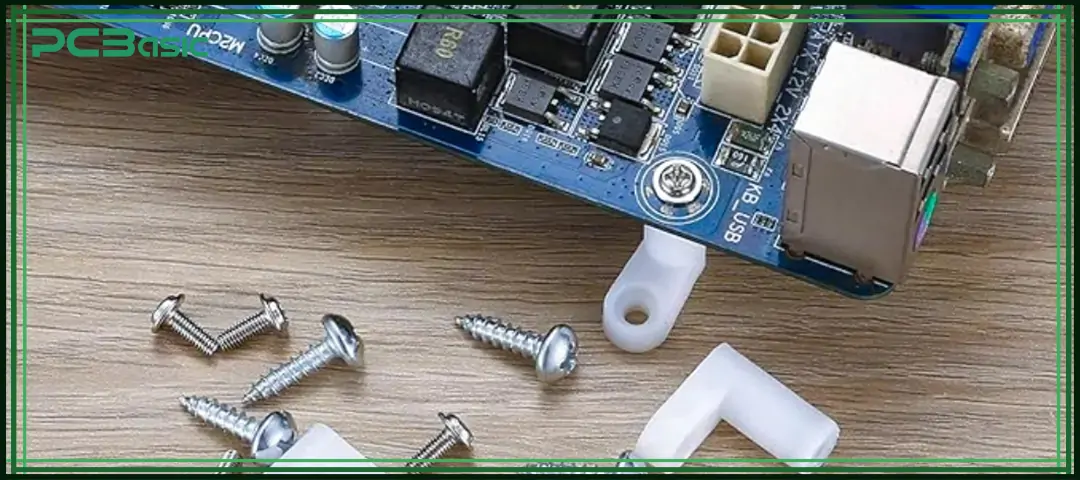
PCB mounting refers to the process of securing a printed circuit board (PCB) within the internal structure of a product. This usually involves attaching the PCB to the chassis, enclosure or other mechanical components. The purpose is to keep the circuit board stable during use without movement or damage.
Proper PCB mounting can bring multiple benefits. First, it can maintain the physical stability of the board and prevent cracking due to vibration or impact. Then, it also provides electrical insulation, avoiding short circuits between the metal enclosure and the circuit. Additionally, PCB mounting improves the durability and maintainability of the product.
PCB mounting can be divided into two aspects: component mounting and PCB mounting. Component mounting uses through-hole technology (THT) or surface mount technology (SMT) to fix electronic components onto the PCB. PCB mounting secures the entire board to the product's structure, such as an enclosure or support frame. This article focuses on the second aspect.
To achieve a reliable connection, PCB mounting holes, PCB mounting clips and PCB mounting screws are usually used. In many designs, insulating washers or grounding rings are also combined to enhance mechanical strength and electrical performance.
Depending on the equipment size, functional requirements and the structural design of the enclosure, different products will choose different PCB mounting methods. The following are several common and practical installation methods:
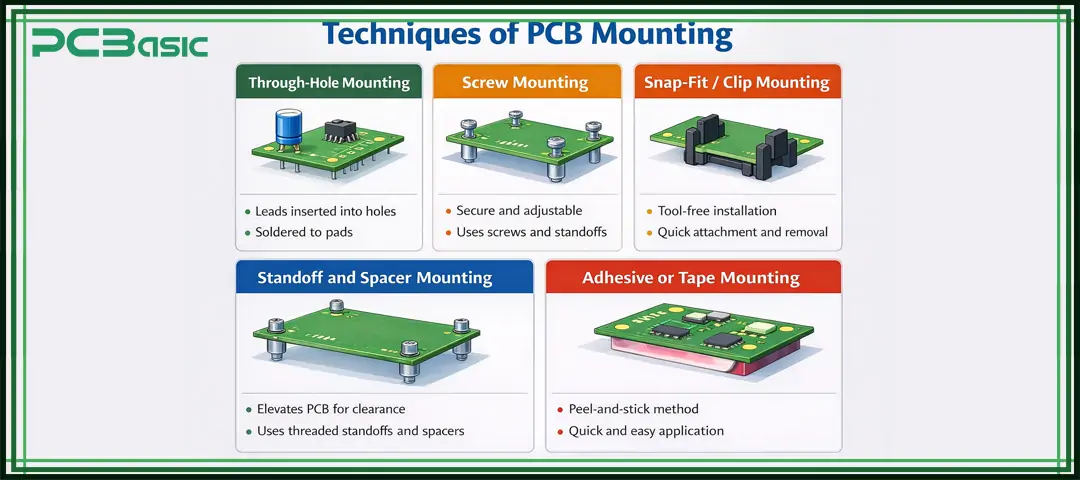
Through-hole mounting is not only used for soldering electronic components onto PCBs but also for securing PCBs onto mechanical structures. For example, copper-plated mounting holes are reserved on the circuit board. Screws can pass through these holes and then be fastened onto the metal frame or standoff with nuts.
The advantage of this method is that it has a solid structure and is suitable for resisting vibration and impact. Meanwhile, if a grounding copper ring is used to connect the PCB mounting holes to the ground layer, it can also enhance the electromagnetic compatibility (EMC) of the product.
Using PCB mounting screws is the most common and widely used PCB mounting method. When designing a PCB, multiple PCB mounting holes are arranged at key positions. Through these holes, screws go through these mounting holes and are tightened into standoffs, support brackets, or plastic mounting bosses inside the enclosure.
This mounting method is suitable for various scenarios and performs particularly well in situations where anti-vibration is required. Commonly used screw materials include metals (such as stainless steel) or nylon, and they are usually used in combination with washers to prevent the PCB from being crushed during tightening.
In the plastic casing, there are often PCB mounting clips or slot structures designed for the quick installation of circuit boards. These fixtures allow PCBs to be directly inserted into the reserved positions without tools, making installation quick and easy. They are suitable for high-volume assembly and consumer electronics.
However, the mechanical strength of PCB mounting clips is relatively low, and it is not recommended for use in application environments with significant vibration or high-temperature changes.
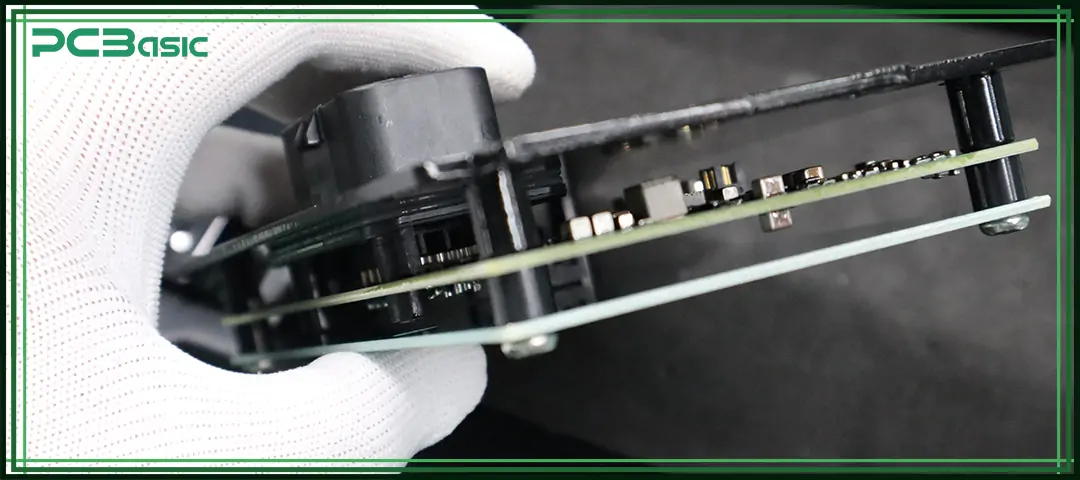
Using standoffs or spacers can maintain a certain gap between the PCB and the base. This not only helps with airflow and lowers the temperature but also enables electrical isolation, preventing the conductive parts at the bottom of the PCB from short-circuiting with other structures.
Standoffs can be fixed with screws. Common materials include nylon, brass, and stainless steel. The material with appropriate strength and insulation properties should be selected according to the actual application.
For designs that are cost-sensitive or have very limited space, the PCB can directly adhere to the interior of the casing using double-sided foam tape or epoxy adhesive. This method does not require screws or fixtures, which can save space and materials.
However, this method has obvious drawbacks: insufficient support strength, making it unsuitable for high-temperature or high-vibration environments, and it is also not conducive to heat dissipation and later maintenance. Therefore, it is recommended to use it only in non-critical applications.
|
Mounting Method |
Key Features |
Pros |
Cons |
|
Through-hole Mounting |
Screws + plated mounting holes |
Strong, supports grounding |
Takes space, more steps |
|
Screw Mounting |
PCB mounting screws into standoffs |
Secure, widely used |
Risk of over-tightening |
|
Snap-Fit / Clip Mounting |
Snap-fit PCB mounting clips |
Fast, tool-free |
Low strength |
|
Standoff/Spacer Mounting |
Spacers + PCB mounting screws |
Good airflow, insulation |
Needs more parts and space |
|
Adhesive/Tape Mounting |
Tape or glue to fix the PCB |
Cheap, space-saving |
Weak, poor heat resistance |
Different PCB mounting methods have their own advantages and disadvantages. The most suitable fixation method should be selected by comprehensively considering the product's usage environment, structural space, heat dissipation requirements and assembly process. The correct installation method, combined with reasonable mounting hole design and suitable PCB mounting hardware, is the key to ensuring the safe and stable operation of the circuit board.
PCB mounting holes are specially designed holes for mechanical fixation and are pre-defined on the circuit board. They do not carry electrical signals, but are very crucial in structural installation. Correctly setting the PCB mounting holes can enhance the stability of the circuit board, prevent it from cracking due to mechanical stress, and also reduce the risk of signal interference.
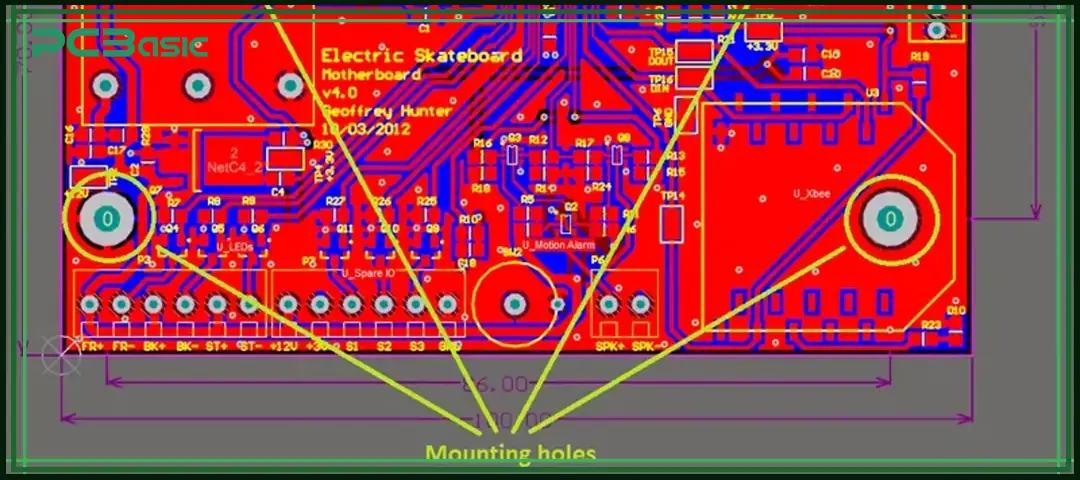
PCB mounting holes are mainly divided into two types: plated through holes (PTH) and non-plated through holes (NPTH). The hole walls of the through-plated holes are copper-plated and can be connected to the ground layer of the circuit board. In addition to being used for screw fixation, it can also serve as electromagnetic shielding and grounding protection and is suitable for designs with EMC requirements.
The non-plated through-hole walls are not copper-plated and are entirely used for structural support without electrical connection functions. It is suitable for general mechanical fixation and does not affect the circuit performance.
Generally speaking, small and medium-sized circuit boards usually have 4 to 6 PCB mounting holes. The specific number and location depend on the size and shape of the circuit board as well as the mechanical support points required for installation.
Reasonable design and layout of PCB mounting holes can not only enhance the structural strength of the product but also contribute to assembly efficiency and later maintenance.
In the design and assembly of circuit boards, choosing the appropriate PCB mounting hardware is crucial for achieving a reliable PCB
mounting method. Different mounting methods require the use of different types of accessories to ensure that the circuit board remains stable under temperature changes, vibrations or long-term use. The following are common PCB mounting hardware and their functions:
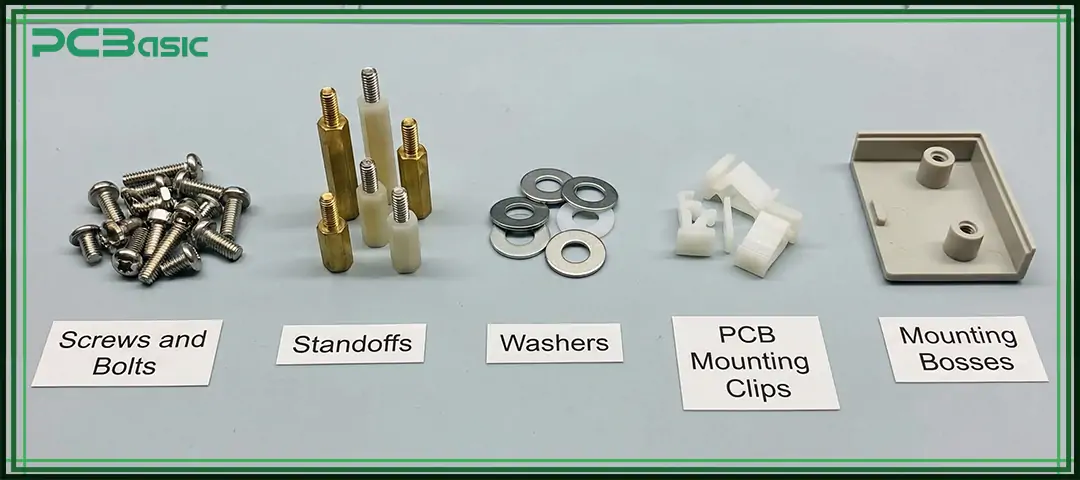
PCB mounting screws are the most common fasteners and are suitable for most PCB mounting methods. Common materials include steel, stainless steel, brass and nylon. Metal screws are suitable for withstanding greater mechanical stress, while nylon screws are applicable in situations where electrical insulation is required. The thread types include machine threads and self-tapping threads. They are usually used in conjunction with nuts or thread standoffs. After the screws pass through the PCB mounting holes, they can be firmly fixed to the enclosure or support structure to ensure that the circuit board does not loosen.
The standoff is used to provide vertical spacing between the circuit board and the base, preventing the bottom of the PCB from contacting other structures and causing short circuits. It also helps with heat dissipation. Standoffs come in various structural forms, such as hex or cylindrical. Common types include internal threads, external threads, or different threads at both ends. The material can be selected from nylon, brass or stainless steel. The appropriate type should be chosen based on structural strength and insulation requirements. Standoffs are generally used in conjunction with screws and are key fasteners in multilayer PCBs or space-compact designs.
Washers are used to protect the pads and copper foil around the PCB mounting holes from damage caused by tightening screws. When installing, place the washer between the screw head and the PCB to evenly distribute the pressure and enhance the reliability of the fixed area. Common materials include nylon and stainless steel. When choosing, it should be considered whether an insulation function is required.
The PCB mounting clip is a tool-free mounting fastener commonly found in plastic enclosures. The circuit board can be quickly installed by inserting fixtures, making it suitable for prototype development and lightweight electronic products. This method saves space and has high assembly efficiency, but its mechanical strength is relatively low. It is not recommended for use in high-load or highly vibrating environments. PCB mounting clips are suitable for small equipment or design environments with limited space.
The mounting boss is usually an integrated structure in the injection-molded housing, corresponding to the PCB mounting holes on the circuit board. The circuit board can be directly fixed to the boss using PCB mounting screws or fixtures. This design is widely used in consumer electronic products, suitable for mass production, with a simple structure and convenient assembly.
The correct selection and matching of PCB mounting hardware can not only enhance the structural strength but also improve the heat dissipation efficiency and maintenance convenience. When designing, full consideration should be given to environmental conditions, electrical requirements and assembly processes to ensure the stability and reliability of the entire PCB system.
Mounting the PCB properly actually means ensuring that the circuit board is firmly fixed so it does not loosen and can be used for a long time. Just follow the steps below:
Check whether the PCB mounting holes are aligned with the standoffs or mounting points inside the enclosure, and if there is any interference or blockage.
According to the size of the board and application environment, select the appropriate PCB mounting screws, standoffs or PCB mounting clips. If insulation is needed, washers can be added.
First, fix the standoffs or spacers onto the enclosure. This way, there will be a space between the PCB and the base, which is more conducive to heat dissipation and short circuit prevention.
Place the PCB carefully and align all the mounting holes, and do it gently to avoid bending the board.
Fix it with PCB mounting screws. Just tighten them evenly, but do not over-tighten them to avoid damaging the board.
Gently shake the PCB to check if it is secure. At the same time, make sure that no other components are touched to avoid short circuits.
Make sure all the screws are properly installed, the PCB is stable, and the heat dissipation space is not blocked.
By following this process, PCB mounting can be stable and reliable, and it is also convenient for later maintenance. It is applicable to both prototyping and mass production.
To achieve reliable and professional PCB mounting, engineers should follow these important design tips. Good planning and the right choices will help the PCB stay strong, safe, and easy to assemble.
Always include PCB mounting holes at the beginning of your schematic and layout design. If you add them later, it may cause problems or require layout changes. Early planning helps avoid rework.
Place at least four mounting holes at the corners of the board. For larger PCBs, add more holes along the edges or center. This keeps the board from bending or breaking under stress.
Leave extra space around each PCB mounting hole. Avoid placing signal traces or copper pads too close together. This reduces the chance of damage from pressure or vibration when the board is screwed down.
If needed, use plated mounting holes and connect them to the ground layer. This improves EMC (electromagnetic compatibility) and helps reduce noise in high-frequency designs.
Select proper PCB mounting screws, standoffs, or PCB mounting clips based on your board's size, weight, and environment. For example, use metal hardware for heavy boards or nylon parts in high-humidity areas to prevent corrosion or short circuits.
Follow industry-standard hole sizes for PCB mounting holes, like 3.2mm for M3 screws. This makes it easier to find matching PCB hardware and avoids custom parts.
Refer to IPC standards such as IPC-2221 and IPC-7351 when designing mounting features. These standards give trusted rules for mechanical design and mounting hole layout, helping ensure quality and manufacturability.
By following these simple and clear PCB mounting practices, your board will be more durable, easier to assemble, and ready for real-world use.
At PCBasic, the key point of PCB mounting is not just lowering prices, but controlling the cost of each step well under the premise of ensuring quality.
We use mature SMT production lines for PCB mounting, reducing manual operations, improving efficiency, and also avoiding human errors. The products are more stable, and the overall cost is also lower.
With long-term partnerships with component suppliers, PCBasic can obtain better prices. Combined with bulk purchasing, costs can be reduced while ensuring quality and traceability.
During the PCB mounting stage, we will carry out DFM optimization in advance, such as reducing unnecessary components, simplifying the structure, and choosing a more suitable mounting method to cut costs from the source.
From materials to production, PCBasic uses the MES system to manage the entire PCB mounting process, reducing communication costs and delivery risks, and also avoiding issues such as mid-process price hikes.
A well-designed PCB mounting system helps your electronic product stay stable and reliable during its entire life. Just like electrical design, every part of PCB mounting is important. This includes choosing the right PCB mounting method, placing mounting holes correctly, and using the right PCB mounting hardware.
Whether you use through-hole mounting, PCB mounting screws, or snap-fit clips, make sure your mounting method matches the real use of the product. For example, a product in a high-vibration area needs stronger mounting.
With a smart PCB mounting design, you can build a solid, safe, and easy-to-repair device. Good mounting also helps meet product function and safety rules.
1. What is the purpose of mounting holes in PCBs?
Mounting holes are used to secure the PCB mechanically to an enclosure, frame, or panel. They allow the use of PCB mounting screws, standoffs, or clips to prevent movement and ensure reliable operation.
2. Can I use double-sided tape for PCB mounting?
While double-sided tape can be used in some low-cost applications, it's not a preferred PCB mounting method for critical systems. It lacks structural integrity, heat resistance, and long-term reliability.
3. Are plated holes necessary for grounding?
Plated mounting holes can be connected to the ground plane to serve as EMC grounding points, which is useful in shielded or high-speed designs. However, non-plated holes are better for insulating mechanical connections.
4. What are the common mistakes in PCB mounting design?
• Forgetting to include enough mounting holes
• Placing mounting holes too close to traces or pads
• Using incorrect PCB mounting hardware
• Misaligning PCB mounting holes with enclosure bosses
• Neglecting thermal and vibration considerations

Assembly Enquiry
Instant Quote



Phone contact

+86-755-27218592
In addition, we've prepared a Help Center. We recommend checking it before reaching out, as your question and its answer may already be clearly explained there.
Wechat Support

In addition, we've prepared a Help Center. We recommend checking it before reaching out, as your question and its answer may already be clearly explained there.
WhatsApp Support

In addition, we've prepared a Help Center. We recommend checking it before reaching out, as your question and its answer may already be clearly explained there.
