
Global high-mix volume high-speed PCBA manufacturer
9:00 -18:00, Mon. - Fri. (GMT+8)
9:00 -12:00, Sat. (GMT+8)
(Except Chinese public holidays)





HomePage > Blog > Knowledge Base > How PCBA Manufacturing Meets Industry 4.0 Demands
Table of Contents
1. What does Industry 4.0 demand from PCBA production?
2. How is traceability held from incoming material to the finished board?
3. How do changeovers stay controlled when the product mix changes daily?
4. What happens to inspection data after a board passes?
5. Where do manual steps belong in a connected factory?
6. What should you check before you place a PCBA production order?
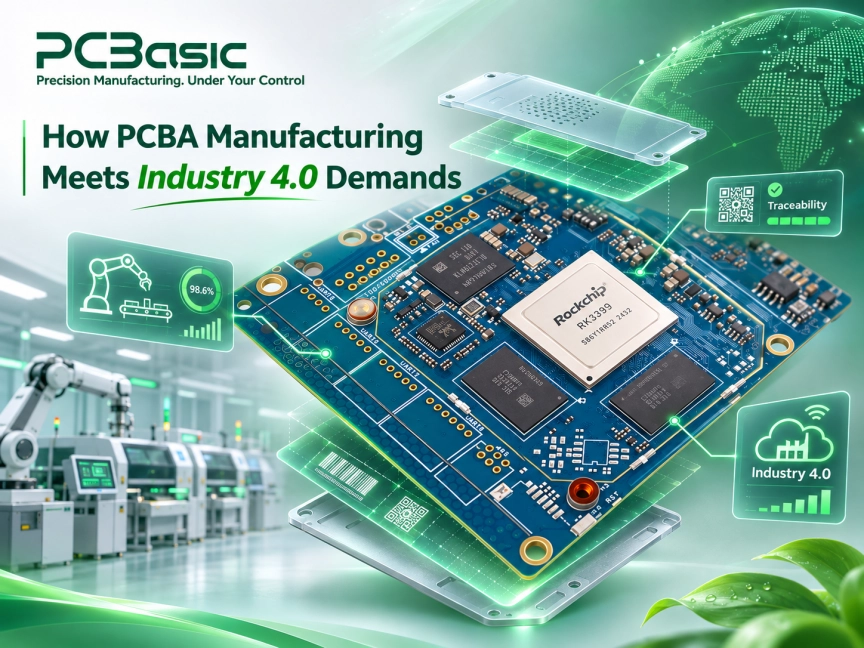
Industry 4.0 reaches a PCBA factory as a set of order conditions. A customer in automotive, medical, or industrial equipment may order more than assembled boards alone. The order may also specify what records must accompany the boards: component lot information at the agreed traceability level, inspection and test results for the batch delivered as data, and a production record that can be audited when a field failure has to be traced. PCBA production can meet those conditions when the line runs on connected systems that record each step as it happens, instead of on paper travellers filled in afterwards.
At PCBasic, these systems are developed in-house. The company developed its CRM system in 2016 and introduced its self-developed MES in 2018, and the MES links material and production records from incoming inspection to final testing. The sections below take the demands one at a time: what each one requires on the line, what record it produces, and what a buyer can ask to see before placing a production order.
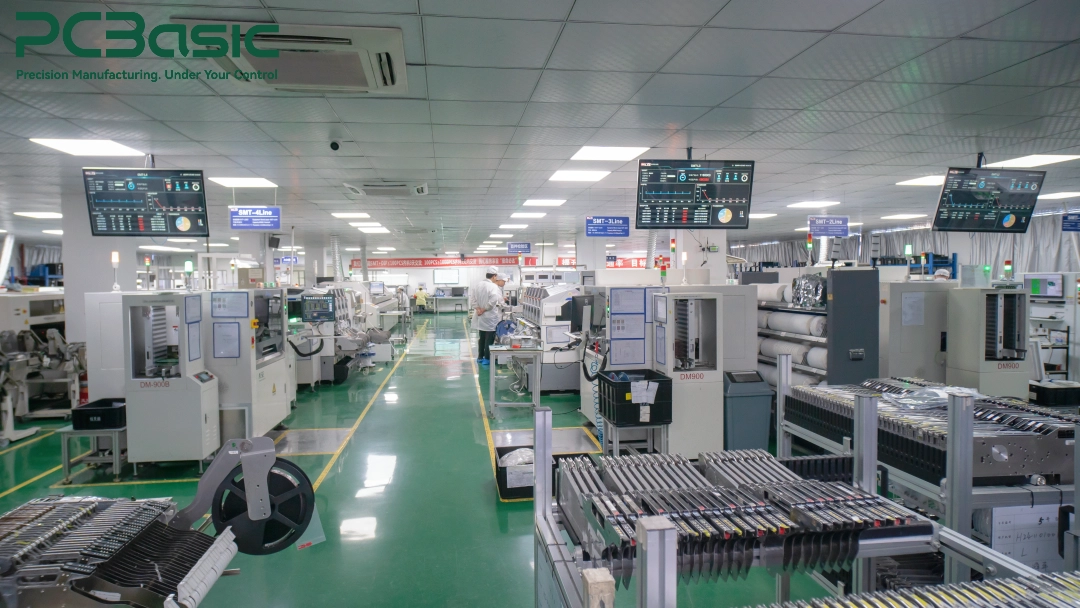
Four demands recur in production orders, and each one is testable. The first is traceability: given a board or a batch, the manufacturer must be able to retrieve the component lot, line, and process records required by the order. The second is data as a deliverable. Inspection results, reflow profiles, and functional test results can be included in the order deliverables when specified. The third is changeover control. High-mix PCBA manufacturing can involve several product changeovers a day, and the demand is that quality checks are repeated after each changeover. The fourth is controlled change: when a revision or a component substitution enters production, the change is recorded against the orders it affects.
None of these demands is met by a single machine. Each one can be verified through the record the process leaves behind, which is why the sections below are organised by demand rather than by equipment. A buyer evaluating a PCBA manufacturer can use the same order: ask what record each demand produces, and ask to see one from a completed order.
Traceability starts before the line. Incoming components at PCBasic pass an automated IQC system that checks quantity and model against the BOM and measures LCR parameters on sampled parts, and each accepted material receives a QR code in the intelligent warehouse. The code is the identity the material carries through production.
When a reel is loaded onto a feeder on the PCBA production line, the operator scans the code, and a mismatch can trigger an alert before placement starts. This gives operators a chance to catch the mismatch during loading, before placement begins.
The MES holds the other half of the record. Material lots, the line and program used, inspection results, and test results can be linked to the applicable board, panel, or batch identifier, so a shipped batch can be traced in both directions at the agreed level of detail: from a component lot to the boards that received it, and from a returned board back to its lots and process conditions. Production data is displayed on factory dashboards in real time, and customers can follow order progress through the available customer-facing tools.
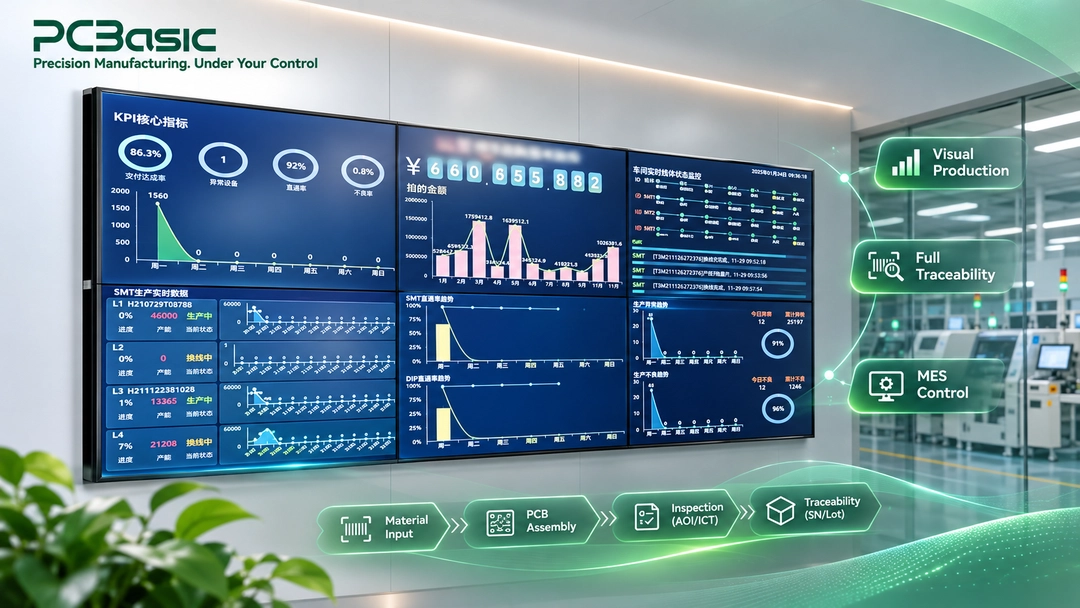
The check for a buyer is direct. Ask for the traceability record of one shipped batch, and see how far it goes: board, lot, line, inspection result. A record that stops at the shipping date does not establish material or process traceability.
A changeover is a point of risk in high-mix production loses quality, because the new product may require a different program, a new stencil and a new set of feeders, and any of those can be wrong. The control is to set up the line using approved production data and then verify the first board against it. At PCBasic, the first-piece tester uses the approved BOM and placement coordinates to check the first article against the intended build. A disagreement between the approved data and the assembled board can be detected on the first piece, within the scope of the checks performed.
The supporting steps are also run in-house. Stencils are cut in PCBasic's own stencil factory, with delivery in as fast as one hour, and test fixtures are made in-house, so a changeover does not wait on an outside supplier. The eight SMT lines are split by work type: the Shenzhen factory runs small-batch quick-turn work, and the Huizhou factory runs larger volumes, which keeps short runs from being scheduled behind long ones. On the SMT assembly lines, the job data, feeder assignments, and process parameters travel with the order in the MES, so the second and third runs of the same product start from the recorded setup of the first.

In a connected factory, inspection produces data as well as a pass decision. Solder paste inspection measures paste volume, height, and area on every board before placement, and the results are retained according to the inspection plan. AOI after reflow checks component placement and visible solder joints, and X-ray can inspect hidden joints under BGA and similar packages when specified. The reflow profile can be verified with a KIC thermal profiler and retained with the applicable process record. When a board later fails in the field, those records s help investigators assess whether design or process conditions contributed to the failure.
The records also run in the other direction. Trends in solder paste measurements and inspection results can reveal drift while the run is still on the line, and PCBasic's self-developed SMT fault detection system can flag equipment alerts during production. A process corrected during the run does not leave a full batch carrying the same defect.
The same data is what the customer receives. Test report files are kept with the order record, and a customer who has selected testing can view the reports for their order after the tests are completed. For PCBA assembly orders in regulated industries, that report set is part of the delivery: it is the evidence the customer's own quality system files against the batch.
Industry 4.0 is often described as automation replacing people, and on a PCBA production line that description is wrong in a specific way. Through-hole soldering, conformal coating, final assembly, and exception handling may involve manual or semi-automated work, depending on the process and equipment used. The demand is not that these steps disappear. The demand is that the required details are recorded with the same discipline as the machine steps: the operator, the work instruction revision, the material lot, and the inspection findings.
Check how manual steps are documented when you evaluate a factory, and test it with one request. Ask the supplier for the record of a manual step on a completed order: the wave soldering parameters, the coating batch, the operator sign-off inside the MES. If that record sits in the same system as the SMT data, the manual step is inside the production system. If it sits in a notebook, it is not. PCBasic runs its through-hole, coating, and box-build work inside the same order record as its SMT work, so a mixed-technology board carries one history, not two.
Check records, not claims. For each demand, one document from a completed order shows what the supplier actually recorded for that build. The table below pairs the demands with the records to request from a PCBA manufacturer before the order is placed, whether the order covers PCBA assembly only or full turnkey production.
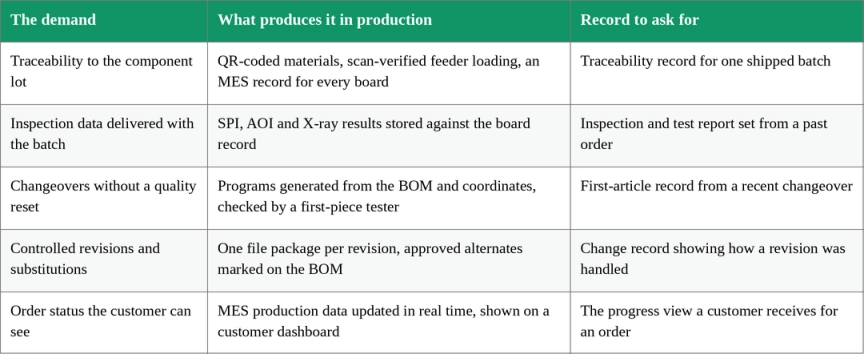
Two background checks complete the picture. Ask how long the production system has been running: a self-developed MES that has carried orders since 2016 has been corrected against years of real production problems, which a recently installed package has not. Then check the certification frame the records sit inside. PCBasic works to ISO9001, IATF 16949, and ISO13485, and the audit trail those systems require is the same trail the traceability record comes from. With turnkey PCBA services, the same record covers sourcing as well as assembly, so the component lots in the traceability file are the lots the factory itself purchased.

Industry 4.0 changes what a production order delivers. The boards are the physical part. The rest of the delivery is the record: which lots were placed, which inspections ran, which profile the batch saw, and which revision governed the build. PCBA production that runs on connected systems produces that record as a by-product of building the boards. Production that runs on paper produces it afterwards, if at all, and the difference shows the first time a customer has to trace a failure.
To place an order on that basis, send PCBasic the Gerber files and the BOM for the board, the quantity, and the traceability and test-data requirements your own quality system will file. The quotation is generated from the same BOM the line will run, and the record your order carries is defined before production starts, not assembled after the boards ship.
Q1: What traceability should a buyer expect from PCBA production?
A1: A buyer should expect the agreed board, panel, or batch identifier to be linked to the applicable component lots, line and program records, and inspection and test results. At PCBasic, the applicable records can be retrieved through the agreed traceability process and within the agreed retention period.
Q2: Does a connected factory cost more for small-batch production?
A2: The major cost driver in small batches is setup and changeover, and the agreed testing and reporting scope can also affect the quote. Programs generated from the BOM, first-piece testing, and in-house stencils shorten changeovers, and PCBasic runs dedicated small-batch lines in Shenzhen with no minimum order quantity. What the systems add is the record, which a small batch needs as much as a large one when the product is regulated.
Q3: Which PCBA manufacturing steps stay manual at PCBasic?
A3: Through-hole soldering, conformal coating, final assembly, and exception handling may involve manual or semi-automated work, depending on the build. The required operator, instruction revision, and material lot records can be linked to the same production order.
Assembly Enquiry
Instant Quote
Phone contact

+86-755-27218592
In addition, we've prepared a Help Center. We recommend checking it before reaching out, as your question and its answer may already be clearly explained there.
Wechat Support

In addition, we've prepared a Help Center. We recommend checking it before reaching out, as your question and its answer may already be clearly explained there.
WhatsApp Support

In addition, we've prepared a Help Center. We recommend checking it before reaching out, as your question and its answer may already be clearly explained there.
