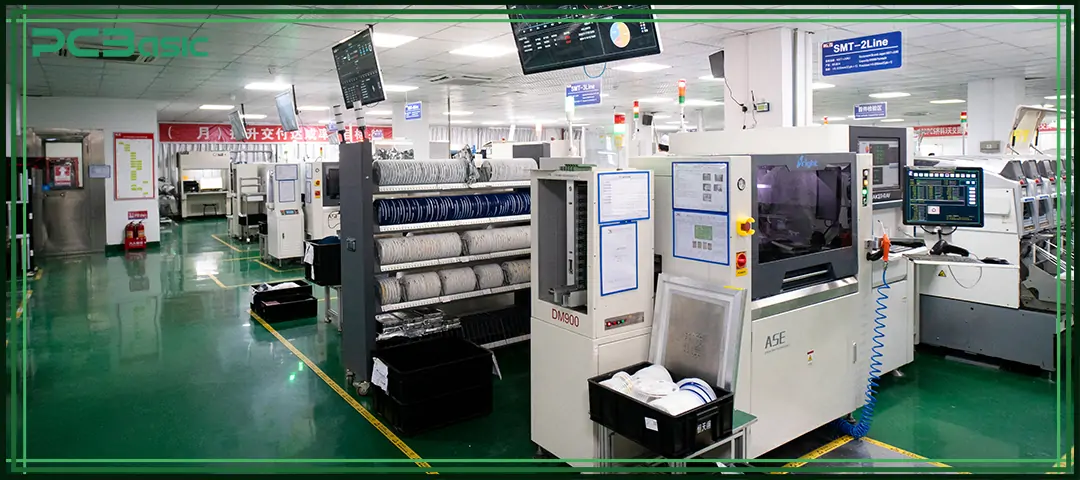
In modern electronics manufacturing, whether the products are stable, whether they are consistent between batches, and whether the delivery is controllable largely depend on the actual manufacturing capacity of the SMT production line. In PCBasic, we do not simply understand the SMT production line as the stacking of equipment such as pick-and-place machines and reflow ovens, but plan and operate it as a complete manufacturing system.
Whether it is low-volume prototype validation or high-mix, large-batch SMT PCBA projects, our SMT assembly line operates in accordance with the same quality logic to avoid introducing new risks due to batch changes.
This article will take the SMT production line as the core and start from the basic concepts of the SMT production line, gradually introduce the configuration of key equipment and the SMT assembly process, and further explain the implementation method of high-density SMT PCB assembly in the actual production line. Combined with the actual manufacturing cases of PCBasic, this article will illustrate how we can achieve this through engineered surface mount technology, digital production management, and strict quality control, transforming the SMT production line into a direct guarantee for product reliability and delivery capacity.
What Is an SMT Production Line?
The SMT production line is essentially an automated PCB assembly line. It uses surface mount technology to directly mount and solder electronic components onto the surface of the PCB instead of through through-hole assembly.
Many people will ask: What does SMT mean?
SMT is short for surface-mount technology. This manufacturing method places surface mount components(also known as SMD components or surface mount devices) directly onto the PCB pads for soldering without the need for through-holes.
Compared with traditional assembly methods, SMT technology can achieve higher assembly density, smaller circuit board size and higher production efficiency, and is also more suitable for automated production. Therefore, it has become the most fundamental and mainstream assembly method in modern SMT electronics manufacturing and SMD electronics. manufacturing

Core Equipment That Defines an SMT Line
A truly stable SMT production line is not determined by the performance of a single piece of equipment, but depends on whether all kinds of equipment on the entire production line can operate smoothly and collaboratively as a whole. At PCBasic, when planning and operating each SMT assembly line, we configure key equipment around the complete process flow instead of single-point stacking.
|
Equipment
|
Primary Function
|
|
Solder Paste Printers
|
Precisely controls solder paste printing and deposition on PCB pads, providing a stable foundation for subsequent SMT soldering
|
|
SPI Systems
|
Inspects and controls solder paste volume, shape, and condition before component placement, enabling early detection of printing defects
|
|
SMT Machines / Pick-and-Place
|
Places SMD components at high speed and accuracy according to design data
|
|
Multi-Zone Reflow Ovens
|
Completes controlled SMT soldering and surface mount soldering through precisely managed thermal profiles
|
|
Inline AOI and X-ray Systems
|
Performs inline inspection for placement and soldering defects to ensure assembly quality and reliability
|
In actual production, each surface mount technology machine undertakes clear process responsibilities, jointly ensuring mounting accuracy, solder joint reliability and the long-term stability of the overall process.
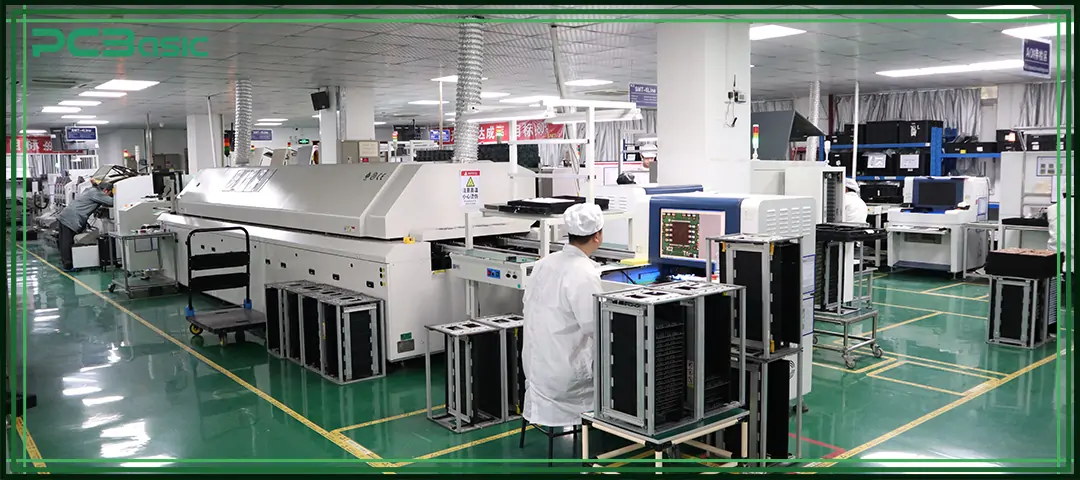
Step-by-Step SMT Manufacturing Process at PCBasic
The SMT process of PCBasic adopts a strictly validated surface mount technology process. The core goal is to make each production repeatable, controllable, and maintain a stable yield rate.
1. PCB Loading & Preparation
The bare board enters the SMT assembly line through the automatic board loading equipment, achieving continuous and stable board handling in the entire PCB assembly line, avoiding the takt time fluctuations caused by manual operation.
2. Solder Paste Printing & SPI
The solder paste is accurately printed onto the PCB pads, and then the height, shape and position of the solder paste are inspected by SPI.
3. Component Placement
High-speed SMT machines carry out mounting according to the design data and precisely place various surface-mount components.
4. Reflow Soldering
The completed PCB enters the reflow oven and forms stable electrical and mechanical connections through the controlled SMT soldering process, thus completing the critical surface mount assembly.
5. AOI & X-ray Inspection
Online AOI and X-ray inspection are used to identify placement misalignment, soldering defects, and hidden joint issues, ensuring that each SMT PCB assembly meets quality requirements before leaving the production line.
Through this clear and step-by-step SMT production line workflow, PCBasic can support both rapid prototyping and stable mass production without changing the process logic, avoiding the introduction of new manufacturing risks due to changes in output.
About PCBasic
Time is money in your projects – and PCBasic gets it. PCBasic is a PCB assembly company that delivers fast, flawless results every time. Our comprehensive PCB assembly services include expert engineering support at every step, ensuring top quality in every board. As a leading PCB assembly manufacturer, we provide a one-stop solution that streamlines your supply chain. Partner with our advanced PCB prototype factory for quick turnarounds and superior results you can trust.
Advanced SMT Capabilities for High-Density PCBA
With the continuous development of electronic products towards miniaturization and high integration, higher requirements have been put forward for the capabilities of SMT production lines. The SMT production lines of PCBasic have been specially optimized for a variety of complex technology packages and can stably support the following types of devices and packages:
• BGA / uBGA
• QFN / QFP
• SOIC / PLCC
• PoP(Package-on-Package)
• Ultra-fine pitch surface mount devices
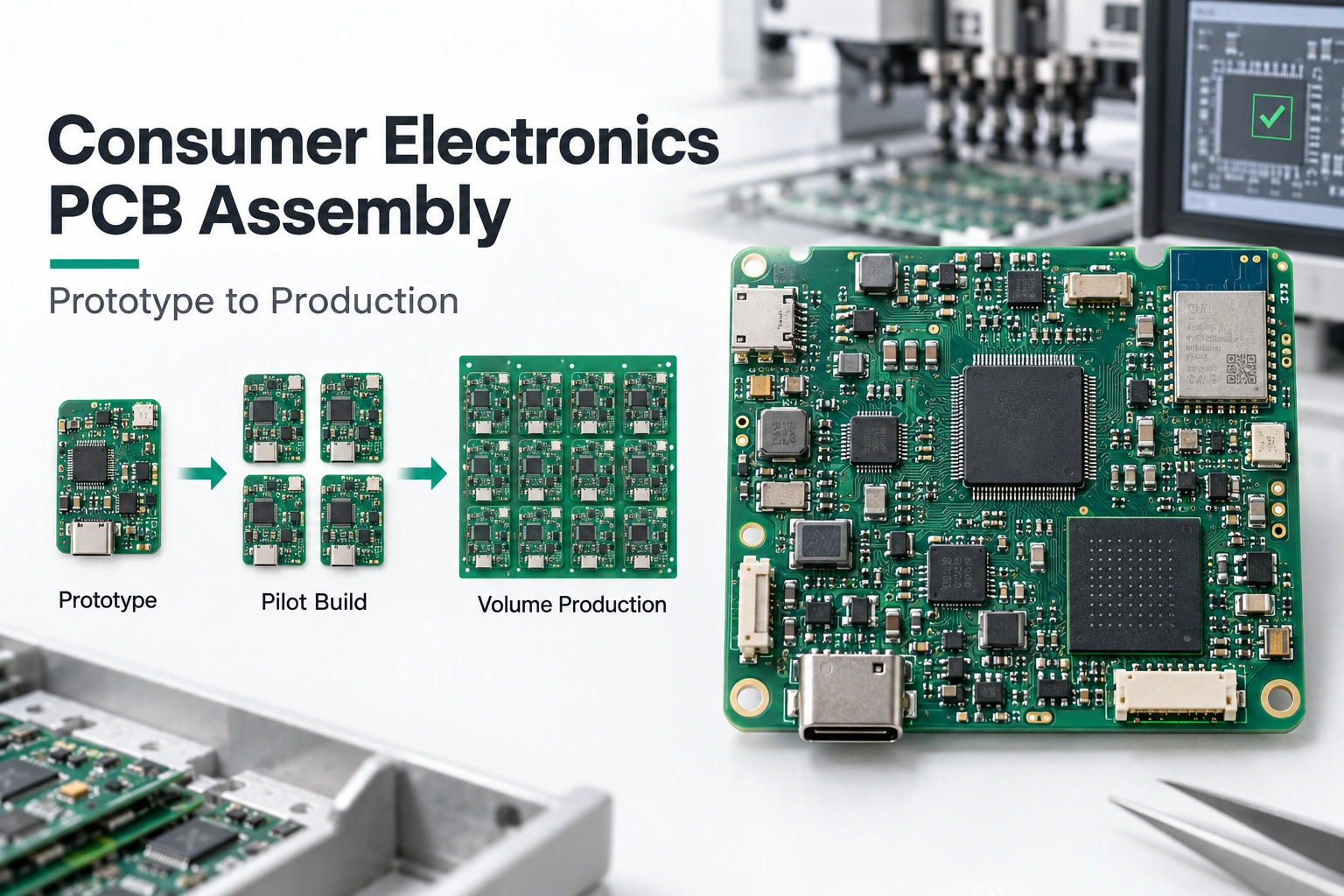
In actual production, our SMT assembly capability supports both single-sided and double-sided surface mount PCB assembly at the same time. Even in projects with high-density layout or high reliability requirements, SMT PCBA can be stably completed.
It is precisely this adaptability to processes and packaging that enables PCBasic to undertake SMT electronics manufacturing projects from multiple fields such as industry, medical care, automotive, and consumer electronics.
Quality Control Inside the SMT Production Line
Quality is not inspected only after the SMT production line workflow is completed, but is controlled step by step during the production process. PCBasic places quality control directly in each key process of SMT PCB assembly instead of remedial measures afterwards.
In actual operation, the SMT line incorporates multiple layers of quality control measures, such as:
• SPI to control solder paste consistency
• Inline AOI for placement and solder verification
• X-ray inspection for hidden joints
• Electrical and functional testing after SMT board assembly
By embedding quality control into the entire SMT production line, we can reduce rework, improve the overall yield rate, and ensure the reliability of surface mount PCB assembly in long-term use.
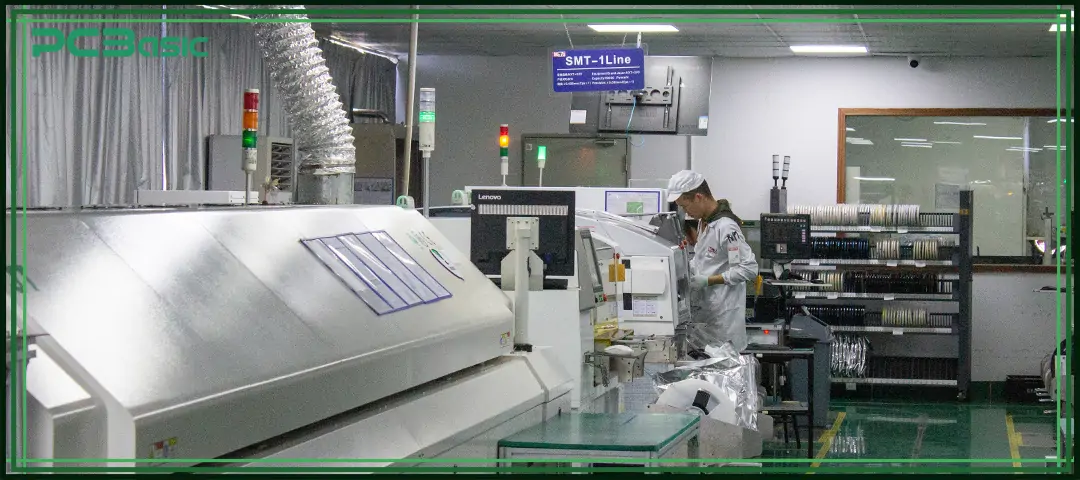
Digitalized SMT Lines – MES & Traceability at PCBasic
In actual production, if an SMT production line does not have digital control and management, it is difficult to maintain stable quality and consistent output for a long time. Based on this, PCBasic has independently developed and deployed its own MES system in the SMT assembly lines to uniformly manage and record the entire SMT manufacturing process.
Through the MES system, the production line can achieve complete traceability of the entire SMT manufacturing process, including:
• Component and lot tracking
• Process parameter recording
• Inspection and test data linkage
These data do not exist in isolation but run through the actual operation process of the entire SMT assembly line.
This digital SMT technology makes the production process of each order clear and traceable, and the results verifiable, which helps to maintain stable quality continuously. For SMT electronics projects with high requirements for compliance and reliability, this traceability capability is particularly important.
PCBasic’s SMT Production Line Advantage
The core advantage of PCBasic is not merely having 8 SMT production lines, but that we truly understand how to operate and manage the entire production lines in an engineering manner. We regard the SMT production lines as a manufacturing system that operates continuously and is constantly optimized, rather than relying solely on the equipment itself.
In actual production, our advantages are mainly reflected in the following aspects:
• Multiple flexible SMT assembly lines
• Seamless transition from prototype to volume SMT PCBA
• Deep experience with complex surface mount assembly
• Strong process control across the entire PCB assembly line
In PCBasic, the SMT production line is not a bottleneck that limits production capacity or delivery time. Instead, it is a key manufacturing capability that supports product consistency, reliability and large-scale delivery, and it is also an important foundation for us to create value for our customers.

Conclusion
Not all SMT production lines have the same manufacturing capacity. Although the equipment itself is important, what truly determines the performance of a production line is process control, engineering experience, and systematic integration capabilities.
By combining advanced surface-mount technology, stable SMT assembly lines, digital control and strict quality management, PCBasic is capable of continuously delivering reliable, scalable and high-quality SMT PCB assembly solutions.
If your product has high requirements for consistency, assembly density and reliability, choosing the right SMT production line partner will have a decisive impact on the success or failure of the project.